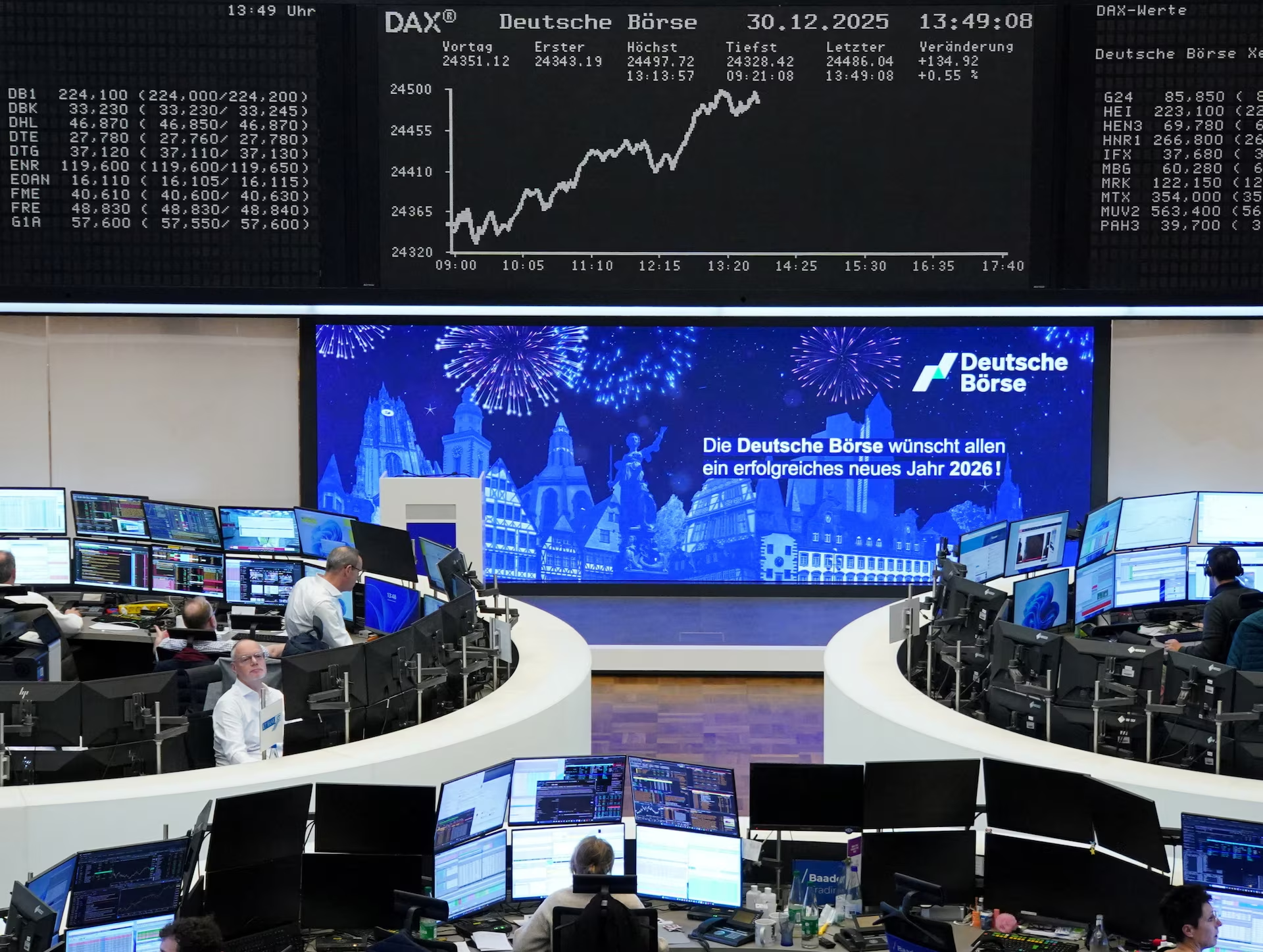
European stocks edged lower on Monday, November 2, as investors assessed growing concerns about France’s public finances following Fitch Ratings’ decision to revise the country’s sovereign credit outlook to negative.
The decline came despite falling oil prices, which provided some relief from inflationary pressures and supported energy-sensitive sectors.
Meanwhile, investors remained focused on upcoming European economic data, corporate earnings, and the European Central Bank’s (ECB) next monetary policy decisions.
The pan-European STOXX 600 Index declined 0.3% in early trading, following its strongest monthly performance since June.
European Stocks Slip as Major Indexes Show Mixed Performance
European equity markets opened the week with mixed performances as investors weighed sovereign debt concerns against improving conditions in energy markets.
Germany’s DAX Index remained largely unchanged, while London’s FTSE 100 declined 0.3%.
Spain’s IBEX 35 outperformed several regional benchmarks, gaining 0.6%. In contrast, Italy’s FTSE MIB dropped 0.9%.
The modest decline in the broader European market followed a relatively strong October, although investors remained cautious about the region’s economic outlook.
Concerns about government borrowing costs, political instability, and future interest rate decisions continued to influence market sentiment.
Falling Oil Prices Ease European Inflation Concerns
Lower crude oil prices provided some support for European equities, particularly businesses sensitive to energy costs.
Brent crude futures declined approximately 3.3% to $109.70 per barrel, reversing part of October’s substantial rally.
Oil prices had surged 13.6% during the previous month amid geopolitical tensions and fears of supply disruptions.
The latest retreat offered potential relief for transportation companies, manufacturers, and other businesses exposed to elevated energy expenses.
Lower oil prices could also help reduce inflationary pressures across Europe if the decline proves sustainable.
However, energy markets remain vulnerable to developments in the Middle East.
Continued attacks on commercial tankers in the Persian Gulf and disruptions around the Strait of Hormuz have kept shipping and insurance costs elevated.
These risks suggest that a significant geopolitical premium remains embedded in crude oil prices despite the latest decline.
Fitch Cuts France’s Credit Outlook to Negative
France’s fiscal challenges returned to the spotlight after Fitch Ratings revised the country’s sovereign credit outlook from stable to negative on Friday, October 30.
The agency maintained France’s A+ credit rating but warned that deteriorating government finances could increase the likelihood of a future downgrade.
Fitch highlighted several factors behind its decision, including weaker economic growth, rising sovereign borrowing costs, and a widening fiscal deficit.
Political fragmentation has also made it increasingly difficult for French authorities to implement long-term budget consolidation measures.
The ratings agency expressed concerns about France’s ability to stabilize its public debt over the medium term.
The announcement added pressure to investor sentiment toward French equities and government bonds.
French Government Debt Raises Concerns Across Europe
France’s worsening fiscal outlook has increased attention on the country’s sovereign borrowing costs.
The yield spread between French 10-year government bonds and equivalent German Bunds remains historically elevated, reflecting investor concerns about France’s financial position.
A wider yield spread generally indicates that investors are demanding additional compensation for holding French government debt relative to German securities.
Persistent political disagreements and uncertainty surrounding future budget measures could maintain pressure on French bond markets.
The developments may also affect major French financial institutions, particularly banks and other businesses exposed to domestic government debt.
Investors will be watching whether French authorities can introduce credible measures to reduce fiscal deficits and stabilize the country’s debt trajectory.
Apple Overtakes Nvidia as AI Investment Concerns Grow
Technology stocks also remained a major focus as investors reassessed the enormous capital expenditure associated with artificial intelligence.
Apple recently regained its position as the world’s most valuable publicly traded company, overtaking semiconductor giant Nvidia.
The shift reflected growing investor caution toward businesses making substantial investments in AI infrastructure.
Market participants have become increasingly concerned about whether the hundreds of billions of dollars being committed to artificial intelligence will generate sufficient returns.
Apple’s comparatively different approach to AI investment has attracted attention as investors reassess technology sector valuations.
The company is also preparing to release its latest financial results, providing another important test for market sentiment.
Apple Earnings Put New CEO John Ternus in Focus
Apple’s upcoming earnings announcement will be closely watched as John Ternus prepares to lead his first earnings conference call since becoming chief executive.
Investors are expected to focus on the company’s financial outlook, product demand, and ability to protect profitability amid rising component costs.
Higher prices for memory chips and other semiconductor components could challenge Apple’s profit margins.
At the same time, the company’s latest hardware launches may provide opportunities for additional revenue growth.
Investors will also examine management’s comments regarding artificial intelligence initiatives and future product development.
The results could influence broader technology sector sentiment as markets continue evaluating the sustainability of AI-related investment spending.
Eurozone Economic Data Takes Center Stage
Beyond corporate developments, investors are preparing for several important European economic releases.
Germany’s September retail sales figures will provide further insight into consumer spending across Europe’s largest economy.
Meanwhile, final manufacturing and services Purchasing Managers’ Index (PMI) readings for October will offer updated information about economic conditions across the Eurozone.
These indicators could help investors assess whether European business activity is stabilizing or facing additional pressure.
Weak economic figures could reinforce concerns about growth, while stronger readings may improve expectations for corporate earnings and economic resilience.
The data will also be closely monitored for potential implications for European Central Bank monetary policy.
ECB December Rate Hike Expectations Remain in Focus
European interest rate expectations remain another important influence on financial markets.
The European Central Bank recently decided to leave its benchmark interest rates unchanged, following a similar pause by the US Federal Reserve.
However, investors continue assessing whether the ECB could introduce another interest rate increase before the end of 2026.
A potential 25-basis-point increase in December remains under consideration as policymakers evaluate inflationary pressures and economic developments.
Upcoming comments from senior ECB officials could provide further guidance on the central bank’s policy outlook.
Market participants will be monitoring remarks from ECB Vice-President Boris Vujčić, Bank of Spain Governor José Luis Escrivá, and Bank of France Governor Emmanuel Moulin.
Their assessments of inflation, economic growth, and financial conditions could influence expectations for the ECB’s next policy move.
European Stock Market Outlook Remains Cautious
European equities face several competing influences as November trading begins.
Falling oil prices could provide relief for businesses and consumers by easing energy-related inflation pressures.
However, concerns surrounding France’s fiscal position, elevated government borrowing costs, and geopolitical tensions continue to create uncertainty.
Meanwhile, technology sector valuations remain sensitive to corporate earnings and questions about the profitability of artificial intelligence investments.
Upcoming Eurozone economic data and ECB commentary could provide additional direction for European stock markets.
For now, investors are balancing the potential benefits of lower energy prices against ongoing fiscal, monetary, and geopolitical risks.