European stocks declined on Friday, October 23, as growing political and fiscal uncertainty in France, concerns about artificial intelligence investment costs and rising oil prices weighed on investor sentiment.
Major European stock market indices were heading toward weekly losses as investors reduced exposure to riskier assets and increased demand for relatively safer government bonds.
The pan-European STOXX 600 index fell 0.1% during Friday’s session, leaving the benchmark on course for a weekly decline of approximately 1%.
Meanwhile, French equities suffered heavier losses as concerns about government debt, nationwide protests and political instability continued to unsettle financial markets.
European Stocks Head for Weekly Losses as Market Uncertainty Rises
European equity markets remained under pressure following a volatile week marked by political developments, technology sector weakness and higher energy prices.
France’s CAC 40 index declined 0.5% on Friday, putting the benchmark on track for a weekly loss approaching 2%.
The decline followed Thursday’s sharp selloff, which represented one of the French market’s weakest sessions since early October.
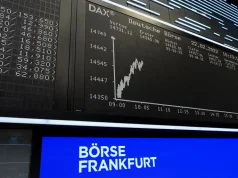
Elsewhere in Europe, Germany’s DAX slipped 0.3%, while Britain’s FTSE 100 edged 0.1% lower.
The broader weakness reflected growing caution among investors as multiple economic and geopolitical risks affected market confidence.
Financial market participants increasingly favored defensive investments, including German government bonds and US Treasuries, amid uncertainty surrounding the outlook for European equities.
French Political Unrest Deepens Stock Market Concerns
France’s ongoing political and social unrest has become a major source of uncertainty for European financial markets.
Large demonstrations and incidents of violence across several French cities have intensified concerns about political stability and the government’s ability to address its fiscal challenges.
Earlier in the week, French authorities introduced curfews in parts of major cities, including Paris and Nice, following unrest and damage to public and private property.
However, tensions remained elevated as labor unions and political organizations prepared additional nationwide demonstrations.
Investors are particularly concerned that prolonged instability could complicate government efforts to control public spending and reduce France’s budget deficit.
The uncertainty has contributed to selling pressure in French equities, with investors reassessing the risks associated with the eurozone’s second-largest economy.
French Bond Yields Surge to 24-Year Highs
The deterioration in market confidence has also affected France’s sovereign debt market.
French 10-year government bond yields climbed above 5% during the week, reaching their highest levels since 2002.
The sharp increase reflected growing concerns about the country’s fiscal outlook and the additional borrowing costs investors now demand to hold French government debt.
Bond prices move inversely to yields. Consequently, rising yields indicate declining bond prices and can signal weaker investor demand.
Higher borrowing costs could make it more difficult for France to finance its spending requirements and manage its existing debt obligations.
The widening yield gap between French government bonds and benchmark German Bunds has highlighted the growing divergence in perceived sovereign risk across Europe.
As uncertainty increased, some investors shifted capital toward German Bunds and US Treasuries, which are traditionally regarded as relatively safer government securities.
The movement has reinforced a defensive investment environment across European financial markets.
AI Spending Concerns Pressure European Technology Stocks
Technology companies also contributed to the broader European stock market weakness.
Despite resilient third-quarter revenue performance from several major industry participants, investors have become increasingly concerned about the enormous capital requirements associated with artificial intelligence infrastructure.
Companies such as SAP, BE Semiconductor Industries and major US technology firms remain closely watched as markets evaluate the financial sustainability of AI expansion.
Developing advanced AI systems requires substantial investment in data centers, high-performance computing equipment, semiconductor technology and energy infrastructure.
These costs have raised questions about how quickly companies can generate sufficient revenue and profitability to justify their spending.
Meanwhile, rising interest rates have increased the cost of financing major infrastructure projects.
Investors are increasingly assessing whether future AI-related earnings will be sufficient to support current technology sector valuations.
Meta’s AI Financing Strategy Raises Investor Questions
Recent developments involving Meta Platforms have intensified concerns about financing requirements across the artificial intelligence industry.
The US technology giant announced plans to create a new class of nonvoting shares that could provide additional flexibility for future capital raising.
The proposed structure would allow Meta to pursue financing opportunities while preserving the voting rights associated with its existing share classes.
However, the possibility of issuing additional equity has drawn attention to potential shareholder dilution and the scale of future AI investment needs.
Investors are also evaluating the risks associated with higher corporate debt issuance as technology companies expand infrastructure capacity.
These concerns have contributed to volatility across semiconductor and technology stocks, including European companies exposed to the AI investment cycle.
European chipmakers such as ASML, Infineon and BE Semiconductor remain sensitive to changes in investor expectations surrounding AI spending and semiconductor demand.
Although the long-term outlook for artificial intelligence continues to attract investment, financial markets are placing greater emphasis on capital efficiency and the potential returns generated by new infrastructure.
Brent Crude Reaches Five-Month High Amid Middle East Tensions
Rising energy prices introduced another significant challenge for European equities.
Brent crude oil climbed toward $114 per barrel on Friday, reaching its highest level in approximately five months as geopolitical tensions in the Middle East raised concerns about potential supply disruptions.
The increase followed reports of attacks by Yemen’s Houthi movement targeting important Saudi Arabian infrastructure, including energy facilities and transportation operations.
The developments raised concerns about the security of petroleum production and exports from one of the world’s most important energy-producing regions.
Additional reports involving diplomatic evacuations and security incidents near major shipping routes contributed to uncertainty, although some reported incidents remained unconfirmed.
The Strait of Hormuz continues to attract particular attention because of its importance to international oil and gas transportation.
Any prolonged disruption to regional energy supplies could maintain upward pressure on crude prices and increase volatility across global commodity markets.
Higher Oil Prices Threaten European Inflation Outlook
Europe’s dependence on imported energy makes the region particularly vulnerable to sustained increases in crude oil prices.
Higher petroleum costs can raise transportation, manufacturing and distribution expenses for European companies.
Energy-intensive industries may face additional pressure on profit margins if businesses cannot fully pass higher operating costs on to customers.
At the same time, elevated fuel prices could contribute to renewed inflationary pressures across the eurozone.
This creates another challenge for the European Central Bank as policymakers evaluate economic growth, inflation trends and the appropriate direction of interest rates.
Investors are closely monitoring upcoming central bank meetings for indications of how policymakers intend to respond to changing financial conditions.
The combination of expensive energy, uncertain borrowing costs and political instability has created a difficult environment for European equities.
European Stock Market Outlook Remains Cautious
European stocks remain exposed to several sources of uncertainty as the trading week approaches its conclusion.
Political unrest and fiscal concerns in France continue to affect investor confidence, while elevated sovereign borrowing costs have raised questions about the country’s financial outlook.
Meanwhile, the technology sector faces growing scrutiny over artificial intelligence investment requirements, financing strategies and future profitability.
Rising oil prices have added further pressure by increasing concerns about inflation and operating expenses for European businesses.
The performance of European equities in the coming sessions will likely depend on developments in France, global technology market sentiment and the direction of energy prices.
With the STOXX 600 heading toward a weekly loss and French equities underperforming, investors remain cautious about the near-term outlook for European stock markets.
Further clarity surrounding fiscal policy, central bank decisions and geopolitical developments could play an important role in determining whether European markets stabilize or experience additional volatility.