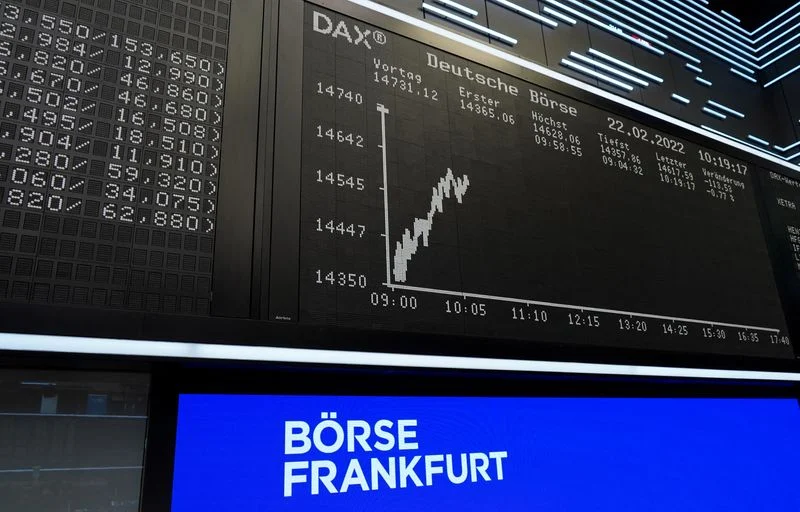
European stocks declined on Thursday as rising French government bond yields, political uncertainty and renewed selling pressure across technology shares weakened investor sentiment.
The pan-European STOXX 600 Index fell approximately 0.8%, reversing modest gains from the previous trading session.
France’s CAC 40 led losses among major continental benchmarks, declining more than 1%, as the country’s benchmark 10-year government bond yield climbed above the psychologically important 5% threshold.
Technology stocks also came under pressure following renewed concerns about artificial intelligence investment costs. Meanwhile, stronger earnings from defensive companies such as Nestlé provided some support to the broader market.
European Stocks Fall as French Bond Yields Exceed 5%
French government bonds experienced another significant selloff as investors grew increasingly concerned about the country’s deteriorating fiscal position.
The yield on France’s benchmark 10-year government bond climbed above 5%, reaching levels last observed in 2002.
The increase reflects growing uncertainty surrounding France’s public finances, political stability and ability to reduce its budget deficit.
Higher bond yields indicate that investors are demanding greater compensation for holding French government debt.
They also increase borrowing costs, potentially placing additional pressure on public finances and economic growth.
France’s benchmark CAC 40 Index declined more than 1% as financial markets reacted to the latest developments.
Italy’s FTSE MIB also traded lower, although Italian government bonds avoided the same degree of selling pressure seen in French sovereign debt.
France’s Political Crisis Raises Concerns Over Public Debt
Political instability has become an increasingly important factor influencing French financial markets.
President Emmanuel Macron pledged Wednesday to prevent further violent unrest following widespread anti-government demonstrations over the previous weekend.
However, additional protests are expected as public opposition to government spending reductions continues.
France faces significant challenges in addressing a budget deficit equivalent to approximately 5.4% of gross domestic product.
Efforts to reduce government expenditure have encountered political resistance, increasing concerns about the country’s ability to stabilize its public finances.
Investors are particularly worried that prolonged political disagreements could delay fiscal reforms and weaken confidence in French government debt.
The uncertainty has also contributed to the widening gap between French and German government bond yields.
What Could Signal an Improvement in France’s Fiscal Outlook?
Several developments could help restore investor confidence in French financial markets.
Progress toward approving a credible government budget would be an important first step.
Investors will also monitor whether French authorities can introduce measures that gradually reduce the fiscal deficit without significantly weakening economic growth.
A sustained decline in French government bond yields would provide another indication of improving market sentiment.
The spread between French and German 10-year bond yields is particularly important because it measures the additional compensation investors demand for holding French sovereign debt.
A narrowing spread could suggest that investors are becoming more confident about France’s fiscal outlook.
However, renewed political unrest or additional delays to budget negotiations could prolong uncertainty.
Protests Spread Across Southern Europe
Social tensions have also affected other European countries as households respond to higher living costs and concerns about public services.
In Greece, thousands of students and teachers participated in demonstrations Wednesday, demanding increased education funding and improvements to public services.
The protests reflected broader concerns about living expenses and government spending priorities.
Nevertheless, Greece’s financial markets showed periods of relative resilience compared with the declines experienced across several other European exchanges.
Italy has also witnessed demonstrations over the cost of living, including protests in Milan.
Prime Minister Giorgia Meloni’s government responded by introducing tougher measures intended to address violent unrest.
Despite these developments, Italian government bond yields have remained comparatively more stable than their French equivalents.
This divergence highlights differences in how investors currently assess political and fiscal risks across European economies.
European Technology Stocks Slide as AI Investment Concerns Return
European semiconductor companies experienced renewed selling pressure as investors questioned the financial sustainability of massive artificial intelligence investments.
The weakness followed declines across Asian technology markets, particularly among companies exposed to semiconductor manufacturing and AI infrastructure.
Shares of major European chipmakers, including ASML, ASM International, Infineon Technologies and Soitec, fell sharply.
Several companies recorded declines of approximately 3% to 5% during the session.
The selloff reflected concerns about rising capital expenditures, elevated valuations and uncertainty surrounding the long-term profitability of AI-related investments.
Higher borrowing costs have added to these concerns because technology businesses investing heavily in infrastructure may face greater financial pressure.
Meta’s New Share Structure Adds to AI Spending Concerns
Meta Platforms also attracted attention after announcing a new nonvoting share class alongside stronger-than-expected third-quarter financial results.
The Facebook and Instagram parent reported robust advertising revenue growth but continued increasing investment in artificial intelligence infrastructure.
Meta’s proposed Class C shares are intended to provide greater flexibility for future corporate financing, employee compensation and other business purposes.
However, investors remain focused on the potential implications of additional equity issuance and the enormous costs associated with expanding AI computing capacity.
While the new share structure does not immediately change existing shareholders’ voting power, future share issuance could affect economic ownership.
The announcement contributed to broader discussions about how major technology companies intend to finance their long-term AI ambitions.
BE Semiconductor Shares Decline Despite Buyback Announcement
BE Semiconductor Industries (BESI) also faced selling pressure despite announcing a new share repurchase programme.
The Dutch semiconductor equipment manufacturer indicated that improving customer demand could support positive order momentum during the fourth quarter.
Nevertheless, the company’s shares declined approximately 3% amid the broader technology sector retreat.
The reaction suggests that concerns about AI infrastructure spending and semiconductor valuations continued to outweigh company-specific positive developments.
Investors will be watching whether stronger equipment orders can translate into sustainable revenue growth and improved profitability.
Nestlé Earnings Provide Support as Consumer Defensive Stocks Outperform
While technology shares struggled, several defensive businesses demonstrated greater resilience.
Swiss food and beverage group Nestlé reported stronger-than-expected organic sales growth during the third quarter.
The company benefited from improved underlying sales volumes and continued demand across its major product categories.
Nestlé recorded organic sales growth of 4%, exceeding analysts’ expectations of approximately 3.4%.
The results suggested that the company was making progress in strengthening its operating performance despite challenging consumer conditions.
Its shares advanced following the announcement, helping offset some of the broader European market weakness.
Consumer defensive companies can attract investor interest during periods of financial uncertainty because demand for essential products tends to remain relatively stable.
Hermès Shares Fall as Luxury Sales Growth Disappoints
French luxury goods manufacturer Hermès experienced a sharp decline following its latest quarterly sales report.
The company reported third-quarter revenue growth of approximately 4.3% on a reported basis, below market expectations.
Although sales continued increasing, the slower growth raised concerns about demand for high-end consumer goods.
Hermès shares fell more than 7% during trading as investors reassessed the company’s growth outlook.
The disappointing performance highlighted continued challenges facing the global luxury sector, particularly in important international markets.
Investors remain attentive to consumer spending trends, regional demand and the ability of luxury manufacturers to maintain premium valuations.
What Comes Next for European Stock Markets?
European equities face several challenges as investors assess rising sovereign borrowing costs, political uncertainty and the sustainability of artificial intelligence investments.
France’s fiscal situation remains a major concern, particularly after its 10-year government bond yield moved above 5%.
Further increases in borrowing costs could pressure financial markets and complicate efforts to stabilize public finances.
Meanwhile, European semiconductor shares remain vulnerable to changing expectations surrounding AI infrastructure spending and corporate profitability.
Defensive companies such as Nestlé may continue attracting investor attention if uncertainty persists.
Upcoming corporate earnings, government budget negotiations and European Central Bank policy decisions will provide additional signals about the market outlook.
Ultimately, the direction of European stocks will depend partly on whether French bond markets stabilize, political tensions ease and technology companies demonstrate sustainable returns from their AI investments.