European stocks declined on Friday as disappointing technology earnings from Alphabet, Amazon and Intel reignited concerns about the enormous costs of artificial intelligence investments.
The selling pressure spread across European technology companies, although the broader market remained on course for its strongest monthly performance since June.
The pan-European STOXX 600 index slipped approximately 0.2%, reflecting investor caution over the financial sustainability of the global AI infrastructure boom.
European Stocks Fall as AI Spending Concerns Intensify
Major European stock indices delivered mixed performances as technology shares came under renewed pressure.
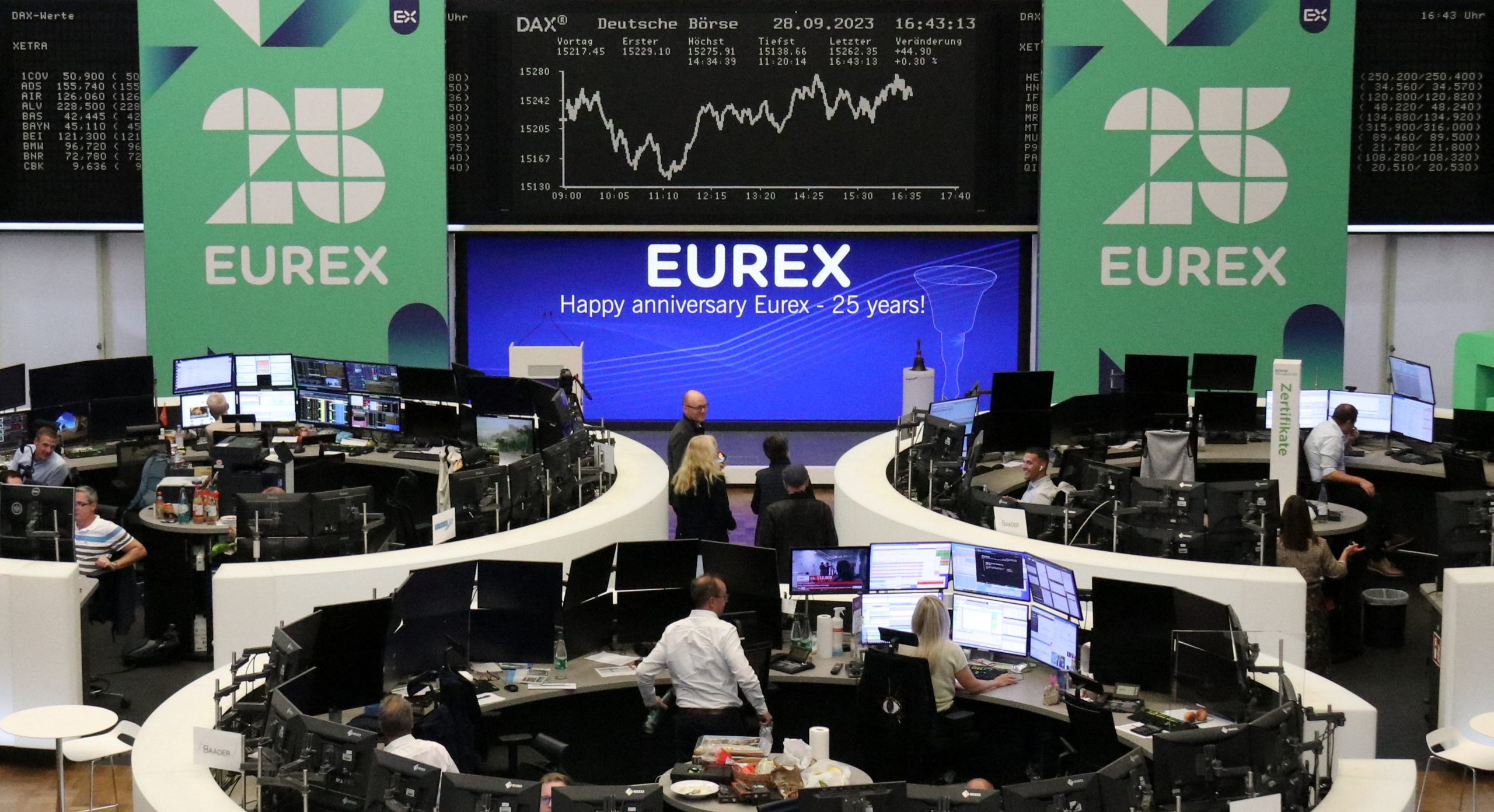
Germany’s DAX declined 0.7%, while France’s CAC 40 remained relatively unchanged. Meanwhile, London’s FTSE 100 managed a modest 0.1% gain.
The weakness followed a broader technology selloff triggered by financial results from three major US companies.
Alphabet reported revenue below market expectations and a shift into negative free cash flow, raising questions about the financial burden of its investments.
Amazon disclosed negative free cash flow of $42.4 billion over the previous 12 months. The company’s third-quarter capital expenditure reached $77.3 billion, more than double the amount recorded a year earlier.
Intel added to investor concerns after forecasting fourth-quarter revenue below analysts’ expectations, citing weaker demand in the personal computer market.
Together, these developments highlighted the growing financial pressure associated with expanding artificial intelligence infrastructure.
European Semiconductor Stocks Hit by Global Tech Selloff
European semiconductor companies experienced some of the sharpest declines as investors reassessed the profitability of AI-related investments.
Dutch chip equipment manufacturer ASML fell more than 5%, alongside ASM International and BE Semiconductor Industries.
German semiconductor producer Infineon also suffered significant losses, declining more than 4%.
The downturn reflected broader concerns that the rapid expansion of AI infrastructure is placing increasing pressure on technology companies’ finances.
Major technology corporations are spending billions on data centers, advanced computing equipment and other infrastructure.
As investment requirements increase, some companies are relying more heavily on borrowing to finance their expansion plans.
Meanwhile, rising technology costs are beginning to affect consumers, with higher prices potentially weakening demand for personal computers and smartphones.
Rising AI Infrastructure Debt Raises Financial Stability Concerns
The scale of artificial intelligence investment is also attracting attention from central banks and financial institutions.
European Central Bank President Christine Lagarde recently highlighted the growing influence of large technology companies on global borrowing costs.
According to Lagarde, increased issuance of long-term corporate bonds by major cloud computing providers is contributing to higher long-term interest rates.
Reports also indicated that Barclays was exploring credit protection arrangements covering more than $10 billion in AI infrastructure debt.
These developments have intensified concerns about the financial risks associated with debt-funded technology investments.
Investors are increasingly questioning whether the substantial capital committed to artificial intelligence will generate sufficient returns to justify the spending.
STOXX 600 Remains on Track for Strong Monthly Gains
Despite Friday’s losses, European equities were still positioned to finish October with solid gains.
The STOXX 600 had advanced more than 2% during the month, supported by strong corporate earnings and Europe’s relatively limited exposure to major technology companies.
European stock markets also benefit from substantial representation in banking, energy and defense, sectors that have helped offset weakness in technology shares.
However, October was marked by significant volatility.
The STOXX 600 fell to approximately 625.5 points on October 8 amid concerns about debt-financed AI investment.
Meanwhile, the US 10-year Treasury yield approached 5.36%, adding pressure to global financial markets.
Political unrest in France also contributed to market uncertainty, pushing French government bond yields above 5%.
Elevated oil prices further complicated the outlook, with crude reaching a five-month high and increasing concerns about inflation and economic growth.
European Corporate Earnings Provide Support to Markets
Corporate earnings have played an important role in supporting European equities despite the challenging economic environment.
Although the third-quarter reporting season began unevenly, with notable declines among luxury companies such as Kering, overall earnings expectations remained strong.
According to LSEG data, STOXX 600 companies were projected to deliver quarterly earnings growth of 23.6%.
That would represent the second-strongest quarterly performance since 2022.
However, much of the expected growth came from the energy sector, where profits were forecast to rise by approximately 139%.
Excluding energy companies, earnings growth was expected to reach a more moderate 9.8%.
Several major European corporations also delivered encouraging results.
Pharmaceutical company AstraZeneca gained approximately 4% after its third-quarter core earnings exceeded analysts’ expectations of $2.62 per share.
The stronger performance was partly supported by operating costs coming in below forecasts.
Meanwhile, Universal Music Group surged around 10% after reporting improved subscription streaming revenue during the third quarter.
These positive earnings developments helped limit losses across the broader European stock market.
ECB Interest Rate Outlook Adds to Market Uncertainty
Monetary policy developments remain another important factor influencing European equities.
The European Central Bank maintained its deposit rate at 2.50% during Thursday’s meeting, adopting a cautious stance amid persistent inflation concerns.
However, investors interpreted the decision as a potentially hawkish pause rather than a signal that monetary tightening had ended.
Financial markets assigned approximately a 67% probability to another ECB interest rate increase in December.
The central bank also emphasized that it has the necessary tools to respond to disorderly financial market conditions.
Meanwhile, Christine Lagarde’s announcement that she intends to leave her position in February 2027 introduced additional uncertainty surrounding the institution’s leadership.
UBS analysts suggested that policymakers are unlikely to change interest rates without clearer economic evidence.
Nevertheless, elevated energy costs and inflation running at approximately twice the ECB’s 2% target could keep further tightening under consideration.
European Markets Face Mixed Outlook Despite Economic Resilience
Recent economic data provided some encouragement, with the eurozone economy expanding faster than analysts had anticipated during the third quarter.
However, investors continue to balance improving corporate earnings against several significant risks.
These include rising AI infrastructure costs, elevated bond yields, geopolitical uncertainty and the possibility of additional ECB interest rate increases.
The latest technology selloff demonstrates how concerns originating in major US companies can quickly spread to European financial markets.
For now, European stocks remain supported by relatively strong earnings and their diversified sector exposure.
Nevertheless, the sustainability of AI investment spending and the direction of monetary policy are likely to remain central factors shaping market sentiment.