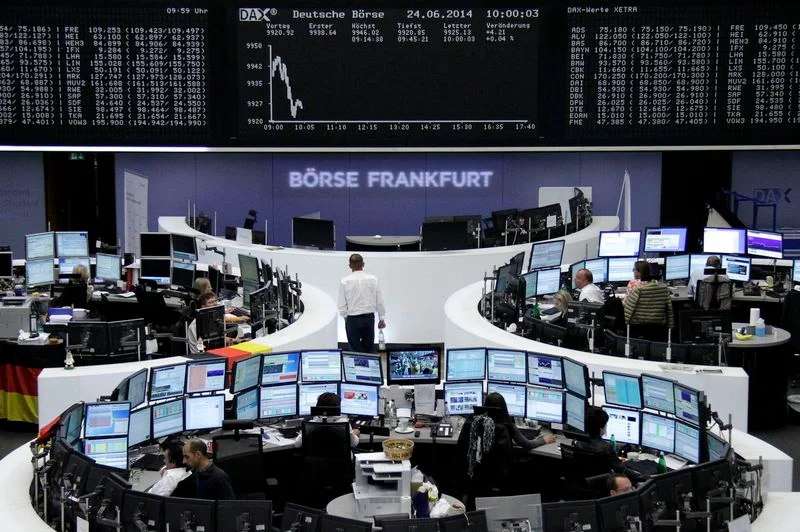
European stocks reversed their earlier gains on Thursday, November 5, as a sharp decline on Wall Street weakened investor confidence and triggered selling across major European markets.
The pan-European STOXX 600 index closed approximately 0.4% lower, surrendering an early rally that had pushed shares close to their highest levels since August.
European markets initially benefited from easing energy prices, encouraging corporate earnings, and optimism following the Democratic Party’s victory in the US midterm elections.
However, mounting pressure on American technology stocks eventually spread across the Atlantic, overshadowing positive developments in several European industries.
European Stocks Retreat as Wall Street Selling Intensifies
European stocks began Thursday’s trading session on a positive note, extending the previous day’s strong recovery.
Investors initially welcomed declining energy costs and signs of resilience in corporate profitability, particularly among companies supplying artificial intelligence infrastructure.
The STOXX 600 approached record territory before reversing direction as major US stock indices moved sharply lower.
Technology and defense shares were among the weakest performers, reflecting growing uncertainty about future investment spending and government policies.
Analysts at Lloyds Bank suggested that the recent energy price shock remains manageable at its current magnitude.
They also questioned whether consumer demand is sufficiently strong for businesses to transfer higher operating expenses directly to customers.
Despite these concerns, European companies have generally continued reporting resilient financial results during the current earnings season.
Approximately half of the companies included in the STOXX 600 have published their latest quarterly results.
European Markets Deliver Mixed Performance
Major European stock indices finished Thursday’s session with contrasting performances.
France’s CAC 40 managed to gain approximately 0.3%, while Spain’s IBEX 35 advanced around 0.4%.
However, the UK’s FTSE 100 declined 0.4%, reflecting pressure from weaker global market sentiment and tighter monetary policy.
Germany’s DAX also lost approximately 0.4%, while Italy’s FTSE MIB fell around 1%.
The losses highlighted how quickly investor sentiment shifted as selling intensified in US technology shares.
European semiconductor companies also faced pressure as investors reassessed the outlook for artificial intelligence investment and potential regulatory changes in the United States.
ArcelorMittal and Air France-KLM Rally on Strong Earnings
Despite the broader decline in European stocks, several companies delivered impressive share price gains following encouraging financial updates.
Steel producer ArcelorMittal climbed approximately 5% after reporting core earnings above market expectations.
The results helped strengthen confidence in the company’s financial performance despite persistent economic uncertainty.
Air France-KLM was another major outperformer, with shares rising around 11% after its third-quarter operating profit exceeded analysts’ forecasts.
Renewable energy companies Orsted and Nordex also advanced more than 4% following the release of their financial results.
The positive reactions demonstrated that strong corporate earnings continued attracting investors even as broader European markets weakened.
AI Data Center Demand Boosts Legrand Shares
French electrical equipment manufacturer Legrand also attracted investor attention after raising its full-year 2026 sales growth forecast for the second time this year.
Its shares advanced during the session as management highlighted strong demand for equipment used in artificial intelligence data centers.
Legrand supplies electrical distribution systems, cable management solutions, and other infrastructure components essential for large computing facilities.
The growing need for AI computing power has increased demand for reliable electrical infrastructure and advanced data center equipment.
This trend continues creating opportunities for companies supplying the physical systems required to support artificial intelligence expansion.
Although investors remain concerned about the valuations of major technology companies, Legrand’s performance suggests that demand for underlying AI infrastructure remains substantial.
Rheinmetall Shares Plunge After Sales Forecast Cut
German defense manufacturer Rheinmetall suffered one of the session’s largest declines after reducing its 2026 revenue outlook for the second time in three months.
The company’s shares dropped approximately 16%, reflecting investor disappointment over delays affecting major military contracts.
Rheinmetall lowered its annual sales forecast to approximately €13.2 billion, compared with its previous target range of €13.7 billion to €14.2 billion.
The company also reduced its expected operating profit margin from around 19% to 18.5%.
Delays involving Germany’s Arminius Boxer armored vehicle program and artillery ammunition approvals contributed to the revised outlook.
Despite continued European defense spending, the announcement raised concerns about the company’s ability to translate strong demand into revenue within its expected timeframe.
The sharp decline placed additional pressure on Germany’s DAX and the wider European defense sector.
Bank of England Raises Interest Rates to 4%
Monetary policy also influenced European stock markets after the Bank of England announced its first interest rate increase in more than three years.
The central bank raised its benchmark Bank Rate by 25 basis points, bringing it to 4.00%.
The widely anticipated decision reflected mounting inflationary pressures associated with the prolonged Middle East conflict and elevated energy costs.
British consumer price inflation reached 3.5% in September, remaining significantly above the central bank’s 2% target.
Policymakers also warned that inflation could approach 5% by the middle of 2027 if higher energy costs continue affecting household expenses and business prices.
The Bank of England’s Monetary Policy Committee voted 8-1 in favor of the quarter-point increase, with one member supporting a larger adjustment.
Danni Hewson, head of financial analysis at AJ Bell, suggested that policymakers had limited room to maintain their previous cautious approach as inflation pressures intensified.
However, the central bank emphasized that future interest rate decisions will depend on economic developments rather than following a predetermined path.
Diageo Shares Jump After Revenue Beats Expectations
British beverage producer Diageo emerged as another notable performer, with its shares climbing approximately 5% following encouraging first-quarter sales figures.
The company reported revenue that exceeded analysts’ expectations, offering reassurance about its business performance amid challenging consumer conditions.
Diageo’s reported net sales increased 1.2% to approximately $4.93 billion during the quarter ending September 30.
Organic revenue growth reached 1.4%, supported by improvements across several international markets.
The company also maintained its full-year financial guidance, reinforcing investor confidence in its operating outlook.
The positive market reaction helped offset some of the broader weakness affecting British equities.
What Comes Next for European Stock Markets?
The reversal in European stocks highlights the growing influence of US market developments on investor sentiment across international financial markets.
Although stronger corporate earnings and easing energy costs initially supported European equities, the sharp decline in American technology shares ultimately weighed on the region.
Investors are now balancing several important developments, including the outlook for artificial intelligence investment, changing US political priorities, European interest rates, and geopolitical uncertainty.
The Bank of England’s latest rate increase also demonstrates that inflation remains a significant challenge despite recent improvements in energy market conditions.
Meanwhile, company-specific earnings results continue creating opportunities for individual stocks to outperform the broader market.
For now, European stock markets remain vulnerable to volatility as investors reassess valuations, monetary policy expectations, and global economic risks.
The direction of Wall Street, particularly the technology-heavy Nasdaq, could remain an important influence on European trading sentiment in the coming sessions.