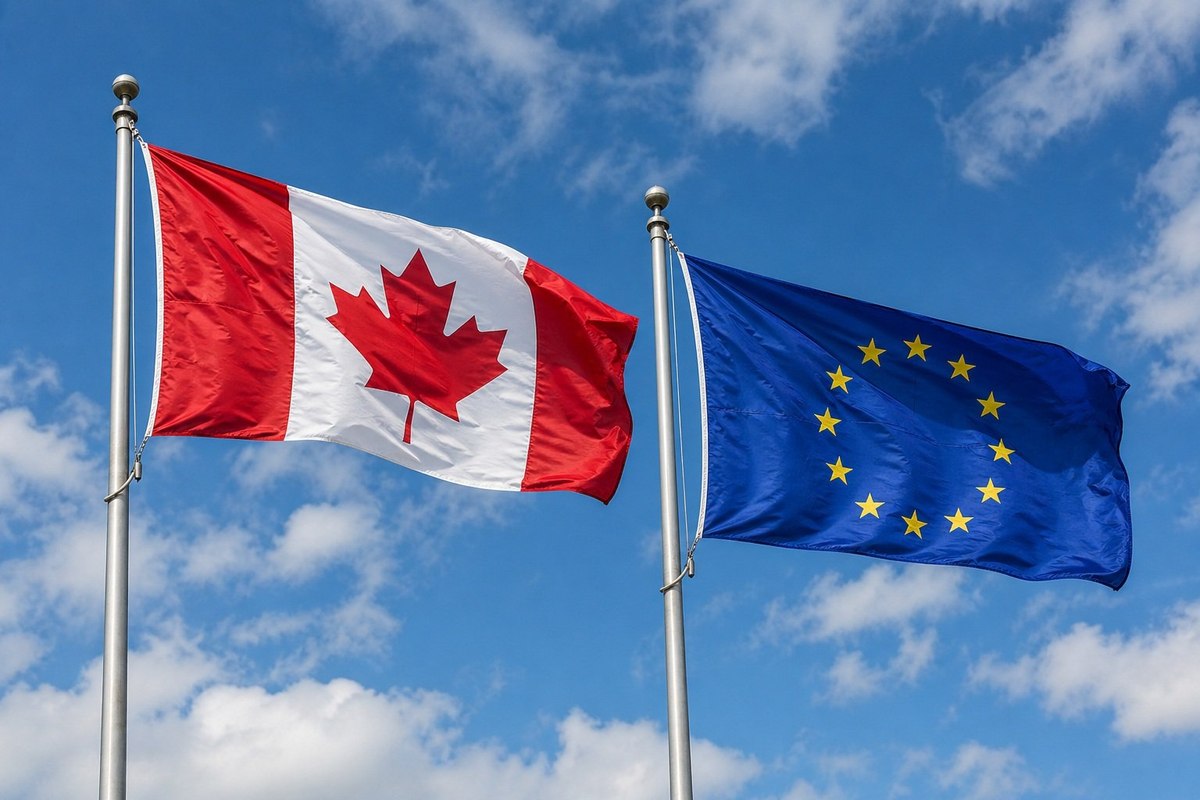
The European Union and Canada are preparing to announce a broad strategic alliance designed to deepen cooperation in trade, defense and economic policy.
The initiative reflects a wider effort by both sides to strengthen their position as global middle powers while reducing dependence on the increasingly dominant U.S.-China geopolitical rivalry.
EU and Canada Prepare New Strategic Partnership
European Commission President Ursula von der Leyen is expected to unveil the initiative during her annual State of the Union address in Strasbourg on Sept. 16.
Canadian Prime Minister Mark Carney is set to attend the speech and is also expected to address European lawmakers the following day.
His presence highlights Canada’s growing interest in building a closer relationship with the European Union without seeking formal EU membership.
Trade and Economic Cooperation Set to Expand
The planned EU-Canada alliance is expected to strengthen cooperation across several strategically important sectors.
These areas include critical supply chains, raw materials, scientific research and space exploration.
Both sides are also exploring ways to expand their existing trade relationship and create stronger economic links.
Officials are reportedly considering how closely Canada could align with the EU single market under existing legal and regulatory frameworks.
Defense Cooperation Becomes a Key Priority
Defense is another major part of the developing partnership.
Canada has already moved closer to the EU on security matters after becoming the first non-EU country to participate in the bloc’s €150 billion defense procurement fund.
That agreement opened the door to deeper cooperation on military equipment, procurement and industrial capacity.
The new alliance could expand this relationship even further as Europe and Canada seek to strengthen their defense capabilities amid rising geopolitical uncertainty.
U.S.-China Rivalry Drives Closer EU-Canada Ties
The initiative comes at a time when global politics are increasingly shaped by competition between the United States and China.
Canada and the European Union are seeking ways to protect their economic and strategic interests without becoming overly dependent on either major power.
Prime Minister Carney has previously warned that the traditional rules-based international order has become increasingly fragmented.
That shift has encouraged governments to search for new alliances capable of providing greater economic and political stability.
Supply Chains and Critical Materials Take Center Stage
Critical supply chains are expected to play an important role in the partnership.
Canada is a major producer of natural resources, while the European Union is working to reduce its dependence on foreign suppliers for strategic materials.
Closer cooperation could therefore help both sides improve access to critical minerals, energy resources and industrial inputs.
These materials are increasingly important for sectors such as clean energy, advanced manufacturing, defense and technology.
Canada Could Move Closer to the EU Single Market
One of the most important long-term questions is how closely Canada can integrate with the European Union economically.
The two sides already have a trade agreement and an established security partnership.
However, officials are now exploring whether Canada could achieve deeper access to the EU single market.
Any closer integration would likely require new regulatory or legal arrangements.
Those discussions are still ongoing, meaning the final structure of the relationship has yet to be determined.
EU and Canada Expected to Formalize Next Steps
The new alliance is expected to build on the existing relationship between Canada and the European Union rather than replace it.
Both sides are likely to focus on expanding cooperation in trade, security, technology and strategic industries.
Further details are expected to emerge during a joint EU-Canada summit scheduled to take place in Canada in October.
If the agreement progresses as planned, it could mark a significant step toward a stronger political and economic bloc capable of operating more independently in an increasingly competitive global environment.