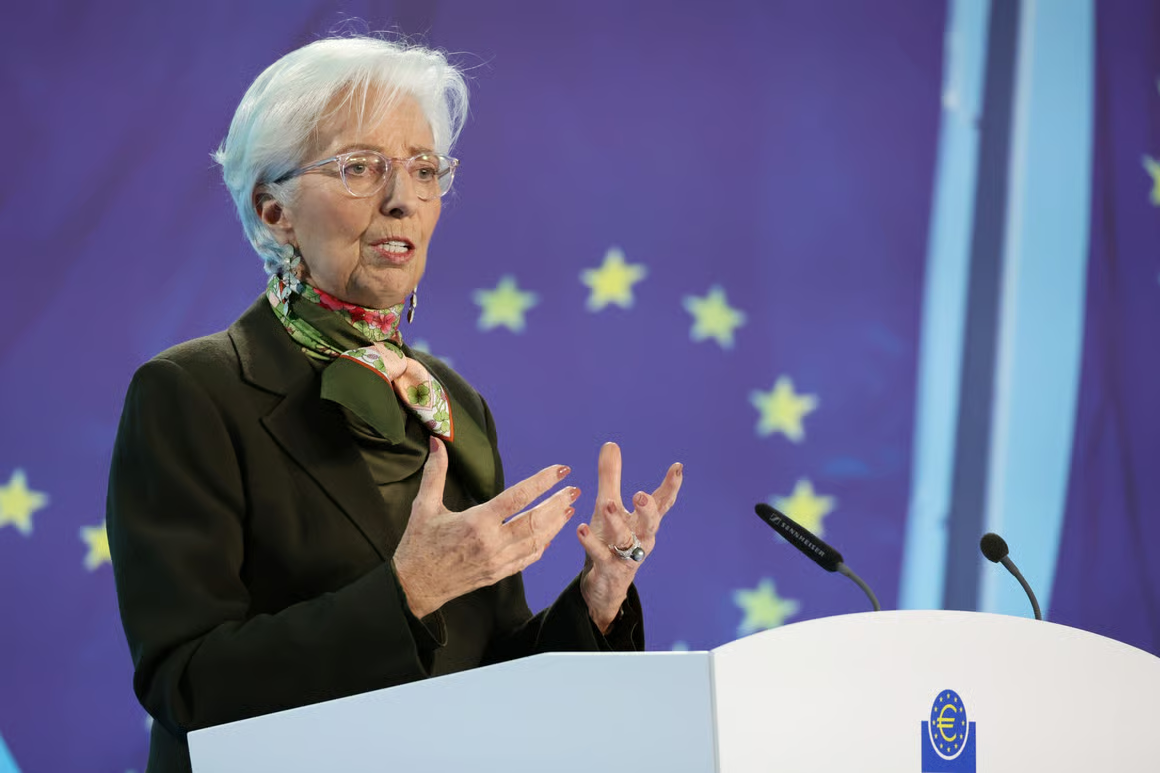
The European Central Bank (ECB) is closely monitoring economic indicators to determine whether another interest rate increase will be necessary in December, according to outgoing ECB President Christine Lagarde.
Speaking at a financial literacy conference in Milan on Thursday, November 5, Lagarde emphasized that policymakers need additional economic evidence before deciding whether to tighten monetary policy further.
The ECB maintained its benchmark deposit rate at 2.5% during its October meeting. However, several influential policymakers have indicated that another increase could be appropriate as inflationary pressures continue affecting the eurozone economy.
ECB December Rate Hike Depends on Economic Data
The possibility of an ECB December rate hike has attracted increasing attention as European policymakers assess persistent inflation risks.
Lagarde explained that a range of economic indicators released before December will help the central bank determine whether higher borrowing costs are justified.
Senior officials, including the heads of the German and Italian central banks, have already suggested that additional monetary tightening may be necessary.
However, the ECB has not committed to another rate increase.
Instead, policymakers are evaluating how rising energy costs, consumer demand, and broader economic activity could influence inflation in the months ahead.
The central bank must also consider the potential consequences of higher interest rates for businesses and households across the eurozone.
Rising Energy Prices Threaten Eurozone Economic Growth
Lagarde acknowledged that the European economy faces significant challenges as elevated energy prices simultaneously weaken economic growth and increase inflation.
Higher energy costs place pressure on businesses by increasing production and transportation expenses.
At the same time, households face higher living costs, potentially reducing consumer spending and weakening economic activity.
This combination presents a difficult challenge for monetary policymakers.
Raising interest rates can help contain inflation, but tighter borrowing conditions may also discourage investment and slow economic growth.
The ECB must therefore carefully distinguish between inflation caused by supply disruptions and price pressures generated by stronger consumer demand.
According to Lagarde, applying monetary policy too aggressively without understanding the underlying causes of inflation could create unnecessary economic damage.
Artificial Intelligence Investment Supports Eurozone Resilience
Despite concerns about rising energy prices, Lagarde identified artificial intelligence as a positive development supporting the European economy.
Growing investment in AI technologies is generating additional demand for infrastructure, computing resources, and business innovation.
These investments could help strengthen economic resilience at a time when energy costs and geopolitical uncertainty are weighing on growth.
However, stronger investment demand also complicates the ECB’s assessment of inflation.
Policymakers must determine whether price increases primarily reflect restricted supply or stronger economic activity.
The distinction is important because different sources of inflation can require different monetary policy responses.
Consequently, the ECB is taking a cautious approach as it evaluates the interaction between energy market disruptions and investment-driven economic growth.
ECB Warns Against Persistent Inflation Pressures
Lagarde also stressed the importance of preventing temporary inflationary shocks from spreading throughout the wider economy.
Although higher energy prices may initially affect specific industries, their impact can eventually extend to wages, goods, and services.
Businesses facing increased operating expenses may raise consumer prices, while workers could demand higher compensation to offset rising living costs.
Such developments can create secondary inflationary effects, making price stability more difficult to restore.
The ECB is particularly concerned about preventing inflation expectations from becoming entrenched.
If consumers and businesses begin anticipating persistently higher prices, inflation could become more resistant to conventional monetary policy measures.
For this reason, Lagarde emphasized that interest rates must be used carefully but decisively when economic conditions require action.
Lagarde Prepares to Leave ECB in February 2027
The upcoming December monetary policy decision will take place during the final months of Christine Lagarde’s leadership of the European Central Bank.
Lagarde has announced plans to step down on February 7, 2027, several months before the scheduled conclusion of her term.
Her departure introduces an additional leadership transition at a time when the eurozone faces considerable economic uncertainty.
Nevertheless, the ECB’s interest rate decisions will continue to depend on inflation developments, economic growth, and the broader financial outlook.
Investors will closely monitor upcoming economic releases for indications of whether another rate increase is becoming more likely.
For now, the ECB’s message remains clear: a December interest rate hike is possible, but the final decision will depend on incoming data.
With elevated energy prices weighing on growth and artificial intelligence investment supporting economic activity, policymakers face a delicate balance between controlling inflation and protecting the eurozone’s economic recovery.