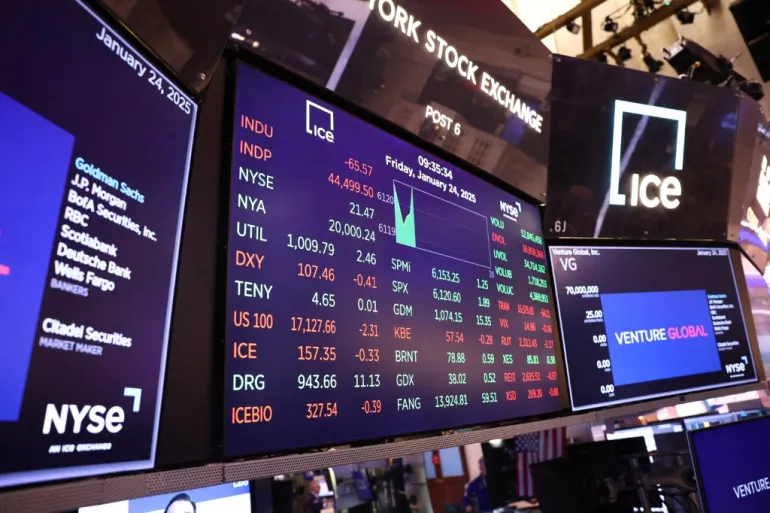
Wall Street opened the holiday-shortened week on a weak note Tuesday as investors returned from the Labor Day break to renewed geopolitical tensions in the Middle East and elevated expectations for a Federal Reserve rate hike.
The S&P 500 fell around 0.4% to 7,685.45, while the Dow Jones Industrial Average dropped 1.1% to 52,812.18. The Nasdaq Composite performed slightly better, declining about 0.2% to 26,457.08.
Fed Rate Hike Bets Pressure U.S. Stocks
U.S. stocks entered the week after a volatile stretch driven by rising Treasury yields, surging oil prices and a much stronger-than-expected August employment report.
The latest jobs data significantly changed expectations for Federal Reserve policy.
The U.S. economy added 162,000 nonfarm payrolls in August, nearly three times the expected increase of 55,000.
The unemployment rate remained unchanged at 4.1%.
In addition, employment growth for June and July was revised higher by a combined 55,000 jobs.
Strong Jobs Data Raises Inflation Concerns
The employment report reinforced the view that the U.S. labor market remains resilient.
Combined with persistent inflation, the figures raised concerns that the economy may still be running too hot.
A strong labor market can give the Federal Reserve more room to tighten monetary policy if inflation remains elevated.
Markets responded by increasing expectations for a quarter-point interest rate hike later this month.
According to the CME FedWatch tool, traders were pricing in roughly a 60% probability of a 25-basis-point Fed rate increase.
Fed Officials Send Mixed Signals
Recent comments from Federal Reserve policymakers have not provided a completely clear direction.
Fed Chair Kevin Warsh delivered a more hawkish message during his Jackson Hole speech in late August.
However, that tone was partly offset by more dovish comments from New York Fed President John Williams and Fed Governor Christopher Waller.
Both officials are voting members of the Federal Open Market Committee.
The mixed signals have made upcoming inflation data even more important.
CPI and PPI Could Decide the Fed’s September Move
Investors will now focus heavily on the August Producer Price Index and Consumer Price Index reports.
These inflation readings could play a decisive role in determining whether the Fed raises rates at its Sept. 16 meeting.
JPMorgan analysts said recent Fed commentary suggests policymakers remain relatively confident about the labor market.
That means inflation data may now be the main factor driving the next policy decision.
The bank expects core CPI to rise around 0.21% month over month.
JPMorgan believes such a reading could be low enough to keep the Fed on hold beyond the September meeting.
Brent Oil Briefly Climbs Above $99
Geopolitical tensions also added pressure to financial markets.
Brent crude oil futures rose during Tuesday’s session and briefly reached $99.45 per barrel before easing back toward $97.32.
The global oil benchmark had already surged 9.3% during the previous week.
The rally followed renewed military exchanges between the United States and Iran.
U.S.-Iran Conflict Raises Oil Supply Risks
Military activity continued over the weekend.
U.S. Central Command said it struck three Iranian crude oil carriers on Saturday in response to missile attacks against two U.S. Navy warships operating in the region.
Iranian state media later reported that Tehran retaliated by targeting six vessels in the Strait of Hormuz and Persian Gulf.
Those vessels reportedly included three tankers and three U.S.-linked ships.
The escalation has increased concerns that the conflict could disrupt oil shipments through one of the world’s most important energy corridors.
Iran Threatens Maritime Exclusion Zone
Iranian officials have also increased their rhetoric toward Washington.
Mohsen Rezaee, a senior Iranian official, warned that further U.S. economic pressure could be met with a maritime exclusion zone across the Persian Gulf.
Iranian Parliament Speaker Mohammad Bagher Ghalibaf also warned that U.S.-linked oil and gas infrastructure throughout the region could be vulnerable to retaliation.
Those comments have added another geopolitical risk premium to crude oil prices.
Strait of Hormuz Remains Critical
The Strait of Hormuz remains at the center of global oil market concerns.
The narrow waterway carries a significant share of global crude and refined petroleum products.
According to TankerTrackers.com, Middle East crude exports in August were down roughly 39% compared with the January and February baseline of 18.5 million barrels per day.
The decline reflects the growing impact of the regional conflict on energy flows.
Saudi Refinery Reports Add to Supply Concerns
Reports of fresh drone and missile strikes targeting Saudi Aramco’s Jazan refinery added another layer of uncertainty.
The refinery has a capacity of around 400,000 barrels per day.
Any prolonged disruption could tighten the availability of refined petroleum products and add further upward pressure to energy prices.
That would be particularly important for inflation expectations.
Higher oil prices can increase transportation and production costs across the economy.
Oil and Inflation Create a Difficult Fed Backdrop
The combination of strong employment and rising energy prices creates a challenging environment for the Federal Reserve.
Higher oil prices can feed into inflation just as policymakers are assessing whether further monetary tightening is necessary.
For equity markets, that creates two potential headwinds at the same time.
Higher interest rates can reduce stock valuations, while elevated energy prices may hurt consumer spending and corporate profit margins.
Wall Street Faces a Crucial Week
Investors now face several major market catalysts.
The first will be the upcoming U.S. inflation reports, which could determine whether expectations for a September Fed rate hike strengthen or fade.
At the same time, markets will remain highly sensitive to developments in the Middle East and movements in oil prices.
For now, rising geopolitical risk, stronger rate hike expectations and higher crude prices are combining to keep pressure on the S&P 500 and Dow.