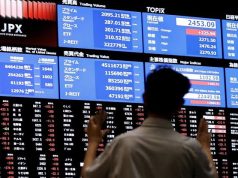
Asian stocks fell sharply on Friday as surging oil prices and rising bond yields triggered a broad risk-off move across financial markets.
The selloff overshadowed continued optimism surrounding artificial intelligence and semiconductor stocks, which had supported parts of the Asian market earlier in the week.
Asian Stocks Follow Wall Street Lower
The decline followed a fourth consecutive losing session on Wall Street on Thursday.
Brent crude had climbed above $100 per barrel, while U.S. Treasury yields moved higher.
During Asian trading, Nasdaq 100 futures fell around 0.2%, while S&P 500 futures were broadly unchanged.
Investors remained cautious as markets prepared for another important U.S. inflation report.
Fed Rate-Hike Bets Rise After PPI Data
U.S. producer prices increased 0.4% in August, while annual producer inflation accelerated to 5.4%.
The stronger inflation figures reinforced expectations that the Federal Reserve could raise interest rates at its next meeting.
Markets are now pricing roughly a 70% probability of a rate hike.
Attention has therefore shifted to the latest U.S. Consumer Price Index report.
Investors will be watching closely for signs that higher energy costs are spreading into broader consumer inflation.
Oil Surge Hits Asian Market Sentiment
Higher oil prices have become one of the biggest risks facing global markets.
Brent crude traded around $107.66 per barrel after approaching $110 and was up nearly 13% for the week.
Rising energy prices can increase costs for companies and consumers while also keeping inflation elevated.
That creates additional pressure on central banks to maintain tighter monetary policy.
For equity markets, the combination of high oil prices and elevated interest rates can create a difficult environment for valuations and economic growth.
Asian Stock Markets Fall Sharply
The broader MSCI Asia Pacific Index fell around 1.3% as selling spread across the region.
South Korea’s KOSPI dropped 2.4%, while Japan’s Nikkei 225 fell 2.9%.
Hong Kong’s Hang Seng declined around 1.5%.
Despite Friday’s losses, weekly performance remained mixed.
The KOSPI was still roughly 2.5% higher for the week, while the Nikkei was down about 2.6%.
Semiconductor Stocks Retreat
Technology and semiconductor companies were among the hardest hit.
South Korea’s SK Hynix fell approximately 3.4%, although the stock remained nearly 13% higher for the week.
Samsung Electronics dropped around 3.9%, but it was still up more than 5% on a weekly basis.
The declines showed how quickly macroeconomic concerns can overshadow optimism surrounding the artificial intelligence sector.
Japanese Chip Stocks Come Under Pressure
Selling was particularly strong among Japanese technology companies.
Kioxia fell nearly 7.8%, while electronic-components manufacturer TDK dropped around 3.1%.
Taiwan Semiconductor Manufacturing Company also declined approximately 1.4%.
The weakness came despite continued expectations that AI-related investment will support long-term demand for advanced semiconductors.
AI Investment Boom Remains Strong
The broader AI investment story still showed signs of strength.
Oracle shares jumped more than 6% in extended U.S. trading after the company reported stronger-than-expected growth in its cloud business.
Oracle also reported a record backlog of around $664 billion, highlighting the enormous level of spending linked to AI infrastructure.
The figures reinforced the view that corporate investment in artificial intelligence remains strong despite growing macroeconomic risks.
China AI Chip Company Surges on Debut
Chinese markets also came under pressure.
The Shanghai Composite fell more than 2%, while several major Hong Kong technology stocks declined.
Alibaba slipped around 0.9%, while Meituan and Tencent also traded lower.
However, one Chinese semiconductor company stood out.
Tencent-backed Shanghai Enflame Technology surged roughly 200% during its Shanghai market debut after raising approximately 6.12 billion yuan.
The strong debut highlighted intense investor demand for Chinese alternatives to Nvidia and other international AI-chip suppliers.
Asian Bond Yields Jump
Government bond markets also came under significant pressure.
Australia’s three-year bond yield climbed to around 5.05%, its highest level since 2011.
New Zealand’s two-year yield increased by approximately 24 basis points.
Meanwhile, the U.S. 10-year Treasury yield moved close to the psychologically important 5% level.
Higher yields can make bonds more attractive relative to equities, while also increasing borrowing costs for companies and consumers.
India, Australia and Southeast Asia Decline
Weakness was also visible across other major Asian markets.
India’s Nifty 50 futures fell around 0.2%, while the benchmark index remained about 1.8% lower for the week.
Singapore’s Straits Times Index declined approximately 0.3%, while Indonesia’s Jakarta Composite fell around 1.4%.
Australia’s S&P/ASX 200 dropped 1.26%, extending its weekly decline to roughly 3.3%.
New Zealand’s NZX 50 also fell around 0.6%.
Middle East Tensions Keep Oil Risk Elevated
Geopolitical tensions remain one of the key reasons behind the surge in oil prices.
Disruptions around the Strait of Hormuz have reduced shipping activity through one of the world’s most important energy routes.
Meanwhile, Iran-backed Houthi forces have increased pressure around the Bab el-Mandeb Strait near Yemen.
The possibility of disruption across both shipping routes has increased concerns about Middle Eastern energy supplies.
Oil and Fed Policy Could Drive Asian Stocks
For now, investors face a difficult combination of geopolitical risks, rising oil prices and tighter monetary policy expectations.
AI and semiconductor investment remains an important source of optimism for technology stocks.
However, Friday’s selloff demonstrated that strong sector-specific growth can be overwhelmed by broader macroeconomic concerns.
The next direction for Asian stocks could therefore depend heavily on U.S. inflation data, Federal Reserve policy and whether oil prices continue their recent surge.