Asian stock markets recovered from early losses on Friday, October 23, as selling pressure across artificial intelligence and technology shares began to ease. Chinese equities also staged a rebound after entering bear market territory earlier in the week.
However, investor sentiment remained fragile following a sharp decline on Wall Street, rising oil prices and growing concerns about the sustainability of AI infrastructure spending.
South Korea’s KOSPI returned to positive territory, while China’s CSI 300 and Shanghai Composite indices advanced. Japanese stocks remained under pressure as stronger inflation figures reinforced expectations of further interest rate increases by the Bank of Japan.
Asian Stocks Recover as AI Selloff Loses Momentum
Asian equities initially followed Wall Street lower after the Nasdaq recorded its steepest daily decline since June.
The US technology selloff reflected growing investor concerns about elevated AI stock valuations and the enormous capital investments required to develop artificial intelligence infrastructure.
Disappointing earnings from several major technology companies added to the uncertainty, raising questions about whether future profits would justify current spending levels.
Although the selling pressure moderated during Friday’s Asian session, investors remained cautious.
US stock index futures showed limited movement, while crude oil prices approached five-month highs amid ongoing geopolitical tensions in the Middle East.
Higher energy costs could increase inflationary pressure and complicate the interest rate outlook, creating further challenges for risk-sensitive assets.
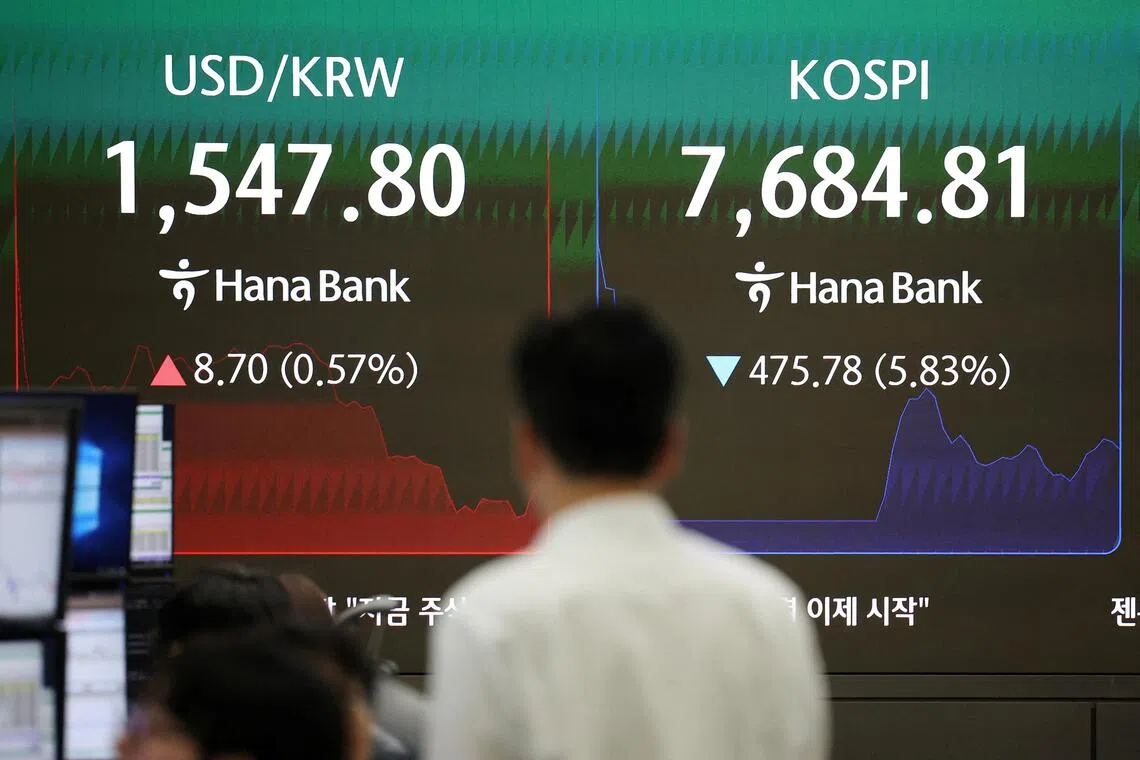
South Korea’s KOSPI Rebounds From Three-Month Low
South Korean stocks staged a recovery after suffering significant losses earlier in Friday’s session.
The KOSPI index climbed approximately 0.2% after initially falling as much as 3% to its lowest level in three months.
Despite the rebound, the benchmark remained on course for a weekly decline exceeding 4%, reflecting substantial weakness across technology and semiconductor stocks.
Memory chip manufacturer SK Hynix played an important role in the recovery.
The company’s shares rose approximately 4% after initially declining more than 3%, following its announcement that it would discontinue reviewing a potential US initial public offering of subsidiary Solidigm.
The decision came amid uncertain capital market conditions and concerns about protecting shareholder value.
Although SK Hynix recovered during Friday’s session, its shares remained approximately 34% lower over the preceding month, according to the reported market snapshot.
Meanwhile, rival Samsung Electronics also recovered from early losses, trading near unchanged levels during the session.
SK Hynix Halts Solidigm IPO as AI Market Concerns Persist
SK Hynix’s decision to suspend its review of a possible Solidigm listing attracted considerable attention from semiconductor investors.
Solidigm specializes in NAND flash memory and enterprise solid-state drives used in servers, cloud computing and artificial intelligence data centers.
The potential IPO had been considered as a way to raise capital for future expansion.
However, SK Hynix decided to halt the review after evaluating market volatility and the interests of existing shareholders.
The announcement came at a time when investors were increasingly questioning the financing requirements of major AI infrastructure projects.
Despite the suspended listing, Solidigm’s long-term expansion strategy remains intact, with alternative financing options still under consideration.
SK Hyper Explores $350 Billion AI Infrastructure Investment
Separately, another SK Group company is pursuing an ambitious investment programme focused on artificial intelligence infrastructure.
According to a Bloomberg report, SK Hyper is discussing financing arrangements with major technology companies and institutional investors for an AI data center project requiring approximately $350 billion.
SK Hyper operates within the SK Telecom group and focuses on developing large-scale AI computing infrastructure.
The reported investment would support an initial 5-gigawatt phase of a broader project targeting 15 gigawatts of data center capacity in South Korea by 2035.
The company plans to share the substantial investment costs with outside investors and potential data center customers.
The initiative highlights the continuing demand for AI infrastructure, even as financial markets grow more cautious about borrowing costs, valuations and future investment returns.
Chinese Stocks Rebound Despite Bear Market Conditions
Chinese equity markets recovered on Friday after declining to their lowest levels in approximately 15 months.
The CSI 300 index advanced around 1.8%, while the Shanghai Composite gained approximately 0.9%.
Hong Kong’s Hang Seng index also recovered, rising around 1.2% after initially trading lower.
The rebound followed substantial losses earlier in the week, particularly among technology and artificial intelligence companies.
China’s CSI 300 entered technical bear market territory on Thursday after falling more than 20% from its June peak.
A technical bear market is commonly defined as a decline of at least 20% from a recent market high.
Despite Friday’s recovery, mainland Chinese equity benchmarks remained on course for an eleventh consecutive week of losses.
The prolonged weakness demonstrated that a single positive trading session was insufficient to reverse the broader negative market trend.
China Economy Faces Pressure From Stronger Yuan and Weak Demand
Several economic challenges have contributed to the decline in Chinese stocks.
A sharp correction in technology valuations has weighed heavily on investor confidence after earlier enthusiasm surrounding artificial intelligence companies.
Meanwhile, the strengthening Chinese yuan has created additional difficulties for export-oriented businesses.
The currency reached a four-year high earlier in October, potentially reducing the price competitiveness of Chinese products in overseas markets.
A stronger yuan can make exports more expensive for foreign buyers and reduce the local-currency value of overseas revenue.
Recent economic indicators have also raised concerns about slowing Chinese growth.
Despite continued policy support from Beijing, investors remain uncertain about the strength of domestic demand and the prospects for a sustained economic recovery.
These factors have contributed to persistent selling pressure across mainland Chinese equity markets.
Japanese Stocks Decline as Inflation Exceeds BOJ Target
Japanese equities remained weaker than several other major Asian markets following the release of stronger consumer inflation data.
The Nikkei 225 declined approximately 0.25%, recovering from a nearly three-month low reached earlier in the session.
Meanwhile, the broader TOPIX index fell around 0.9%, although it also recovered from its intraday lows.
Japanese technology companies faced selling pressure throughout the week as global concerns about AI valuations affected semiconductor-related stocks.
Additional pressure came from Japan’s latest inflation figures.
Core consumer prices increased 2.1% year over year in September, accelerating from 1.7% in August.
The reading exceeded the Bank of Japan’s 2% inflation target for the first time in nine months, reinforcing expectations of further monetary tightening.
Bank of Japan Rate Hike Expectations Add to Market Uncertainty
Japan’s stronger inflation figures have increased investor attention on the Bank of Japan’s upcoming monetary policy meeting.
Higher consumer prices could encourage policymakers to consider additional interest rate increases, particularly if underlying inflation remains persistent.
The central bank may also revise its inflation forecasts upward when it meets next week.
Meanwhile, reports suggest that Japanese authorities are considering ending major consumer fuel subsidies in December.
Such a move could increase household energy expenses and contribute to further inflationary pressures if global oil prices remain elevated.
Higher interest rates can also affect stock valuations by increasing financing costs and making fixed-income investments more attractive relative to equities.
Consequently, Japanese investors remain focused on inflation developments, energy prices and central bank guidance.
Broader Asian Markets Trade Mixed
Elsewhere in the region, stock market performance remained subdued.
Singapore’s Straits Times index recorded a modest increase, while Australia’s ASX 200 traded largely unchanged.
India’s Nifty 50 underperformed several regional benchmarks, declining approximately 1.1% by midday.
The mixed performance reflected continued investor uncertainty despite the recovery in Chinese and South Korean equities.
Asian Stock Market Outlook Remains Cautious
The recovery in Asian stocks offered some relief following a difficult week for technology companies and broader equity markets.
South Korea’s KOSPI rebounded from significant early losses, while Chinese equities advanced after entering bear market territory.
Nevertheless, concerns surrounding artificial intelligence valuations, rising energy costs and global monetary policy continued to influence investment decisions.
Japan’s stronger inflation figures added another source of uncertainty, while China’s slowing economic momentum remained a challenge for its stock market.
The near-term outlook for Asian equities will likely depend on whether the global AI selloff stabilizes, oil prices ease and central bank expectations become clearer.
For now, Friday’s recovery suggests that selling pressure has moderated, although broader market conditions remain fragile.