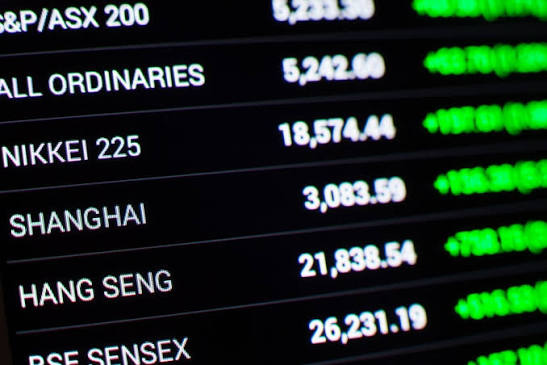
Asian stock markets mostly moved higher on Wednesday as falling oil prices eased inflation concerns and technology shares recovered ahead of Nvidia’s quarterly earnings.
Investors were also watching Thailand, where the central bank is due to announce its latest interest-rate decision.
Wall Street closed higher overnight, supported by a rebound in technology stocks. Meanwhile, U.S. equity futures were little changed during Asian trading. S&P 500 futures slipped around 0.03%, while Nasdaq 100 futures remained broadly flat.
Markets are now focused on both Nvidia earnings and the latest U.S. PCE inflation data.
Asian Tech Stocks Recover Ahead of Nvidia Earnings
The latest rebound follows a sharp decline in Asian technology stocks last week.
Higher Treasury yields and concerns about elevated AI-related valuations had pushed investors to take profits across the semiconductor sector.
Nvidia also suffered a seven-session losing streak before recovering on Wall Street ahead of its results.
The chipmaker is expected to report quarterly revenue of around $92 billion. Investors will closely examine whether the technology industry’s massive investment in artificial intelligence infrastructure is producing strong enough returns.
Asian Markets Climb as Technology Shares Rebound
The MSCI AC Asia Pacific Index rose around 1%, supported by gains across several major regional markets.
South Korea’s KOSPI jumped 2.1%, while Japan’s Nikkei 225 advanced 0.8%. The broader TOPIX gained 0.5%.
In China and Hong Kong, the Hang Seng rose 0.7%, the CSI 300 gained 1.1%, and the Shanghai Composite climbed 0.7%.
South Korean Chipmakers Lead Gains
Semiconductor stocks were among the strongest performers.
SK Hynix rose 2.8%, while Samsung Electronics gained 3.11% after both companies suffered heavy losses during last week’s semiconductor selloff.
The two companies remain particularly sensitive to Nvidia’s results because of their exposure to high-bandwidth memory chips used in AI data centers.
Japan and Taiwan Tech Shares Trade Mixed
Technology stocks in Japan and Taiwan delivered a more mixed performance.
Largan Precision surged 9.97%, Sony gained 1.8%, and TDK added 0.3%.
Taiwan Semiconductor Manufacturing Company rose 0.83%, while Kioxia fell 1% and LG Innotek declined 2%.
The moves reflected ongoing uncertainty across the semiconductor industry ahead of Nvidia’s results.
Chinese Technology Stocks Advance
Chinese technology shares also moved broadly higher.
SMIC jumped 4.4%, while Xiaomi gained 4.3%. Meituan advanced 2.2%, Tencent rose 1%, Baidu gained 1.4%, and Alibaba climbed 1.5%.
Cambricon added 2.2%, while NAURA advanced 1.3%.
Falling Oil Prices Ease Inflation Concerns
Sentiment across Asian markets was also supported by a sharp decline in crude oil prices.
Brent crude fell around 2.6% to approximately $86.25 per barrel after Iran and Oman discussed an interim framework that could restore some shipping activity through the Strait of Hormuz.
Brent has now declined around 8.5% this week.
The fall in oil prices has reduced concerns that the Middle East conflict could trigger another major inflation shock.
Australia Inflation Raises RBA Rate-Hike Bets
Australia remained an exception to the broader positive market trend.
Consumer prices increased 3.5% year over year in July, exceeding forecasts for 3.3%.
Trimmed mean inflation remained at 3.6%, also above market expectations.
The stronger inflation data encouraged traders to increase expectations for another Reserve Bank of Australia rate hike in September.
Australian government bond yields moved higher following the report, while the Australian dollar strengthened.
The S&P/ASX 200 slipped around 0.2%, underperforming most other Asian markets.
Thailand Interest-Rate Decision in Focus
Investors are also awaiting the latest policy decision from the Bank of Thailand.
The central bank is widely expected to keep its benchmark interest rate unchanged at 1% after leaving rates steady at its previous meeting in June.
Any change in policy guidance could influence the Thai baht and regional market sentiment.
PCE Inflation and Jackson Hole Remain Key Catalysts
Outside Asia, traders are preparing for the latest U.S. Personal Consumption Expenditures inflation report.
The PCE index is the Federal Reserve’s preferred inflation measure and could influence expectations for future U.S. interest-rate decisions.
Attention will then shift to Fed Chair Kevin Warsh’s speech at Jackson Hole on Friday, where investors will look for clues about the direction of monetary policy.
Lower oil prices have already helped push U.S. Treasury yields lower.
The 10-year Treasury yield traded near 4.63% after falling around 6.5 basis points on Tuesday.
Government bonds in Japan and New Zealand also gained, while Australian yields moved in the opposite direction following the hotter-than-expected inflation report.