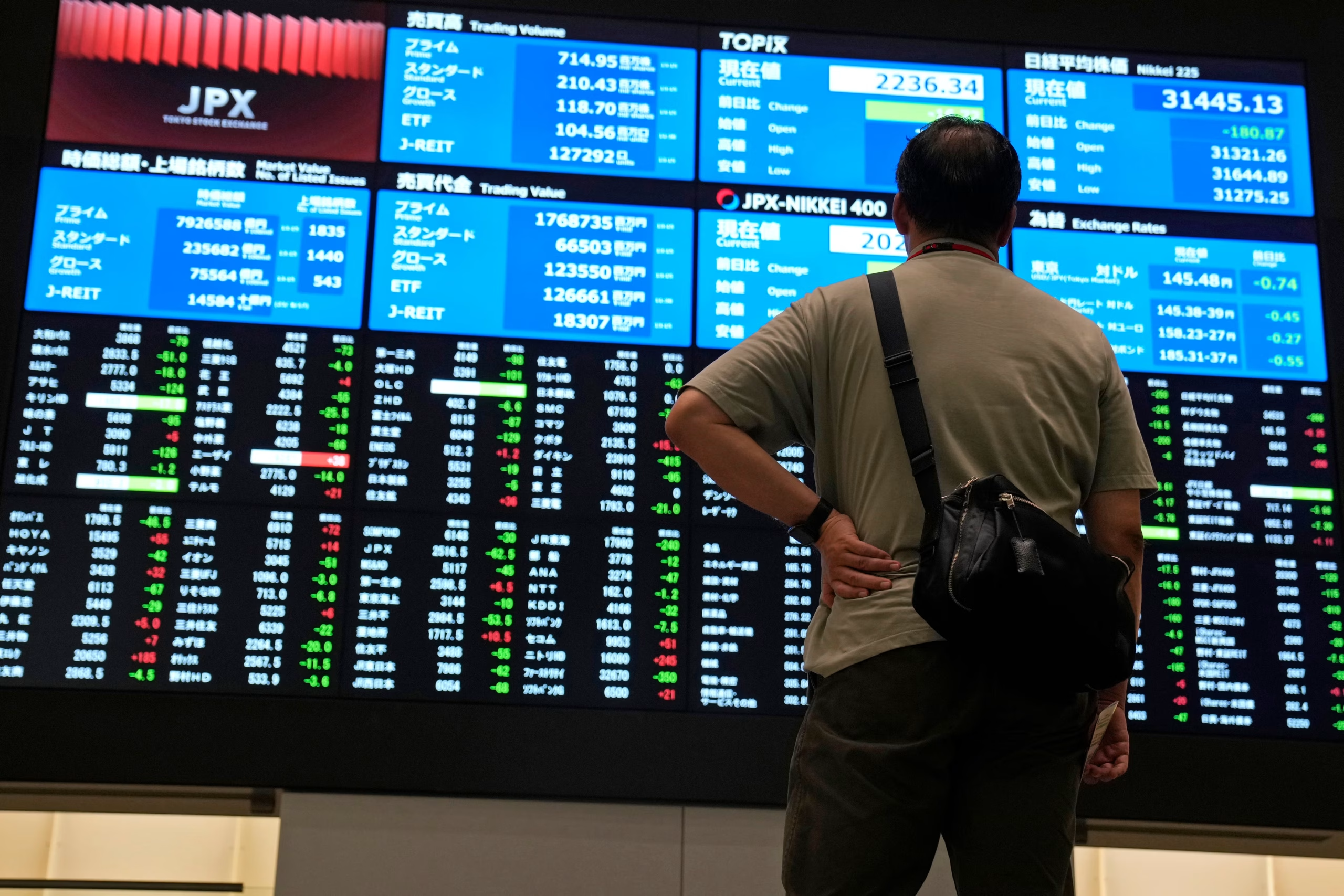
Asian stocks rebounded strongly on Wednesday as upbeat earnings from SpaceX and Super Micro Computer restored investor confidence in artificial intelligence and semiconductor companies.
The recovery followed last week’s technology selloff, which raised concerns about AI valuations and the sustainability of massive investments in computing infrastructure.
South Korean and Taiwanese semiconductor stocks led the gains, supported by renewed optimism about global demand for advanced chips and AI servers.
However, rising oil prices and geopolitical tensions in the Middle East continued to threaten the broader market outlook.
Brent crude traded above $110 per barrel as supply disruptions near the Strait of Hormuz and declining US oil inventories intensified inflation concerns.
Asian Stock Markets Rally as AI Optimism Returns
Asian equities advanced after a mixed session on Wall Street, where stronger corporate earnings provided some relief to technology investors.
The Dow Jones Industrial Average gained 1%, while the S&P 500 advanced 0.3%. The Nasdaq Composite finished the session largely unchanged.
Meanwhile, US stock futures moved higher during Asian trading.
Nasdaq 100 futures climbed 1%, while S&P 500 futures increased 0.4%, reflecting renewed demand for technology-related investments.
The positive sentiment followed stronger-than-expected financial results from SpaceX and an upbeat preliminary business update from Super Micro Computer.
SpaceX shares surged 8.1% in extended trading, while Super Micro jumped approximately 16%.
However, Netflix shares dropped nearly 6% after the streaming company issued weaker-than-expected fourth-quarter guidance despite exceeding third-quarter earnings expectations.
South Korea and Taiwan Lead Semiconductor Stock Recovery
The recovery was particularly strong in semiconductor-heavy Asian markets.
The MSCI Asia Pacific Index advanced 1.1%, ending a two-session losing streak.
South Korea’s KOSPI surged 3.7%, while Taiwan’s Taiex gained approximately 1.4%.
Japanese equities also participated in the rebound, with both the Nikkei 225 and TOPIX advancing more than 1%.
Leading Asian semiconductor companies recorded notable gains:
- Samsung Electronics: Rose 7.1%.
- SK Hynix: Advanced 6.2%.
- Kioxia: Gained 3.2%.
- Murata Manufacturing: Increased 3.4%.
- Taiwan Semiconductor Manufacturing Company (TSMC): Climbed 0.8%.
- Largan Precision: Added 3.8%.
The gains reflected improving investor confidence in semiconductor demand, particularly for memory chips and advanced processors used in artificial intelligence systems.
The rebound also suggested that investors remained interested in companies benefiting directly from expanding AI infrastructure spending.
Super Micro Raises Revenue Expectations as AI Demand Surges
Super Micro Computer provided one of the strongest signals that demand for AI computing equipment remains elevated.
The US-based server manufacturer announced preliminary quarterly revenue expectations of $18.5 billion to $19.5 billion.
That was substantially above its previous guidance of $14.5 billion to $15.5 billion.
The revised forecast also exceeded analysts’ expectations, reinforcing confidence in demand for high-performance computing infrastructure.
The company attributed its improved outlook primarily to increased demand for artificial intelligence platforms.
The announcement helped reverse some of the recent selling pressure affecting semiconductor manufacturers and AI infrastructure companies.
Investors have increasingly questioned whether the industry’s substantial capital expenditure will generate sustainable financial returns.
However, Super Micro’s stronger revenue expectations provided evidence that demand for AI-related hardware remains robust.
SpaceX Earnings Strengthen Confidence in AI Investments
SpaceX also contributed to improving market sentiment after reporting stronger-than-expected third-quarter financial results.
The company generated $14.6 billion in quarterly revenue, representing an increase of 161% compared with the same period last year.
Net profit reached approximately $4.4 billion, supported by rapid expansion in its artificial intelligence operations.
The results demonstrated how AI-related computing services have become an increasingly important part of SpaceX’s business.
Strong earnings from major technology companies helped restore confidence following concerns about elevated valuations, borrowing requirements, and heavy infrastructure spending.
Nevertheless, investors continue questioning whether the rapid growth in AI-related investment can be sustained over the longer term.
AI Infrastructure Stocks Show Sharp Contrasts
Despite the broader semiconductor recovery, performance across artificial intelligence infrastructure companies remained highly uneven.
South Korean data center operator Elice Group surged approximately 30% on Wednesday, recovering from a difficult stock market debut.
The company’s shares had opened 16% below their initial offering price on Tuesday before falling as much as 33% during the session.
The subsequent rebound highlighted the extreme volatility affecting newly listed AI infrastructure businesses.
In Australia, however, data center operator NextDC plunged approximately 40% after sharply reducing its financial outlook.
The company cited delays in electricity network upgrades at its M3 Melbourne facility, which postponed the delivery of contracted computing capacity and associated revenue.
The setback forced NextDC to revise its earnings expectations and suspend discretionary development plans.
These contrasting performances highlighted the challenges facing an industry that requires substantial investment in electricity infrastructure, data centers, and advanced computing equipment.
Japan Trade Data Disappoints as Regional Markets Diverge
While technology stocks supported several Asian benchmarks, the broader regional market performance remained mixed.
Japan reported weaker-than-expected trade figures for September, adding to concerns about the country’s export-dependent economy.
Japanese exports increased 16.7% year over year, missing economists’ expectations for a 20.1% rise.
Imports also grew more slowly than anticipated, advancing 18.9% annually.
The country’s trade deficit reached 536.6 billion yen, exceeding the forecast shortfall of 181 billion yen, although it narrowed from August’s deficit.
Elsewhere, several major Asian markets recorded losses.
Hong Kong’s Hang Seng Index declined 0.2%, while mainland China’s CSI 300 fell 0.7%.
The Shanghai Composite lost 0.4%, and Australia’s S&P/ASX 200 slipped 0.1%.
However, New Zealand’s NZX 50 gained 0.7%, while Singapore’s Straits Times Index advanced 0.8%.
Indonesia’s Jakarta Composite dropped 1.12%, and futures linked to India’s Nifty 50 declined 1.1%.
CATL Shares Plunge After Disappointing Earnings
Chinese electric vehicle battery manufacturer Contemporary Amperex Technology (CATL) was among the region’s notable decliners.
CATL shares fell approximately 8% to a 15-month low after the company reported third-quarter earnings that missed market expectations.
The world’s largest electric vehicle battery manufacturer experienced its slowest profit growth in nearly two years.
Although earnings continued increasing, profitability came under pressure from rising costs, weaker Chinese automotive demand, and intensifying competition.
The disappointing results highlighted the challenges facing China’s electric vehicle supply chain as manufacturers compete for market share.
The selloff also illustrated the divergence between companies benefiting from AI-related investment and businesses exposed to slowing growth in other technology segments.
Rising Oil Prices Remain a Risk for Asian Equities
Despite the rebound in semiconductor stocks, energy market developments continued to create uncertainty for investors.
Brent crude remained above $110 per barrel as attacks near the Strait of Hormuz threatened international energy shipments.
US inventory data also indicated another decline in crude oil stockpiles, adding to concerns about tightening supply.
Higher oil prices could increase operating expenses for manufacturers and transportation companies while reinforcing inflation pressures.
For Asian economies that rely heavily on imported energy, sustained crude oil price increases could also weaken economic growth prospects.
These risks could complicate the outlook for central bank monetary policy, particularly if inflation remains elevated.
Tesla and Meta Earnings Could Determine Next Market Moves
Investor attention is now shifting toward another round of major US corporate earnings announcements.
Tesla and Meta Platforms are scheduled to report quarterly results later Wednesday, providing further insight into technology investment trends and consumer demand.
Meta’s financial results will be closely monitored for evidence that its substantial artificial intelligence spending is generating sustainable business growth.
Meanwhile, Tesla’s earnings could offer additional information about electric vehicle demand, profitability, and its broader technology strategy.
The upcoming reports may help determine whether the rebound in Asian semiconductor stocks can develop into a more sustained recovery.
With AI earnings supporting investor confidence but rising oil prices threatening the inflation outlook, Asian stock markets remain exposed to competing economic forces.
For now, stronger corporate results have provided a welcome recovery for chipmakers following recent market turbulence.