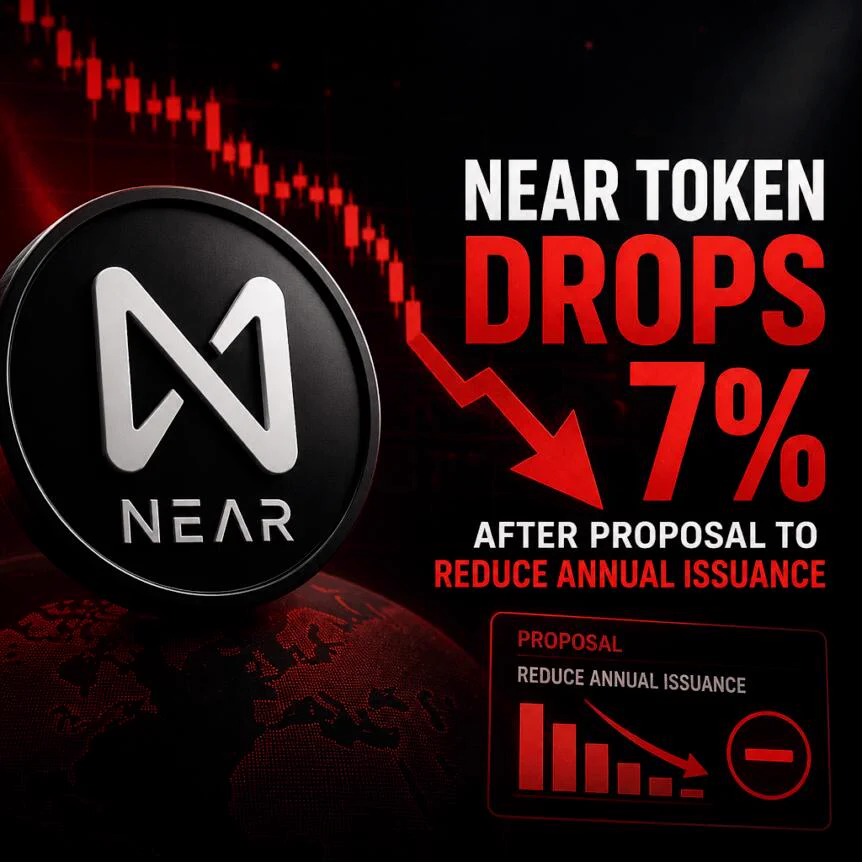
NEAR Protocol’s native cryptocurrency experienced a sharp decline on Tuesday, November 3, despite overwhelming community support for a proposal designed to reduce future token issuance and limit supply inflation.
The NEAR price dropped approximately 7% to $3.82 as of 11:06 a.m. UTC, according to CoinMarketCap. The latest selloff extended the token’s weekly losses to around 13%.
The decline came shortly after the NEAR community approved a significant tokenomics proposal that could reduce the number of new tokens entering circulation over the coming years.
NEAR Price Falls 7% Despite Token Issuance Reduction Vote
NEAR Protocol investors faced renewed selling pressure even as the project’s decentralized governance community supported changes intended to improve the cryptocurrency’s long-term supply dynamics.
On Monday, November 2, the NEAR House of Stake governance platform approved proposal HSP-029, which aims to gradually reduce the network’s maximum annual token issuance rate.
Under the proposed changes, annual issuance would decline from 2.5% to 1.6% over a 24-month period.
The initiative received overwhelming approval, securing approximately 99.9% of participating voting power.
According to governance data, around 3.28 million vote-escrowed NEAR (veNEAR) tokens supported the proposal.
The result demonstrated strong backing among participating governance members for reducing token inflation.
However, the positive governance outcome failed to prevent the NEAR price from falling, highlighting the difference between long-term tokenomics improvements and short-term cryptocurrency market performance.
NEAR Protocol Plans to Reduce Token Supply Inflation
The central objective of HSP-029 is to slow the creation of new NEAR tokens, potentially reducing dilution for existing holders.
Token dilution occurs when additional cryptocurrency units enter circulation, increasing total supply and reducing each existing token’s proportion of that supply.
By lowering the maximum annual issuance rate, NEAR Protocol aims to establish a more restrictive supply growth schedule.
According to the proposal’s estimates, the changes would prevent approximately 11.8 million additional NEAR tokens from being issued over the first two years compared with the existing model.
At the reported market price of $3.82, that difference would represent approximately $45 million in token value.
Over a six-year period, the cumulative reduction in issuance could reach 66.1 million NEAR.
These projections suggest that the proposed adjustment could have a meaningful impact on the cryptocurrency’s longer-term supply dynamics.
However, lower issuance does not automatically guarantee higher market prices, as investor demand and broader cryptocurrency market conditions remain important factors.
NEAR Staking Rewards Expected to Decline
Although reducing token issuance could benefit holders by limiting future supply growth, the proposal also introduces a trade-off for participants earning staking rewards.
Under the current framework, projected gross staking yields are approximately 5.2%.
If HSP-029 is fully implemented, those yields are expected to decline gradually to around 3.3% by the end of the 24-month transition.
Staking allows cryptocurrency holders to participate in network security and validation while earning rewards.
Because those rewards are partly funded through newly issued tokens, reducing issuance also affects the amount available for distribution.
The proposed reduction could therefore lower staking income for some participants, even as it reduces dilution across the network.
Actual staking returns may differ from these projections depending on network participation and other operating conditions.
NEAR Governance Proposal Still Faces Final Approval Process
Despite receiving overwhelming support from governance participants, HSP-029 has not yet taken effect.
The proposal must first pass a 14-day review period during which the NEAR House of Stake Security Council can exercise its veto authority.
If no veto occurs, the proposal can proceed toward ratification.
A 90-day grace period would then follow before the scheduled issuance reduction begins.
The implementation process also requires network validators to adopt the necessary technical upgrade.
Validators play an essential role in processing transactions and maintaining the blockchain’s security.
Their participation is therefore necessary to introduce the revised issuance mechanism across the network.
Until these requirements are completed, the existing issuance framework remains in place.
What the Issuance Cut Could Mean for NEAR Investors
The approval of HSP-029 represents an important step in NEAR Protocol’s efforts to adjust its token economics.
A gradual reduction in annual issuance could improve long-term supply conditions by limiting the creation of additional tokens.
However, investors must also consider the potential reduction in staking rewards and the uncertainty surrounding implementation.
The immediate market reaction suggests that governance approval alone was insufficient to reverse NEAR’s recent downward price momentum.
With the cryptocurrency losing approximately 7% in a single session and 13% over the preceding week, traders will likely continue monitoring market sentiment alongside developments in the governance process.
The next important milestones include completion of the Security Council review, formal ratification and adoption of the required validator upgrade.
Ultimately, the proposed issuance reduction could reshape NEAR Protocol’s long-term tokenomics, but its impact on the token’s market value will depend on demand, network adoption and broader cryptocurrency market conditions.