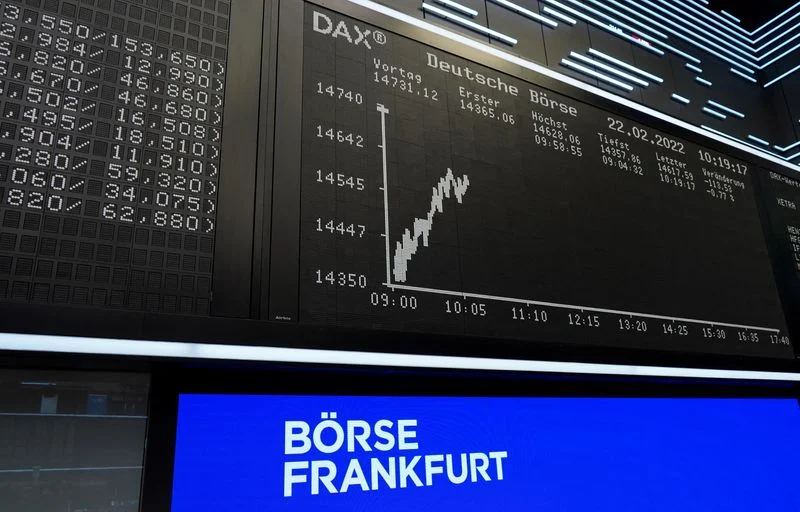
European stocks declined on Tuesday, October 27, as a sharp selloff in HSBC shares and persistent concerns about energy-driven inflation overshadowed renewed optimism surrounding artificial intelligence.
The pan-European STOXX 600 index fell 0.43%, reversing part of Monday’s recovery as investors assessed corporate earnings and prepared for major central bank decisions.
Germany’s DAX slipped 0.2%, while France’s CAC 40 declined 0.4%. Meanwhile, London’s FTSE 100 lost approximately 1%, pressured by weakness in banking stocks.
Despite a technology-led rally across Wall Street and Asian markets, European equities struggled to gain momentum.
European Stocks Fall Despite Renewed AI Market Optimism
Global equity markets received support from renewed enthusiasm for artificial intelligence following Anthropic’s announcement of its planned initial public offering (IPO).
The AI company’s regulatory filing helped revive investor interest in technology stocks after recent concerns about elevated valuations and substantial infrastructure spending.
However, European markets largely missed the recovery.
Unlike the United States, Europe’s major stock indexes have relatively limited exposure to large technology companies. Consequently, European equities have benefited less from the global AI investment boom.
The STOXX 600 has gained approximately 8% in 2026, compared with an advance of more than 12% for the technology-heavy S&P 500.
Nevertheless, selected European semiconductor companies recorded strong gains.
Shares of BE Semiconductor Industries surged approximately 9%, while German chipmaker Infineon Technologies advanced around 1%.
These gains reflected renewed demand for companies connected to AI infrastructure and semiconductor manufacturing.
HSBC Shares Plunge Nearly 7% Following Earnings Report
Banking stocks were among the biggest contributors to Tuesday’s European market decline.
Shares of HSBC Holdings fell more than 6%, despite the banking giant reporting higher third-quarter pretax profits.
Investors focused instead on disappointing underlying business developments, particularly slower revenue growth in HSBC’s wealth management division.
The bank’s operating costs and weaker-than-expected revenue performance also raised concerns about profitability.
As a result, the financial sector came under pressure, weighing particularly heavily on London’s FTSE 100 index.
HSBC’s decline highlighted how investors are increasingly examining the quality of corporate earnings rather than focusing exclusively on headline profit growth.
The results also arrived during a busy European earnings season.
Approximately 30% of STOXX 600 companies are scheduled to report quarterly financial results this week, potentially creating additional volatility across regional stock markets.
Novartis Gains as Stronger Outlook Supports Healthcare Stocks
While banking shares declined, pharmaceutical companies provided some support to European equities.
Swiss healthcare giant Novartis gained approximately 2.1% after raising its full-year outlook for core operating income.
The improved forecast strengthened investor confidence in the company’s earnings prospects.
Healthcare stocks are often considered relatively defensive investments because demand for essential medical products tends to remain more stable during economic uncertainty.
Consequently, Novartis helped offset some of the losses recorded elsewhere in the European market.
However, its gains were insufficient to reverse the broader decline in regional stock indexes.
Federal Reserve and ECB Rate Decisions Take Center Stage
Beyond corporate earnings, European investors are preparing for several important monetary policy announcements.
The US Federal Reserve is widely expected to maintain its benchmark interest rate within the 3.75% to 4.00% range when its two-day meeting concludes on Wednesday, October 28.
Meanwhile, the European Central Bank (ECB) is expected to leave its deposit facility rate unchanged at 2.50% during Thursday’s policy announcement.
Although both institutions are expected to keep interest rates steady, investors will closely monitor their statements for clues about future monetary policy.
In particular, comments from ECB President Christine Lagarde could influence expectations for European borrowing costs.
Persistent inflation remains a major concern as elevated energy prices continue to affect businesses and households.
Therefore, financial markets are paying close attention to whether central banks will maintain restrictive monetary conditions for longer than previously anticipated.
Rising Energy Prices Fuel European Inflation Concerns
Higher natural gas and crude oil prices remain significant risks for Europe’s economic outlook.
The ongoing geopolitical uncertainty in the Middle East has increased concerns about energy supply disruptions and the potential for renewed inflationary pressure.
European businesses are particularly sensitive to changes in energy costs, which can affect manufacturing expenses, transportation and consumer prices.
Furthermore, sustained increases in energy prices could eventually influence wages and other business costs, creating additional inflationary pressures across the eurozone.
ECB policymakers have warned about the possibility of these broader effects becoming embedded in the economy.
According to the market pricing cited in the report, interest rate swaps indicated an approximately 80% probability of a 25-basis-point ECB rate increase in December.
However, these expectations remain sensitive to upcoming inflation data, energy market developments and central bank guidance.
European Stock Market Outlook: Earnings and Inflation in Focus
The latest decline in European stocks highlights the competing forces influencing regional financial markets.
Although renewed enthusiasm for artificial intelligence has supported global technology shares, European benchmarks remain more exposed to traditional sectors such as banking, industrials and healthcare.
Meanwhile, HSBC’s disappointing revenue performance has reinforced concerns about corporate earnings, despite the bank’s increase in headline profits.
Investors will now focus on upcoming quarterly results, Federal Reserve and ECB policy announcements, and developments in global energy markets.
Further increases in oil and natural gas prices could strengthen inflation concerns and complicate expectations for future interest rate cuts.
Conversely, encouraging corporate earnings and signs of easing inflation could help improve sentiment toward European equities.
For now, European stock markets remain under pressure as investors balance renewed AI optimism against banking sector weakness, elevated energy costs and uncertainty surrounding monetary policy.