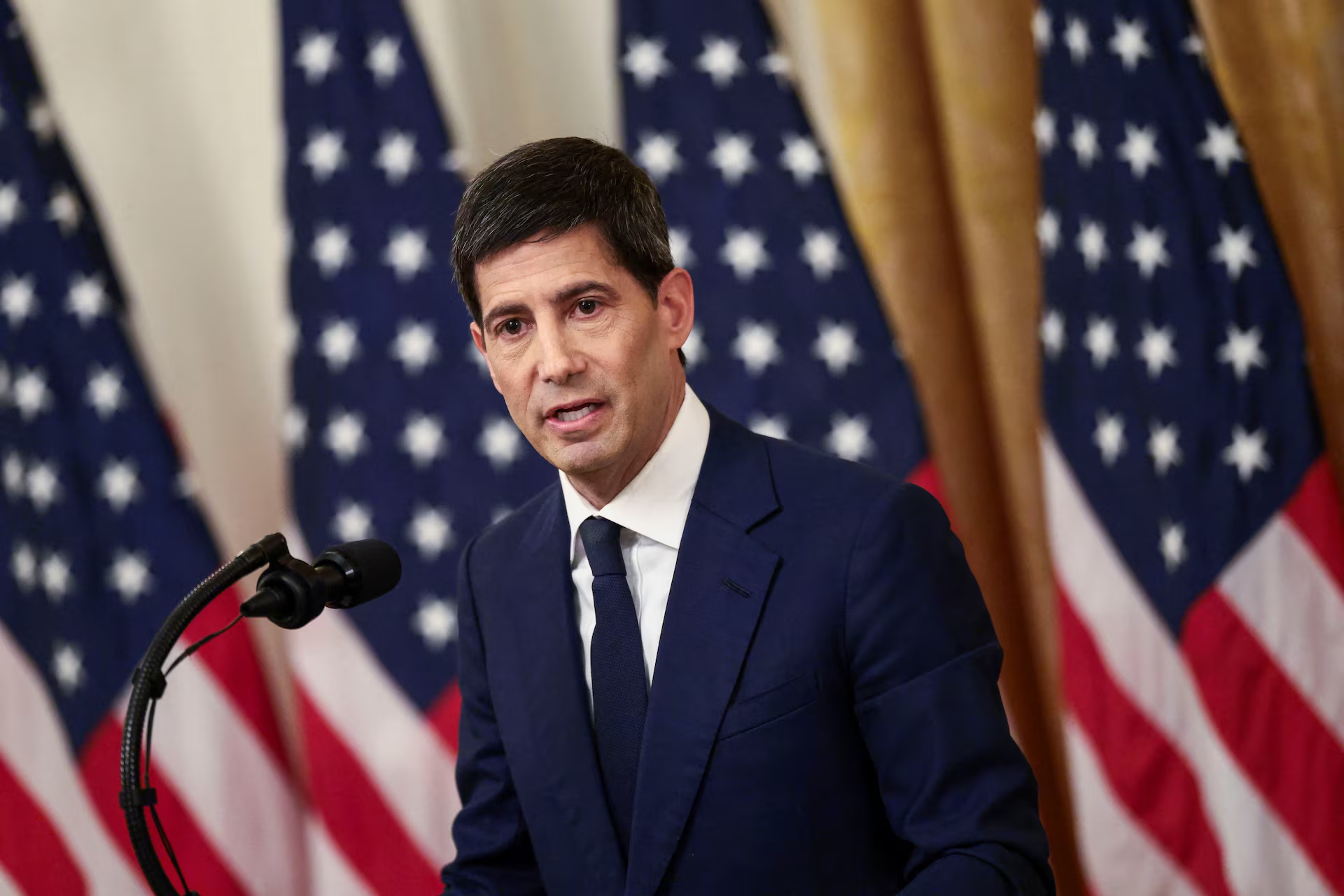
Federal Reserve Chair Kevin Warsh believes the artificial intelligence boom could significantly accelerate economic growth and productivity in the coming years. However, he cautioned that the transition toward an AI-driven economy could create considerable uncertainty for businesses, workers and monetary policymakers.
Speaking on Friday at an International Monetary Fund (IMF) event in Bangkok, Warsh described artificial intelligence as one of the most transformative economic developments of his lifetime.
While emphasizing AI’s long-term potential, he also reaffirmed the Federal Reserve’s commitment to controlling inflation and maintaining price stability.
AI Boom Could Deliver Major Productivity Gains
Warsh expressed optimism that artificial intelligence could eventually create a powerful positive supply shock, enabling businesses to produce more goods and services with greater efficiency.
According to the Fed Chair, AI investment is currently stimulating economic demand as companies spend heavily on technology, infrastructure and computing capabilities.
However, the longer-term benefits are expected to emerge through improvements in productivity and the economy’s overall productive capacity.
Such developments could potentially support stronger economic growth without necessarily generating the same inflationary pressures associated with traditional demand-driven expansion.
Warsh emphasized that artificial intelligence represents a fundamental transformation for both the U.S. and global economies.
Nevertheless, he warned that the economic benefits may take time to materialize, making the transition particularly challenging for policymakers.
Federal Reserve Warns of AI-Related Economic Disruption
Despite his optimistic outlook, Warsh acknowledged that the rapid adoption of artificial intelligence could create significant disruptions across multiple sectors.
Employment patterns, business models and competitive conditions may undergo substantial changes as companies integrate increasingly advanced AI technologies into their operations.
The transition could also produce uneven results, with some businesses benefiting significantly while others struggle to adapt.
Consequently, policymakers must carefully evaluate how artificial intelligence affects employment, inflation, productivity and financial stability.
These uncertainties could complicate traditional economic forecasting, particularly if technological improvements begin influencing supply and demand at different speeds.
Warsh suggested that central bankers must remain flexible and reconsider established assumptions as the global economy evolves.
Fed Remains Focused on Inflation and Interest Rate Policy
Although artificial intelligence could strengthen the economy’s long-term growth potential, the Federal Reserve remains committed to restoring price stability.
Warsh highlighted the central bank’s decision to withdraw some monetary accommodation during its September policy meeting as evidence of its determination to address persistent inflation.
However, he avoided providing specific guidance about future interest rate decisions.
Instead, the Fed Chair emphasized that policymakers would evaluate incoming economic information before determining their next steps.
Developments in employment, economic output and inflation will remain central to monetary policy discussions during the remaining Federal Reserve meetings of 2026.
Warsh also identified elevated inflation as a shared challenge for central banks worldwide.
Despite differences in national economic conditions, he argued that monetary authorities have demonstrated a strong commitment to maintaining price stability.
U.S. Investment Boom Supports Economic Growth Outlook
Beyond artificial intelligence, Warsh pointed to a broader increase in investment activity as an important source of strength for the U.S. economy.
He noted that substantial capital spending across multiple industries was helping support economic expansion.
This investment momentum could provide additional support for growth even as businesses and consumers adjust to changing financial conditions.
Warsh also acknowledged that the global economy had demonstrated greater resilience than he anticipated several months earlier.
Despite ongoing geopolitical conflicts, trade uncertainties and other international challenges, economic activity has remained relatively robust.
The combination of strong investment and technological innovation could therefore create favorable conditions for medium-term economic expansion.
However, the Fed Chair cautioned that policymakers should remain attentive to risks arising from structural changes and shifting economic relationships.
Fed to Examine Artificial Intelligence’s Impact on Jobs
The Federal Reserve is expanding its examination of artificial intelligence and its implications for the economy.
The central bank has established external task forces to explore how emerging technologies could influence productivity, employment and other important economic indicators.
One initiative focused on productivity and jobs is scheduled to hold its first field hearing in the San Francisco Bay Area on November 16, 2026.
The discussions are expected to help policymakers better understand how businesses and workers are adapting to technological developments.
By gathering insights from outside traditional central banking circles, the Federal Reserve hopes to improve its understanding of AI-driven economic transformation.
AI Economic Outlook: Strong Potential but an Uncertain Transition
Warsh’s remarks highlighted the opportunities and challenges associated with the accelerating adoption of artificial intelligence.
While the technology could eventually boost productivity, expand productive capacity and support stronger economic growth, its short-term effects remain difficult to predict.
Changes in employment, corporate competitiveness and financial markets could create additional uncertainty as the technology becomes more widely adopted.
For the Federal Reserve, the challenge will be understanding these developments while continuing to pursue its primary monetary policy objectives.
Warsh stressed the importance of questioning conventional economic assumptions and remaining receptive to new ideas.
Ultimately, the AI boom could become a powerful driver of future economic prosperity, but the transition toward that outcome may involve considerable volatility and difficult policy decisions.