Gold prices edged higher on Monday, approaching the closely watched $4,200 level as investors weighed geopolitical developments and growing inflation concerns.
Market sentiment remained divided after US President Donald Trump announced an immediate energy ceasefire between Russia and Ukraine. Meanwhile, renewed attacks in the Middle East raised concerns about further disruptions to global energy supplies.
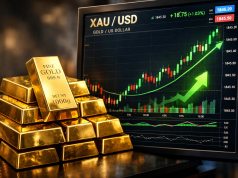
Spot gold (XAU/USD) gained 0.1% to $4,199.72 per ounce by 00:35 ET (04:35 GMT). Gold futures also advanced 0.2% to $4,223.42.
Other precious metals recorded gains during the session. Silver climbed 0.4% to $61.08 per ounce, while platinum rose 0.8% to $1,702.20.
Palladium increased 0.7% to $1,159.70 per ounce, while palladium futures advanced 0.65% to $1,157.50.
Meanwhile, the US Dollar Index slipped 0.04% to 102.17, and Brent crude oil prices declined 1.2%.
The modest increase in gold followed a 1.3% gain during the previous week.
Gold Prices React to Russia-Ukraine Energy Ceasefire Hopes
Gold traders closely monitored developments surrounding a potential energy agreement between Russia and Ukraine.
President Trump announced that an energy ceasefire had taken effect immediately, raising expectations of improved stability in global fuel markets.
Previously, Trump had urged Ukrainian President Volodymyr Zelenskyy to suspend attacks on Russian oil refineries.
The US president also stated that Moscow had agreed to release additional diesel supplies into international markets.
Such developments could help ease concerns about fuel shortages and reduce pressure on global energy prices.
However, uncertainty surrounding the implementation of the ceasefire remains an important consideration for financial markets.
Although lower oil prices could ease inflation expectations, geopolitical tensions elsewhere continue to complicate the outlook for gold.
Middle East Conflict Raises Inflation and Energy Supply Risks
Despite hopes for progress in Eastern Europe, escalating violence in the Middle East continued to threaten regional energy security.
Saudi Arabia’s King Khalid International Airport in Riyadh reportedly came under another attack by Houthi rebels on Sunday.
The incident followed a deadly strike on Saturday that reportedly killed 12 people and injured more than 300.
Saturday’s attack was described as the deadliest incident in Saudi Arabia since the conflict involving Iran began in late February.
The Houthis claimed their operations were retaliation for Saudi military actions, including an attack targeting the airport in Yemen’s capital, Sanaa.
The latest developments have intensified concerns that the conflict could expand further across the region.
Such an escalation could disrupt energy production and transportation, potentially driving oil prices higher.
Consequently, renewed increases in energy costs could add to global inflation pressures and influence central bank monetary policy.
Why Higher Interest Rates Could Pressure Gold
Although gold traditionally benefits from geopolitical uncertainty, rising interest rates can limit its upside potential.
Unlike government bonds or savings accounts, gold does not generate interest income.
Therefore, higher borrowing costs and bond yields can make income-producing investments more attractive than precious metals.
Since the US-Iran conflict began in late February, gold has reportedly lost approximately 20% of its value, despite its recent recovery.
The decline reflects concerns that rising energy costs could keep inflation elevated and encourage central banks to maintain restrictive monetary policies.
Some central banks have already raised interest rates in response to persistent inflation risks.
For gold investors, the Federal Reserve’s next policy decisions remain particularly important.
Further monetary tightening could strengthen the appeal of yield-bearing assets and create additional pressure on gold prices.
Conversely, easing inflation expectations could improve the outlook for the precious metal.
Gold ETF Inflows Reach Four-Year High
Despite the challenges posed by interest rate expectations, investment demand continues to provide support for gold.
Analysts at ANZ highlighted stronger investor interest in the precious metal, particularly through gold-backed exchange-traded funds (ETFs).
According to Bloomberg data cited by the bank, inflows into gold ETFs have reached their highest level in four years.
The increase suggests that investors continue to seek exposure to gold amid uncertainty surrounding global economic conditions.
ANZ analysts linked the growing demand to concerns about government finances, rising debt-servicing costs and changes in money supply.
These factors have increased interest in gold as a potential store of value during periods of financial instability.
However, strong investment demand does not eliminate the risks associated with tighter monetary policy.
China’s Central Bank Extends Gold Buying Streak
Central bank purchases have provided another important source of support for the gold market.
The People’s Bank of China continued expanding its gold reserves during September, adding approximately 740,000 ounces.
The purchase marked the central bank’s 23rd consecutive month of gold accumulation.
China’s sustained buying reflects the continued importance of precious metals in official reserve management.
Central banks can use gold to diversify their reserve assets and reduce reliance on individual currencies.
Persistent official-sector demand may help support gold prices, particularly during periods of geopolitical and economic uncertainty.
Nevertheless, ANZ warned that additional inflation pressures could limit gold’s recovery if they prompt the Federal Reserve to raise interest rates further.
As a result, investors must balance strong central bank demand against the possibility of tighter financial conditions.
Gold Price Outlook: Can XAU/USD Break Above $4,200?
Gold remains close to the psychologically important $4,200 per ounce level, with geopolitical uncertainty and monetary policy expectations shaping its near-term direction.
A sustained move above $4,200 could strengthen short-term market confidence and encourage additional buying interest.
However, the outlook remains complicated by several competing factors.
Progress toward a Russia-Ukraine energy ceasefire could ease fuel supply concerns and reduce inflation expectations.
Meanwhile, escalating tensions in the Middle East could push energy prices higher and increase the risk of further monetary tightening.
Strong gold ETF inflows and continued central bank purchases may provide support, but elevated interest rates remain a potential obstacle.
Looking ahead, traders will closely monitor geopolitical developments, oil prices, US inflation indicators and Federal Reserve expectations.
For now, gold prices remain near $4,200 as investors weigh safe-haven demand against the possibility of higher interest rates and persistent inflation.