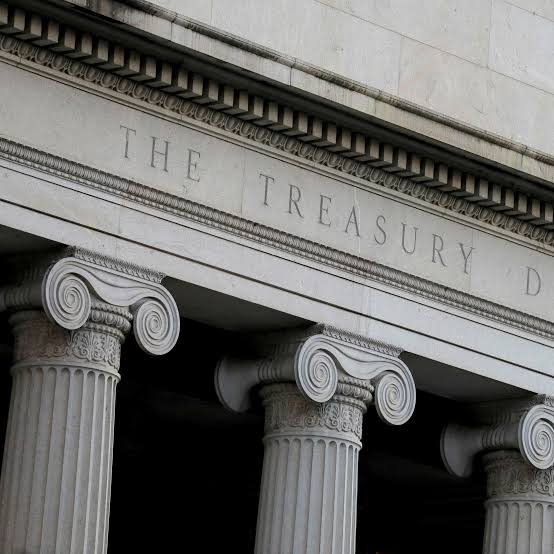
U.S. Treasury yields fell sharply across the middle of the yield curve on Friday after weaker-than-expected September employment data reduced expectations for aggressive Federal Reserve rate hikes.
The benchmark U.S. 10-year Treasury yield dropped by around 6 basis points, falling from 5.23% to approximately 5.17% shortly after the labor-market report was released.
U.S. Treasury Yields React to Weak Jobs Data
At the shorter end of the curve, the two-year Treasury yield remained near 4.78% after experiencing significant declines in previous sessions.
Meanwhile, the 30-year Treasury yield moved slightly higher, rising from around 5.59% to 5.61%.
The different moves across the Treasury curve reflected changing expectations for Federal Reserve policy as well as continued supply pressure on longer-dated bonds.
September Payrolls Miss Expectations
The decline in the U.S. 10-year Treasury yield followed a much weaker September jobs report.
Nonfarm payrolls increased by just 29,000 during the month, significantly below market expectations of around 89,000.
The unemployment rate also increased to 4.2%, up from 4.1% in August.
The softer labor-market figures provided further evidence that tighter monetary conditions may be beginning to slow hiring activity across the U.S. economy.
Higher energy costs may also be contributing to weaker corporate hiring plans.
Softer Data Reduces Fed Rate Hike Expectations
The latest employment figures followed weaker-than-expected Personal Consumption Expenditures inflation data.
Together, the two reports provided some relief for bond investors following a difficult third quarter for fixed-income markets.
Several Federal Reserve policymakers have also recently suggested that the central bank can remain patient before deciding whether additional monetary tightening is necessary.
Officials indicated that more economic data could be evaluated before another rate increase is considered.
Markets Expect Fed to Hold Rates Steady
Following the weaker employment data, traders reduced expectations for another immediate Federal Reserve rate hike.
Markets were pricing in roughly a 72% probability that the Fed would leave interest rates unchanged at its October meeting.
That was up sharply from around 36% one week earlier.
The change in expectations highlights how quickly the outlook for monetary policy can shift in response to new inflation and employment data.
French Bond Yields Remain Under Pressure
European bond markets also remained volatile.
France’s 10-year government bond yield stayed close to its highest level since 2002, trading around 4.96%.
French yields were heading toward a fifth consecutive weekly increase as investors remained concerned about the country’s fiscal outlook.
The government’s draft 2027 budget failed to fully reassure markets over its ability to reduce a deficit projected at approximately 5.4% of GDP.
French-German Bond Spread Widens
The yield premium investors demand to hold French 10-year bonds instead of comparable German government debt widened above 140 basis points.
That represented one of the largest spreads seen since the eurozone sovereign debt crisis more than a decade ago.
The widening gap reflects growing concern about French public finances and the additional risk investors associate with holding the country’s debt.
German Bond Yields Fall on Safe-Haven Demand
Germany’s 10-year government bond yield fell to around 3.48%.
German Bund yields declined for a fourth consecutive session, taking benchmark borrowing costs to their lowest level in more than a week.
The 10-year yield was also on course for its first weekly decline in eight weeks.
Investors increasingly moved toward German government debt as demand for relatively safer assets increased.
European Bond Markets Face Higher-for-Longer Rates
Eurozone bond markets experienced significant pressure during the third quarter.
Benchmark yields across the region climbed to multi-year highs as investors adjusted to expectations that interest rates could remain elevated for longer.
Persistent energy-price pressures and additional European Central Bank rate hikes contributed to the bond-market sell-off.
Geopolitical tensions in the Middle East also supported higher energy costs, adding another layer of inflationary pressure.
Eurozone Inflation Adds to ECB Challenge
Fresh inflation data added further uncertainty to the European interest-rate outlook.
Eurozone headline inflation rose to 3.8% in September, up from 3.2% in the previous month.
The increase exceeded expectations of around 3.6%.
Higher natural gas and fuel prices were the main drivers of the acceleration.
Core inflation, which excludes volatile food and energy prices, increased more modestly to 2.5% from 2.4%.
ECB Faces Mixed Inflation Signals
The relatively limited rise in core inflation could offer some reassurance to European Central Bank policymakers.
However, headline inflation remains well above the ECB’s 2% target.
That could strengthen arguments from policymakers who believe additional rate hikes may still be necessary.
For bond markets, the combination of weaker U.S. employment data and stronger eurozone inflation creates a complicated outlook.
Investors will continue monitoring labor-market data, inflation reports and central-bank guidance for clues about the direction of interest rates and government bond yields.