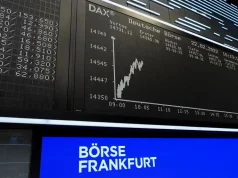
European stocks reversed early gains on Thursday after the European Central Bank raised interest rates by 25 basis points to 2.50%.
The ECB warned that rising energy prices could keep inflation elevated across the Eurozone and increase the risk of broader price pressures.
European Stocks Turn Lower After ECB Decision
The pan-European STOXX 600 initially moved higher but later fell around 0.4%, reaching session lows as investors assessed the ECB’s second interest rate hike of the year.
Germany’s DAX declined about 0.2%, while France’s CAC 40 slipped 0.1%.
The UK’s FTSE 100 fell around 0.5%, with weakness in major retail stocks outweighing support from commodity-related companies.
ECB Raises Rates to Highest Since April 2025
The ECB Governing Council increased the deposit facility rate by 25 basis points to 2.50%.
The decision pushed Eurozone borrowing costs to their highest level since April 2025.
The rate increase follows a major shift in market conditions, driven largely by a sharp rally in energy prices.
Brent crude recently climbed above $100 per barrel for the first time since July, adding to concerns about renewed inflation across Europe.
Oil Rally Adds to Eurozone Inflation Pressure
Crude oil prices have risen sharply following renewed tensions between the United States and Iran.
Oil has gained nearly 40% since the breakdown of a U.S.-Iran ceasefire in early July, creating fresh concerns for European economies that rely heavily on imported energy.
Higher energy prices can increase transportation, manufacturing and household costs, creating wider inflationary pressure throughout the economy.
Eurozone headline inflation accelerated to 3.3% in August, while energy prices increased by 14.3%.
The latest figures strengthened the case for the ECB to act against the risk of persistent inflation.
ECB Tries to Prevent Second-Round Inflation
ECB President Christine Lagarde and other policymakers are particularly concerned that higher energy costs could eventually affect wages and service prices.
If workers begin demanding higher salaries to compensate for rising living costs, inflation could become more difficult for the central bank to control.
The ECB therefore raised rates in an effort to prevent temporary energy-driven inflation from becoming embedded across the wider Eurozone economy.
Markets are already pricing in the possibility of another ECB rate hike before the end of the year.
Investors Await Further ECB Guidance
Investors are closely watching the ECB’s latest economic projections for clues about the future direction of monetary policy.
Particular attention is likely to fall on inflation forecasts for 2027.
Traders want to determine whether the latest increase is simply a response to the recent energy shock or the beginning of a longer period of monetary tightening.
Lagarde’s guidance will also be important in determining whether expectations for additional rate increases continue to strengthen.
U.S. CPI Becomes the Next Major Market Test
Attention is also shifting toward the United States, where investors are awaiting the latest Consumer Price Index report.
The U.S. CPI release will be the final major inflation report before the Federal Reserve’s September 15-16 policy meeting.
A stronger-than-expected inflation reading could reinforce expectations for tighter monetary policy and place additional pressure on global equity markets.
European Stocks See Sharp Individual Moves
Several European companies recorded significant moves during Thursday’s session.
Associated British Foods fell more than 10% after disappointing sales from its Primark fashion business weighed on investor sentiment.
Belgian holding company D’Ieteren gained around 5% following the announcement of a new chief executive.
Meanwhile, shares of Swedish property platform Hemnet dropped approximately 15% after its board decided to pause a share buyback programme worth up to 600 million Swedish crowns.
The combination of higher ECB interest rates, rising energy prices and persistent inflation concerns is likely to remain a key driver for European stocks in the coming weeks.