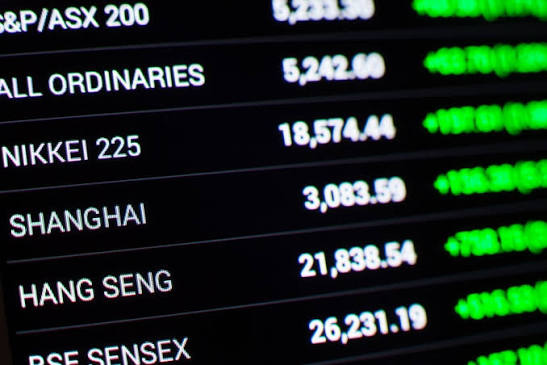
Asian markets traded mixed on Wednesday as semiconductor stocks extended their gains on continued optimism around artificial intelligence.
At the same time, oil prices moved closer to $100 per barrel, while rising geopolitical tensions increased concerns about inflation and future interest-rate decisions.
Asian Markets Track Mixed Wall Street Signals
The cautious session followed weakness on Wall Street on Tuesday.
Technology shares came under pressure as investors worried that artificial intelligence could disrupt traditional software companies.
However, semiconductor stocks moved in the opposite direction.
The Philadelphia Semiconductor Index gained 1.3%, showing that enthusiasm around AI infrastructure and chip demand remains strong.
In Asian trading, Nasdaq 100 futures rose 0.2%, while S&P 500 futures were largely unchanged.
U.S. Inflation Data Comes Into Focus
Investors are now looking ahead to Friday’s U.S. consumer price index report.
The inflation data could influence expectations for the Federal Reserve’s September 15-16 policy meeting.
Markets are currently pricing in roughly a 60% chance of a 25-basis-point interest-rate increase.
A stronger-than-expected inflation reading could increase the likelihood of tighter monetary policy.
Oil Nears $100 as Geopolitical Risks Rise
Higher oil prices are adding to inflation concerns.
Fighting in the Middle East intensified after Iran-backed Houthi forces attacked Saudi cities and U.S. forces struck Iranian tankers.
Tehran also warned tanker crews near Kuwaiti and Bahraini ports to abandon their vessels and threatened further attacks on Gulf energy infrastructure.
Brent crude has risen more than 60% this year and is approaching $100 per barrel for the first time since July.
Chip Stocks Lead Gains in Asia
South Korea’s KOSPI rose 1.5%, supported by strong gains in semiconductor companies.
Japan’s Nikkei 225 added 0.14%.
Meanwhile, Hong Kong’s Hang Seng slipped 0.2%, while China’s CSI 300 gained 0.1%.
Among major chipmakers, SK Hynix rose 3.6% and Samsung Electronics gained 0.8%.
Kioxia advanced 0.6%, while TDK climbed 1.86%.
Sony fell 0.74%, while Foxconn traded largely unchanged.
AI Trade Remains Resilient
The strength in semiconductor stocks contrasts with weakness in U.S. software shares.
OpenAI’s GPT-6 Astra has renewed concerns that artificial intelligence could disrupt established software companies.
However, investors remain optimistic about AI infrastructure.
Intel and Qualcomm surged on Tuesday after agreeing with Amazon to develop custom AI chips.
The move reinforced expectations that spending on AI hardware and data-center infrastructure will remain strong.
South Korea Growth Beats Expectations
South Korea’s economy expanded 0.6% quarter-on-quarter in the second quarter.
That was stronger than the 0.2% growth forecast.
Semiconductor exports played an important role in supporting the economy.
The data highlight how AI-related demand and chip exports are becoming increasingly important for South Korea’s growth outlook.
Japan Economy Expands as BOJ Expectations Build
Japan’s economy expanded at an annualized rate of 1.4%.
Although the figure came in below expectations, other data supported the case for tighter monetary policy.
Real wages rose 2.4% in July, strengthening expectations that the Bank of Japan could raise interest rates next week.
Investors will be watching closely for any signals about the pace of future rate hikes.
China Inflation Accelerates
Chinese stocks were mixed as investors reacted to stronger inflation data.
The Shanghai Composite gained 0.2%.
In Hong Kong, technology shares showed a mixed performance. Baidu rose 3.3% and Alibaba gained 0.6%.
Meituan fell 2.5%, while Xiaomi declined 2.1%.
Energy Costs Push China Prices Higher
China’s consumer price index rose 0.8% year-on-year in August.
On a monthly basis, CPI increased 0.4%.
Producer prices also accelerated, with the PPI rising 3.8% from a year earlier.
Higher energy and metals prices were major drivers of the increase.
However, core CPI rose just 1%, suggesting that domestic demand remains relatively weak.
Chinese Exports Remain Strong
The inflation figures followed another strong set of trade data.
Chinese exports surged 25% year-on-year in August, while imports increased 28.2%.
High-tech exports climbed 42.9% during the first eight months of the year.
The data highlight China’s increasing reliance on external demand and technology-related exports.
Australia, Singapore and India Trade Lower
Elsewhere in the region, Australia’s S&P/ASX 200 declined 0.2% after consumer sentiment weakened.
Singapore’s Straits Times Index lost 0.6%.
India’s Nifty 50 also fell 0.5%.
The mixed performance reflected a broader struggle between optimism around AI and concerns about inflation, oil prices, and global interest rates.
AI Earnings Could Set the Next Market Direction
Investors will also focus on upcoming earnings from Oracle and Adobe.
Their results could provide more clues about the strength of AI infrastructure spending.
They could also show whether artificial intelligence is beginning to place greater pressure on traditional software businesses.
For now, Asian markets remain caught between strong semiconductor momentum and rising macroeconomic risks.