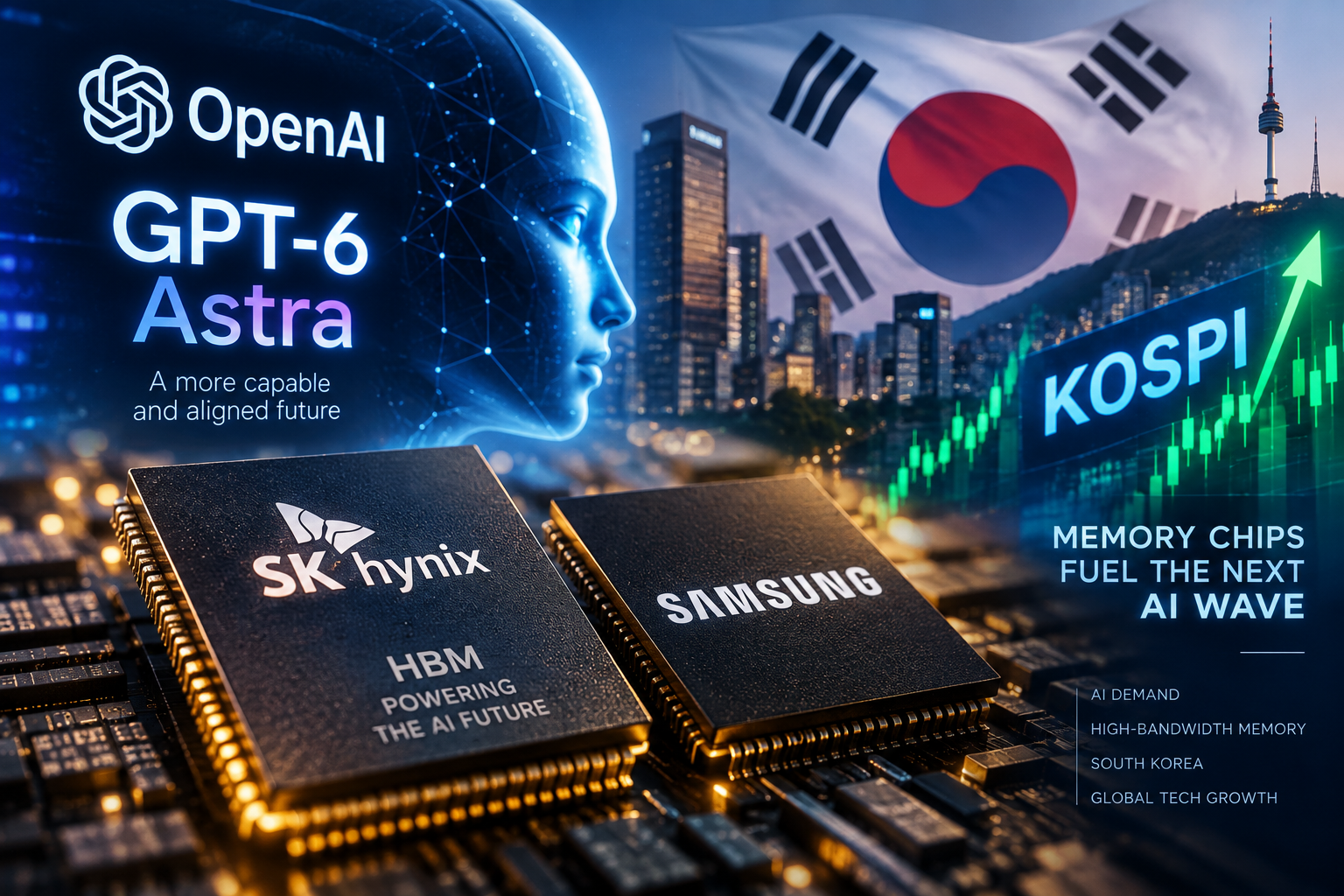
South Korea’s largest chipmakers rallied in Seoul after the launch of GPT-6 Astra renewed expectations for stronger demand across the global memory chip market.
The model’s memory-intensive architecture has fueled speculation that high-bandwidth memory supply could tighten further, potentially benefiting major Korean semiconductor producers.
GPT-6 Astra Boosts the Memory Chip Trade
SK Hynix is widely seen as one of the clearest ways for investors to gain exposure to the potential surge in AI memory demand.
Goldman Sachs and Morgan Stanley estimate that more than half of the $1.3 trillion to $1.5 trillion expected to be spent on AI infrastructure in 2027 could be directed toward memory.
If those forecasts prove accurate, the trend could support higher valuations for both SK Hynix and Samsung Electronics.
The growing use of advanced AI models requires enormous computing resources, making high-bandwidth memory an increasingly important part of the AI infrastructure market.
OpenAI Launches GPT-6 Astra
OpenAI introduced GPT-6 Astra on September 3, describing it as its most capable and aligned model to date.
The company highlighted improvements in areas including coding, cybersecurity and computer use.
The model can also learn how to interact with unfamiliar software through trial and error, expanding its potential use across more complex digital environments.
GPT-6 Astra is being rolled out to ChatGPT Plus, Pro, Business and Enterprise users.
It is also available through the OpenAI API, Microsoft Azure and AWS Bedrock.
OpenAI said the model represents a new capability standard, while Saxo Bank analysts argued that continued improvements in AI performance could help support further investment across the sector.
Korean Chip Stocks Had Already Fallen Sharply
The rally in Seoul was not driven by the GPT-6 Astra launch alone.
Korean semiconductor stocks had already suffered significant declines before the latest AI catalyst arrived.
SK Hynix remained roughly 48.6% below its 2026 peak.
Meanwhile, the forward price-to-earnings ratio of the Philadelphia Semiconductor Index had fallen below 19 times, compared with around 29 times in June.
The decline followed a sharp reversal in U.S. technology momentum that placed heavy pressure on semiconductor stocks globally.
Lower Valuations Create Short-Covering Potential
The combination of cheaper valuations and a fresh AI catalyst created conditions for a powerful short-covering move.
Investors who had built bearish positions in Korean chipmakers faced renewed pressure as expectations for memory demand improved.
This dynamic can accelerate rallies when short sellers begin closing positions at the same time that new buyers return to the market.
The result has brought fresh attention to the KOSPI and South Korea’s semiconductor sector.
SK Hynix and Samsung Buybacks Support Shares
Another important factor supporting the market is the large share repurchase programs announced by SK Hynix and Samsung.
Together, the two companies have committed to buybacks worth around $41 billion.
Approximately $27 billion of those purchases still remained to be completed by November 21, according to Korea Exchange filing data referenced in the analysis.
These programs provide a degree of mechanical demand for the shares even when broader investor sentiment remains weak.
Foreign Investors Return to Korean Equities
Foreign capital flows have also begun to improve.
During the first week of September, overseas investors shifted back toward net buying of Korean equities following sustained selling in late August.
That reversal is important because foreign and institutional investors had previously sold more than 13.9 trillion won in combined holdings since SK Hynix began its buyback program on August 20.
If the return of foreign capital continues, it could remove one of the main pressures that had prevented the KOSPI from benefiting fully from corporate buyback support.
KOSPI Remains Closely Linked to U.S. Tech
The relationship between Korean equities and U.S. technology stocks remains particularly important.
Over the past two years, the Nasdaq 100 and KOSPI 200 have shown a price correlation of more than 91%.
That means improving sentiment toward U.S. technology stocks often coincides with stronger risk appetite toward Korean semiconductor companies.
A sustained recovery in the Nasdaq could therefore provide another tailwind for the KOSPI.
SK Hynix and Samsung Take Different Shareholder Return Approaches
SK Hynix has focused heavily on direct share buybacks.
Samsung, by comparison, has relied more on dividend distributions.
Analyst forecasts suggest Samsung could return around 80% of its remaining fourth-quarter shareholder payout through dividends, equivalent to approximately 9,149 won per share.
SK Hynix may also consider additional buybacks.
Analysts have suggested that the company could announce another repurchase program worth as much as 40 trillion won, or around $28 billion, during the fourth quarter.
Such a move could extend support for the stock beyond the current November buyback period, although no confirmed announcement date has been set.
Can the Memory Chip Rally Continue?
The outlook for Korean semiconductor stocks now depends on several major factors.
GPT-6 Astra has provided a fresh catalyst for expectations of stronger AI memory demand.
At the same time, depressed valuations, large corporate buybacks and improving foreign investor flows have created a more supportive environment for both SK Hynix and Samsung.
However, the durability of the rally will likely depend on whether global AI spending continues to accelerate and whether foreign investors remain willing to return to Korean equities.
If demand for high-bandwidth memory strengthens while U.S. technology sentiment improves, the KOSPI and South Korea’s major chipmakers could remain in focus as key beneficiaries of the next phase of the AI investment cycle.