Investor confidence across global equity markets is beginning to weaken as capital flows deteriorate and risk appetite cools, according to Citi’s latest market positioning analysis.
Despite softer flows, overall investor positioning has remained relatively resilient. However, Citi strategists believe declining exposure beneath the surface suggests investors are becoming increasingly cautious.
Global Equity Flows Show Signs of Weakening
Citi said positioning in U.S. equities remains moderately bullish. However, gross exposure has continued to decline, indicating that investors are reducing risk even though overall positioning has not changed dramatically.
The situation appears weaker in Europe, where equity flows deteriorated more noticeably during the latest reporting period.
Meanwhile, bearish positioning has continued to increase across several Asian equity markets. The KOSPI and Nikkei have experienced particularly notable increases in negative positioning.
According to Citi strategists, one of the most important developments is the growing gap between weakening investment flows and relatively stable overall positioning.
However, markets have not yet reached the extreme positioning levels normally associated with widespread capitulation.
Instead, Citi believes localized short squeezes and the unwinding of crowded positions could represent more significant near-term risks.
U.S. Investors Become More Cautious
In the United States, renewed short selling offset otherwise limited investor demand during the latest week.
As a result, flows into the S&P 500 shifted modestly bearish.
Longer-term positioning remains only slightly above neutral and considerably below the extreme levels recorded in June.
Citi also highlighted a continued decline in gross market exposure. This could indicate that investors are becoming less willing to take large directional positions ahead of important inflation data and other economic releases.
The trend suggests that investors are not necessarily turning aggressively bearish. Instead, many appear to be stepping away from the market and reducing overall risk.
S&P 500 and Nasdaq Positions Face Growing Losses
Unrealized losses have increased across both long and short positions in the S&P 500 and Nasdaq.
Citi estimates that roughly half of existing positions in both markets are currently sitting at a loss.
Small-cap stocks are a notable exception.
According to the bank, concentrated long positioning combined with substantial unrealized losses could make small caps particularly vulnerable if broader market weakness continues.
Around 93% of tracked small-cap positions are currently offside, increasing the possibility that investors could begin closing positions if losses deepen.
Such an unwind could add further selling pressure to an already fragile market.
European Equity Flows Deteriorate
Investor flows across European stock markets weakened significantly during the latest week.
Citi said the deterioration was mainly driven by investors reducing long positions in the EuroStoxx while aggressively adding short exposure to Germany’s DAX.
Despite these weaker flows, overall positioning across the EuroStoxx, FTSE and European banking stocks remained relatively stable.
This stability was largely the result of different investor activities offsetting one another.
Therefore, while European equity flows have weakened, the positioning data does not yet suggest investors are preparing for a broad market collapse.
DAX Short Positions Could Trigger a Squeeze
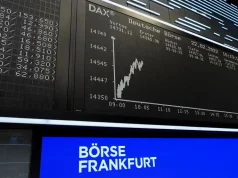
Germany’s DAX presents one of the most interesting positioning setups identified by Citi.
A substantial short position has developed in the German stock market. Many of these bearish positions are currently losing money because their average entry levels remain significantly below current market prices.
That creates the potential for a short squeeze.
If economic conditions improve or concerns surrounding the European economy begin to ease, bearish investors may be forced to close their positions.
Because closing a short position involves buying the underlying asset, widespread short covering could provide additional upward pressure for the DAX.
This makes Germany’s benchmark equity index particularly sensitive to positive economic surprises.
Bearish Positioning Builds in Asian Markets
Investor sentiment has also weakened across several major Asian stock markets.
Positioning in both Japan’s Nikkei and South Korea’s KOSPI deteriorated as investors increased short exposure while reducing long positions.
Both markets are therefore becoming increasingly tilted toward bearish positioning.
China-related markets have shown a somewhat different picture.
Positioning in the Hang Seng and China A50 has remained closer to neutral. However, underlying flows have moved in different directions, with the Hang Seng showing renewed signs of weakness.
This suggests investors remain selective rather than adopting the same bearish view across all Asian equity markets.
KOSPI and Nasdaq Reveal a Semiconductor Divide
Citi also identified an important divergence between positioning in South Korea’s KOSPI and the U.S. Nasdaq.
Investors have become increasingly bearish on the KOSPI while maintaining a more constructive stance toward the Nasdaq.
This difference is particularly significant because both markets have substantial exposure to the semiconductor industry.
Rather than abandoning the broader artificial intelligence and semiconductor investment theme, investors may be distinguishing between different regional opportunities.
In other words, bearish positioning in South Korean equities does not necessarily indicate that investors have lost confidence in the global AI trade.
Instead, capital may be shifting toward regions and companies that investors believe offer stronger growth prospects or more attractive risk-adjusted returns.
Investor Conviction Is Fading, but Capitulation Has Not Arrived
Citi’s latest positioning data points to a global equity market where investor confidence is weakening without turning into outright panic.
U.S. investors are reducing exposure, European equity flows have deteriorated and bearish positions are increasing across parts of Asia.
However, overall positioning remains relatively stable in many major markets.
That distinction is important.
Rather than signaling an immediate global equity selloff, current conditions suggest that investors are becoming more cautious and selective.
For markets in the near term, crowded positions may therefore matter as much as broader sentiment.
Large short positions could produce powerful short squeezes if economic conditions improve, while heavily concentrated long positions could face rapid unwinding if market weakness continues.
For investors, the key signals to watch are not only the direction of global equity markets but also changes in positioning, capital flows and overall risk appetite.