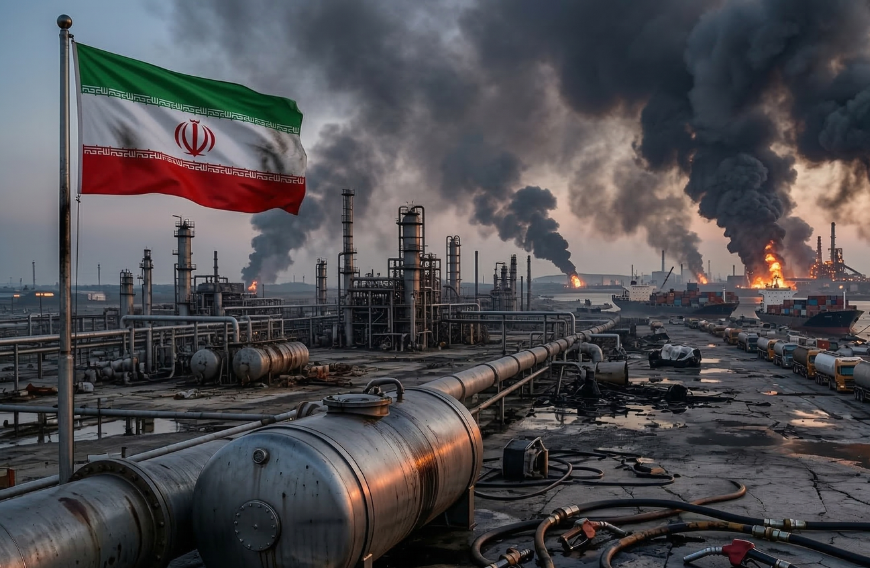
Oil prices could climb as high as $120 per barrel if attacks on shipping in the Middle East continue to intensify, according to Goldman Sachs.
The bank believes growing geopolitical risks around regional shipping routes could create further pressure across global energy markets.
Goldman also suggested that natural gas and diesel may offer stronger opportunities for investors looking to position for additional energy price gains.
Middle East Shipping Risks Threaten Oil Supply
Daan Struyven, co-head of global commodities research at Goldman Sachs, said recent developments have increased the risk that shipping disruptions could become broader and more severe.
Crude oil prices have already climbed to their highest levels since July as tensions between the United States and Iran continue around the Strait of Hormuz.
The waterway is one of the most important energy transit routes in the world, making any disruption there particularly significant for oil markets.
Strait of Hormuz Tensions Support Higher Oil Prices
According to Bloomberg, the United States has targeted Iranian tankers in recent days, while Iran has announced a new restricted zone near the Strait of Hormuz.
US naval forces are also reportedly maintaining pressure around Iranian ports while escorting vessels linked to other oil-producing countries out of the region.
These developments have raised concerns that further escalation could disrupt oil shipments and tighten global supply.
Goldman Sachs Sees Oil at $120 in Bullish Scenario
Goldman Sachs’ $120 oil price forecast represents its bullish scenario if shipping disruptions continue to worsen.
However, the bank also outlined a more moderate outcome.
If regional exports return to normal, Goldman believes Brent crude could fall toward $80 per barrel.
At the time referenced, Brent crude was trading near $97.55 per barrel, while West Texas Intermediate was around $92.64 per barrel.
Both benchmarks were trading higher as investors continued to assess geopolitical risks.
Energy Prices Rise Across the Market
The prolonged Middle East conflict has pushed up prices across a wide range of energy products.
Natural gas and refined fuels have risen even faster than crude oil in some cases.
Diesel prices, for example, have more than doubled so far this year.
This broader surge shows that the impact of supply disruptions is not limited to crude oil alone.
Goldman Favors Natural Gas and Diesel
Goldman Sachs believes investors seeking protection from geopolitical risk may be better positioned through global natural gas and refined oil products rather than relying only on crude oil.
Struyven said supply shocks in these markets can be more severe because they often have fewer alternative sources and less spare capacity.
As a result, products such as diesel and natural gas may react more sharply if regional energy flows are disrupted.
China Could Help Stabilize Crude Oil Markets
China could also play an important role in limiting extreme oil price increases.
Goldman expects Beijing to reduce crude oil imports if prices rise significantly, which could help balance global demand and act as a stabilizing force.
However, the same moderating effect may not apply to natural gas or refined products.
That could leave those markets more exposed to supply shocks if Middle East tensions continue to escalate.
Oil Market Outlook Remains Highly Sensitive
The outlook for oil prices now depends heavily on developments in Middle East shipping routes and the Strait of Hormuz.
A worsening security situation could push Brent crude toward Goldman Sachs’ $120 per barrel upside scenario.
On the other hand, a normalization of exports could bring prices closer to the bank’s $80 downside case.
For now, geopolitical risk remains one of the most important factors driving oil, natural gas and refined fuel markets.