Gold prices moved lower on Monday as investors continued to assess the Federal Reserve’s more hawkish stance on inflation.
Renewed tensions between the United States and Iran also kept oil prices elevated, raising concerns that higher energy costs could keep inflation persistent and interest rates higher for longer.
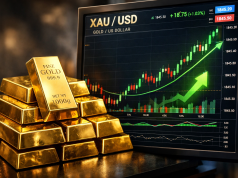
At 02:40 ET (06:40 GMT), XAU/USD fell 0.4% to $4,431.55 an ounce, while gold futures slipped to $4,480.00.
Silver edged 0.1% higher to $66.59 an ounce, while platinum gained 0.8% to $1,810.90. The U.S. Dollar Index rose to 99.55.
U.S.-Iran Tensions Revive Inflation Concerns
Gold came under additional pressure after the United States and Iran exchanged military strikes for the first time in around a month.
U.S. forces struck Iranian rocket launchers on an island in the Strait of Hormuz on Sunday, saying the weapons were being prepared to deploy mines in the strategic waterway.
Iran later responded with attacks on targets in the United Arab Emirates and Jordan.
The renewed fighting highlights the continuing standoff between Washington and Tehran after more than six months of conflict.
Strait of Hormuz Remains a Key Risk
The Strait of Hormuz remains one of the most important points of tension in the conflict.
Disruptions in the region have already affected global energy flows, while the latest escalation pushed oil prices higher.
Oil had already posted its strongest gain in three weeks on Monday.
Higher energy prices are important for gold because they can increase inflationary pressures and encourage the Federal Reserve to maintain tighter monetary policy.
Higher Interest Rates Create a Headwind for Gold
Gold does not pay interest, which makes the metal more sensitive to changes in bond yields and monetary policy expectations.
When interest rates rise, investors can earn higher returns from assets such as government bonds.
As a result, the opportunity cost of holding gold increases.
Markets are now pricing in a probability of more than 60% for a 25-basis-point Federal Reserve rate hike at the September meeting, according to CME FedWatch.
Hawkish Fed Signals Push Bond Yields Higher
Tony Sycamore, senior market analyst at IG, said gold’s recent decline reflected a combination of hawkish Federal Reserve signals and renewed geopolitical concerns around the Strait of Hormuz.
Gold has fallen by roughly $300 from last week’s high near $4,697, reaching a low close to $4,397 on Monday.
Sycamore said the combination of a more hawkish Fed outlook and rising geopolitical risks has pushed bond yields higher.
That has left gold vulnerable ahead of the Federal Reserve’s next policy decision.
Gold Still Posts Strong August Gains
Despite the recent pullback, gold gained nearly 10% in August, marking its strongest monthly performance since January.
The rally accelerated after the U.S. Treasury unexpectedly announced plans to increase purchases of longer-dated government debt.
The move helped reduce borrowing costs and weakened the U.S. dollar.
It also renewed concerns over the size of U.S. government debt and the possibility of long-term currency depreciation.
Debasement Trade Continues to Support Gold
Concerns about fiscal deficits and currency weakness have brought the so-called debasement trade back into focus.
This investment theme played an important role in gold’s strong performance during 2025, when investors increasingly sought protection against rising government debt and weakening currencies.
Gold gained around 65% during 2025, supported by strong safe-haven and inflation-hedging demand.
Gold ETF Demand Remains Strong
Investor demand for gold has also broadened through exchange-traded funds.
Gold-backed ETFs recently recorded their largest daily inflow since September 2025.
The funds have now posted net inflows for five consecutive weeks, highlighting continued institutional interest in the precious metal.
However, the Federal Reserve’s more hawkish stance has interrupted some of that bullish momentum.
Gold Falls Below Key Technical Level
Gold also moved below its 200-day moving average, which stood near $4,526.
A break below this widely followed technical level can weaken short-term market sentiment and increase selling pressure.
Investors will now closely monitor Federal Reserve policy expectations, U.S. bond yields, oil prices and developments in the Middle East for the next major direction in gold.