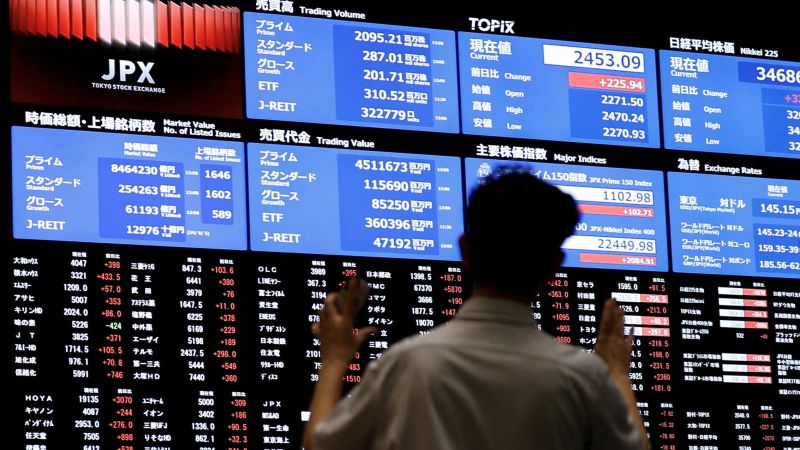
Asian stock markets were mixed on Monday as investors recovered from sharp early losses and reassessed the outlook for U.S. interest rates.
Sentiment turned cautious after Federal Reserve Chair Kevin Warsh delivered hawkish comments that revived expectations for another U.S. rate hike. At the same time, escalating tensions between the United States and Iran pushed oil prices higher and added to inflation concerns.
Asian Stocks Recover From Early Losses
Wall Street closed lower on Friday following Warsh’s speech, while U.S. stock index futures also traded in negative territory during Monday’s Asian session.
South Korea’s KOSPI finished 0.5% higher, recovering dramatically after falling almost 3% earlier in the day.
In Japan, the Nikkei 225 slipped 0.3%, while the broader TOPIX gained 0.2%.
Investors also closely watched the Japanese yen. The USD/JPY pair briefly moved above the 160 yen level, keeping currency markets in focus.
Warsh Comments Revive Fed Rate Hike Expectations
The latest market volatility followed remarks from Federal Reserve Chair Kevin Warsh at the Jackson Hole symposium.
Warsh indicated that the Fed could still have more work to do if policymakers were not convinced that underlying inflation was moving sustainably toward the central bank’s 2% target.
Following his comments, traders increased expectations for a September rate hike.
Markets placed the probability of an increase at around 60%, compared with roughly 35% before the speech.
The shift in expectations put pressure on equities as investors considered the possibility that U.S. monetary policy could remain restrictive for longer.
Iran Tensions Push Oil Prices Higher
Geopolitical risks also weighed on market sentiment.
Brent crude climbed back above $90 per barrel after U.S. forces reportedly struck Iranian launchers on Larak Island.
Iran was also reported to have responded with attacks targeting U.S. forces in Jordan.
The renewed increase in oil prices raised concerns that energy costs could contribute to further inflationary pressure, making the Federal Reserve’s policy outlook even more important for global markets.
China Stocks Rise Despite Weak Manufacturing Data
Chinese stocks managed to recover from early losses.
The Shanghai Composite gained 0.7%, while the blue-chip CSI 300 rose around 0.2%.
Investors were also digesting the latest Chinese economic data.
China’s official manufacturing Purchasing Managers’ Index increased to 49.8 in August from 49.2 in July.
The result beat expectations, but the index remained below 50, indicating that manufacturing activity continued to contract.
Meanwhile, the non-manufacturing PMI pointed to ongoing weakness in the services and construction sectors.
Hong Kong’s Hang Seng Index slipped around 0.2%.
Japan Industrial Output Beats Expectations
Japanese economic data provided a more encouraging signal.
Industrial production increased 0.1% month-on-month in July, beating expectations for a 0.7% decline.
Retail sales also rose 2.4% from the previous month, suggesting that domestic consumer demand remained relatively resilient.
The stronger data helped offset some of the concerns surrounding higher interest-rate expectations and movements in the yen.
India Markets Prepare for MSCI Rebalancing
Indian investors were also preparing for increased market volatility ahead of a major MSCI index rebalancing scheduled to take effect on Tuesday.
Funds that track MSCI indexes were expected to adjust their portfolios to reflect the changes.
Futures linked to India’s Nifty 50 traded around 0.4% lower.
Australia Falls While Singapore Advances
Elsewhere in the Asia-Pacific region, Australia’s S&P/ASX 200 declined 0.2%.
Singapore’s Straits Times Index gained 0.5%, showing stronger performance compared with several other regional markets.
Overall, Asian markets remained cautious as investors balanced stronger regional economic data against rising Fed rate hike expectations, higher oil prices and renewed geopolitical tensions in the Middle East.