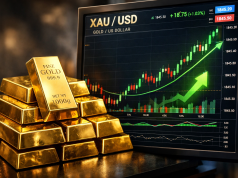
Gold prices hovered near a three-month high on Friday, supported by a weaker U.S. dollar and fresh efforts from the U.S. Treasury to limit pressure on long-term borrowing costs.
The precious metal has gained more than 4% this week and is on track to record its third consecutive weekly advance.
Gold Price Climbs Above $4,500
At 05:03 ET, spot gold was up 1.4% at $4,584.30 per ounce.
Gold futures also moved higher, rising 1.5% to approximately $4,641.89 per ounce.
The latest gains extend a strong weekly rally as investors respond to changes in U.S. bond markets and the dollar.
U.S. Treasury Buybacks Support Gold
One of the main drivers behind gold’s recent strength has been developments in the Treasury market.
The U.S. Treasury Department announced that it plans to double its buybacks of longer-dated government bonds to at least $4 billion per operation during the next quarter.
Treasury Secretary Scott Bessent later indicated that the government could increase those purchases further if necessary.
The announcement has drawn significant attention from bond traders because it signals that policymakers are closely monitoring elevated long-term Treasury yields.
Lower Treasury Yields Benefit Gold
Falling Treasury yields can be supportive for gold because the precious metal does not provide interest payments.
When yields decline, the opportunity cost of holding non-yielding assets such as gold becomes lower.
This can make bullion relatively more attractive compared with interest-bearing investments such as government bonds.
As a result, changes in Treasury yields often have an important impact on the gold price outlook.
Weaker U.S. Dollar Boosts Bullion Demand
A softer U.S. dollar has provided additional support for gold prices.
Because gold is generally priced in dollars, a weaker U.S. currency makes the metal cheaper for investors using other currencies.
This can increase international demand and provide additional momentum for gold during periods of dollar weakness.
ING Highlights Treasury Focus on Long-Term Yields
Analysts at ING noted that Treasury bond buybacks were originally introduced mainly to improve market liquidity.
However, the unusual timing of the latest changes has attracted attention.
ING believes the broader message is that rising longer-term borrowing costs have become an important concern for the Treasury Department.
The government’s willingness to expand buybacks could therefore remain an important factor for bond and gold markets.
Federal Reserve Officials Watch Treasury Strategy
Federal Reserve officials have also expressed caution about how Treasury debt-management policies could interact with monetary policy.
The concern is that efforts to lower long-term Treasury yields could loosen financial conditions.
That could potentially complicate the Fed’s efforts to keep inflation under control.
The relationship between Treasury policy and Federal Reserve monetary policy could therefore become increasingly important for investors.
Energy Prices and AI Spending Add Bond Market Pressure
Treasury yields are also being influenced by several other major economic forces.
Energy markets remain volatile because of the Iran conflict, creating additional inflation concerns.
At the same time, technology companies continue to spend heavily on artificial intelligence infrastructure, increasing borrowing and debt issuance across financial markets.
These factors have contributed to volatility in long-term interest rates.
Traders Watch September Fed Decision
Investors are now closely monitoring expectations for the Federal Reserve’s next interest-rate decision.
According to CME FedWatch, markets currently see roughly a two-in-three chance that the Fed will keep interest rates unchanged in September.
Expectations around interest rates remain particularly important for gold.
Lower or stable rates can reduce the relative appeal of interest-bearing assets and provide support for precious metals.
Gold Outlook Remains Supported
Gold’s move above $4,500 reflects a combination of lower yield expectations, a weaker U.S. dollar and uncertainty surrounding global financial conditions.
Treasury buybacks could provide additional support if they help reduce pressure on longer-term government bond yields.
However, investors will continue monitoring inflation, energy prices, Federal Reserve policy and Treasury markets for signs that the environment supporting gold is beginning to change.