SpaceX reported a sharp increase in revenue in its first earnings release since becoming a publicly traded company.
Strong growth from Starlink and the company’s artificial intelligence operations helped revenue nearly double. However, management warned that the heavy investment needed to support SpaceX’s long-term plans is far from complete.
SpaceX Targets a $100 Billion Revenue Run Rate
The Elon Musk-led company expects to reach an annualized revenue run rate of $100 billion by December.
Management also expects new investments in AI computing infrastructure to pay for themselves in less than one year.
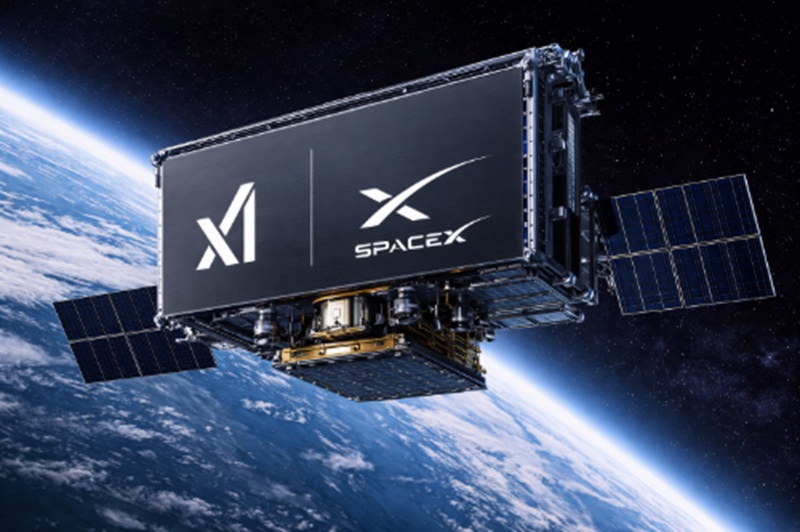
SpaceX plans to launch at least 1,000 next-generation V3 Starlink satellites over the coming year. The company also wants to compete more directly with traditional mobile network providers.
These targets reflect SpaceX’s ambition to expand beyond rocket launches and satellite internet into artificial intelligence, data centers and mobile connectivity.
First Earnings Test SpaceX’s $1.75 Trillion Valuation
The results for the quarter ended June 30 provided investors with an early opportunity to evaluate the strategy behind SpaceX’s reported $1.75 trillion valuation.
The central investment case is based on Starlink’s ability to generate enough profit to finance other capital-intensive projects.
These projects include artificial intelligence infrastructure, next-generation rockets and large-scale data centers.
Until those businesses mature, SpaceX is relying heavily on growth from satellite internet and connectivity services.
AI Business Gains Commercial Momentum
SpaceX’s artificial intelligence division showed signs of stronger commercial demand during the quarter.
Musk said the company was building AI computing capacity at a significant scale while continuing to improve its models.
The AI division includes xAI, the Grok chatbot, social media platform X and an expanding data center business.
However, the company also made clear that developing this infrastructure requires substantial investment.
Quarterly Revenue Beats Expectations
SpaceX generated $7.8 billion in revenue during the April-to-June quarter.
That compared with $4.1 billion during the same period one year earlier and exceeded Wall Street expectations.
Starlink accounted for more than half of the company’s total revenue. Sales from the satellite internet division increased by 66% year over year.
Meanwhile, revenue from SpaceX’s AI operations surged by approximately 250%.
Musk has described artificial intelligence as one of the company’s most important future growth drivers.
Capital Spending Jumps Above $18 Billion
SpaceX’s capital expenditure increased sharply during the quarter.
Total capital spending rose above $18 billion, compared with $2.83 billion one year earlier.
Chief Financial Officer Bret Johnsen said expenditure would likely remain near similar levels during the next two quarters.
The company invested $15.83 billion in AI infrastructure during the second quarter alone. That was significantly higher than the $749 million spent during the same period last year.
This rapid increase highlights the scale of SpaceX’s data center and computing ambitions.
SpaceX Stock Falls After Earnings
SpaceX shares declined approximately 7.5% in after-hours trading following the report.
The stock had gained 9.4% during the regular session before the earnings release.
Shares have also fallen around 8% since the company’s record-breaking initial public offering in June.
The negative reaction suggests that investors remain concerned about spending levels, execution risks and the company’s elevated valuation.
Share Lock-Up Expiry Could Add Pressure
SpaceX stock may face additional volatility as its post-IPO lock-up period begins to expire.
The restriction had prevented insiders and early investors from selling certain shares immediately after the public offering.
As those shares become eligible for sale, the market could experience a significant increase in supply.
This may create additional selling pressure, especially if early shareholders decide to secure profits or reduce their exposure.
Starlink Remains SpaceX’s Main Financial Engine
Starlink and SpaceX’s wider connectivity operations continue to support the company’s broader strategy.
The satellite internet division remains its largest and most important source of revenue and operating income.
SpaceX has used Starlink’s growth to help fund AI development and the costly Starship rocket programme.
Critics have questioned whether this model can remain sustainable until the newer businesses become profitable on their own.
Operating Losses Narrow Sharply
SpaceX reduced its total operating loss to $143 million during the second quarter.
That compared with an operating loss of $970 million one year earlier.
Losses from the AI division also narrowed, while Starlink’s operating income increased by 79%.
The improvement suggests that SpaceX is making progress toward greater operational efficiency despite its rising capital expenditure.
AI Revenue Reduces Reliance on Starlink
Brian Mulberry, chief market strategist at Zacks Investment Management, highlighted the early monetization of SpaceX’s AI business.
He noted that the division was beginning to generate its own revenue rather than depending entirely on Starlink for financial support.
This development could ease some concerns about the company’s aggressive AI investment.
However, the division must continue expanding its customer base and revenue to justify the scale of spending.
Starlink Plans to Challenge Mobile Operators
SpaceX President Gwynne Shotwell said Starlink could attract customers from major US mobile providers.
The company aims to compete with businesses such as T-Mobile, AT&T and Verizon.
SpaceX also plans to build ground-based infrastructure that will operate alongside its satellite network.
The goal is to develop a more complete mobile communications service rather than offering satellite connectivity alone.
Shares of several major telecommunications companies declined in after-hours trading following the comments.
Starlink Subscribers Double to 12 Million
Starlink ended the quarter with 12 million subscribers, twice the number reported one year earlier.
Its services now cover consumers, enterprises, aviation, maritime transport and government customers.
However, average revenue per subscriber fell by 22% year over year.
The decline reflected Starlink’s expansion into more international markets and the launch of lower-priced subscription plans.
Lower prices may help the company attract more users, but they could also place pressure on revenue per customer.
SpaceX Builds a Massive AI Data Center Network
SpaceX’s AI division has become its largest area of investment.
The company is generating revenue through computing agreements with Anthropic, Google and Reflection AI.
However, some contracted recurring revenue has not yet been recognized in its financial results.
Musk said SpaceX expected to build more than two gigawatts of computing capacity during the current year.
The company aims to increase that capacity to nearly 10 gigawatts by the end of next year.
Nvidia Hardware Will Power SpaceX Data Centers
SpaceX plans to rely exclusively on Nvidia hardware for its data center expansion.
Nvidia CEO Jensen Huang has previously estimated that every gigawatt of computing capacity could represent between $40 billion and $50 billion in revenue for Nvidia.
This highlights the enormous cost of building SpaceX’s planned AI infrastructure.
It also underlines the company’s dependence on access to advanced Nvidia processors.
Space Revenue Increases 29%
Revenue from SpaceX’s traditional space operations rose by 29% year over year.
This division includes commercial launches, government missions and the development of the Starship rocket.
Although the segment remains an important source of revenue, it also carries significant costs and technical uncertainty.
SpaceX has increasingly prioritized launches for its own Starlink satellite network over missions for external customers.
At the same time, Starship development continues to require substantial investment.
SpaceX Growth Comes With Major Spending Risks
SpaceX delivered strong revenue growth across Starlink, artificial intelligence and space operations.
Its improving AI revenue and narrower operating losses suggest that the company’s broader strategy is beginning to gain traction.
However, the sharp increase in capital spending remains a major concern.
SpaceX must prove that its investments in AI computing, data centers, mobile services and Starship can generate sustainable returns.
Investors will also monitor the upcoming share unlock, Starlink pricing trends and the company’s ability to control operating costs.
The company’s growth outlook remains ambitious, but meeting expectations attached to its valuation will require consistent execution.