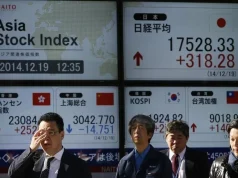
Asian stock markets fell sharply on Tuesday as renewed concerns about artificial intelligence investment triggered another major sell-off in semiconductor shares.
South Korea and Japan recorded the heaviest losses. Meanwhile, weak U.S. stock futures added to the cautious mood across the region.
Nasdaq 100 futures dropped around 1%, while S&P 500 futures declined approximately 0.3%. Wall Street had also ended the previous session mixed after surrendering most of its earlier gains.
Investors were particularly concerned about the scale of AI infrastructure spending and the rapid progress of China’s domestic semiconductor industry.
South Korean Stocks Trigger Trading Halts
South Korea’s KOSPI plunged approximately 10%, falling to its lowest level since the middle of April.
The severe decline triggered sidecar measures and circuit breakers during the trading session. These mechanisms are designed to slow trading activity during periods of extreme volatility.
South Korean semiconductor companies suffered some of the largest losses.
SK Hynix fell by as much as 13%, while Samsung Electronics declined as much as 12%. Both companies are major suppliers of memory chips used in artificial intelligence systems and data centers.
The heavy selling reflected concerns that spending on AI infrastructure may be growing faster than the underlying demand.
Japanese Semiconductor Shares Fall Sharply
Japanese markets also came under significant pressure.
The Nikkei 225 dropped as much as 4.4%, reaching its weakest level since May 22. The broader TOPIX index declined approximately 2.7%.
Semiconductor equipment manufacturers and technology suppliers led the losses.
Kioxia Holdings fell as much as 18%. Tokyo Electron, Disco, Nikon and Murata Manufacturing each dropped by more than 9%.
The declines showed how fears surrounding AI investment had spread beyond chip manufacturers to companies supplying production equipment and electronic components.
Nvidia Financing Commitments Raise AI Spending Concerns
Investor anxiety increased following reports that Nvidia’s latest AI-related financing commitments had exceeded $750 billion.
The reported scale of the commitments raised questions about leverage and the sustainability of the current artificial intelligence investment cycle.
Markets are increasingly asking whether demand for chips, data centers and computing infrastructure can continue growing quickly enough to justify unprecedented spending.
A slowdown in AI investment could affect semiconductor companies throughout the global supply chain.
This includes memory-chip producers, equipment manufacturers, cloud providers and companies developing artificial intelligence platforms.
Chinese Lithography Progress Pressures Overseas Rivals
Sentiment weakened further after reports that a Chinese state-backed company had begun mass-producing immersion deep ultraviolet lithography machines.
Lithography equipment is essential for producing advanced semiconductors.
China has invested heavily in developing domestic alternatives after U.S.-led export restrictions limited its access to cutting-edge chipmaking technology.
Progress in domestic lithography could increase competition for Japanese equipment manufacturers and ASML, the European leader in advanced semiconductor production systems.
Investors appeared concerned that Chinese manufacturers could gradually reduce their dependence on overseas suppliers.
Australia Outperforms Regional Markets
Not all Asian markets declined.
Australia’s S&P/ASX 200 reversed its earlier losses and gained approximately 0.5%.
Singapore’s Straits Times Index fell around 0.3%, while India’s Nifty 50 remained broadly unchanged.
These markets were less exposed to the severe semiconductor sell-off affecting South Korea and Japan.
Australia also benefited from the relative strength of its financial and commodity-related stocks.
Falling Oil Prices Ease Inflation Pressure
Oil prices extended the sharp losses recorded during the previous session.
The decline followed comments from U.S. President Donald Trump, who said there was a good chance of reaching an agreement with Iran.
Washington reportedly paused its daily military strikes while both sides continued diplomatic efforts to end the conflict.
The possibility of a settlement reduced fears of supply disruptions in global energy markets.
Lower crude prices also helped ease inflation concerns before the Federal Reserve’s upcoming interest-rate decision.
However, cheaper oil was not enough to reverse the technology-driven decline across most Asian equity markets.
Chinese and Hong Kong Tech Stocks Show Resilience
Chinese and Hong Kong technology shares performed better than many regional semiconductor stocks.
Hong Kong’s Hang Seng Index traded close to unchanged. However, the Shanghai Composite fell approximately 1.2%, while the CSI 300 declined around 2.6%.
Domestic technology companies received support from growing optimism about China’s semiconductor self-sufficiency strategy.
Investors were encouraged by the successful Shanghai market debut of CXMT.
The listing provided fresh evidence that Beijing remains committed to supporting domestic chip manufacturers and reducing dependence on foreign technology.
CXMT Listing Boosts China Chip Optimism
CXMT’s strong debut raised expectations that the company could expand its position in the global memory-chip market.
Samsung Electronics, SK Hynix and Micron currently dominate the DRAM industry.
CXMT accounts for only a relatively small share of global production capacity. However, capital raised through its stock-market listing could help finance new factories, research and manufacturing expansion.
Greater financial resources may allow CXMT to compete more aggressively with established international producers.
The development also increased pressure on South Korean memory-chip companies, which already face concerns about weaker pricing and rising production capacity.
Domestic DUV Technology Supports Chinese Shares
Reports that Chinese companies had developed domestic immersion DUV lithography capabilities also strengthened sentiment toward local technology stocks.
The development suggested that Chinese chipmakers may be narrowing part of the technology gap with international competitors.
Although DUV systems are less advanced than extreme ultraviolet lithography machines, they remain important for producing a wide range of semiconductors.
Domestic production could help China reduce the impact of Western export restrictions and improve the resilience of its semiconductor supply chain.
Chinese Internet Stocks Advance
Several major Chinese technology shares moved higher despite weakness in the broader mainland market.
NetEase gained more than 3%, while JD.com rose nearly 3%.
Xiaomi, Alibaba, Meituan and Tencent advanced between approximately 0.5% and 1.2%.
These gains helped offset losses in semiconductor companies such as SMIC, which fell around 3%.
The mixed performance showed that investors were distinguishing between consumer internet companies and chipmakers directly exposed to the global semiconductor sell-off.
Central Banks and Tech Earnings Take Center Stage
Markets are now preparing for several major economic and corporate events.
The Federal Reserve, Bank of Japan and Bank of England are all scheduled to announce policy decisions.
Investors will closely monitor their guidance for clues about inflation, interest rates and economic growth.
Quarterly earnings from Microsoft, Meta Platforms, Apple and Amazon will also receive significant attention.
The results could determine whether major technology companies can justify their enormous spending on artificial intelligence infrastructure.
Strong earnings and revenue growth could restore confidence in the AI investment cycle.
However, disappointing results or weaker guidance could deepen the sell-off across global technology and semiconductor shares.