Most Asian stock markets moved higher on Monday as easing tensions in the Middle East and a sharp drop in oil prices improved investor confidence.
Markets also prepared for a major week of central bank decisions and earnings reports from some of Wall Street’s largest technology companies.
Nasdaq 100 futures gained 1.2% during Asian trading, while S&P 500 futures rose 0.7%. The gains pointed to a stronger opening for U.S. markets.
Falling Oil Prices Improve Market Sentiment
Regional risk appetite strengthened after Brent crude prices declined sharply following an apparent pause in attacks between the United States and Iran.
Lower oil prices reduced concerns that another energy shock could push inflation higher ahead of the Federal Reserve’s policy meeting.
Investors are now waiting for the Fed’s interest-rate decision on Wednesday. Markets will also monitor major technology earnings to determine whether heavy spending on artificial intelligence can continue supporting elevated stock valuations.
Australia and Japan Lead Regional Gains
Most major Asian equity markets traded higher as global sentiment improved.
Australia’s S&P/ASX 200 led the region with a gain of 1.1%.
Japan’s TOPIX rose 1%, while the Nikkei 225 advanced 0.4%.
The gains reflected stronger demand for risk assets as oil prices continued to fall and U.S. stock futures moved higher.
Chinese Stocks Rise as Technology Shares Rally
Markets in Greater China also posted gains.
Hong Kong’s Hang Seng Index increased 0.7%, while the Shanghai Composite rose 0.4%. The CSI 300 added 0.3%.
Chinese markets received support from strong performances in technology, semiconductor and battery stocks.
Contemporary Amperex Technology, also known as CATL, climbed after reporting stronger first-half earnings and announcing a new share buyback programme.
CXMT Soars More Than 500% on Debut
Chinese memory chipmaker CXMT Corp surged by more than 500% during its stock market debut.
The remarkable performance highlighted continued investor enthusiasm for Chinese semiconductor companies supported by Beijing.
China is accelerating efforts to build a more independent chip industry as U.S. export restrictions continue to limit access to advanced semiconductor technology.
The rapid expansion of artificial intelligence infrastructure has also increased demand for memory chips used in servers and data centres.
South Korean Stocks Underperform
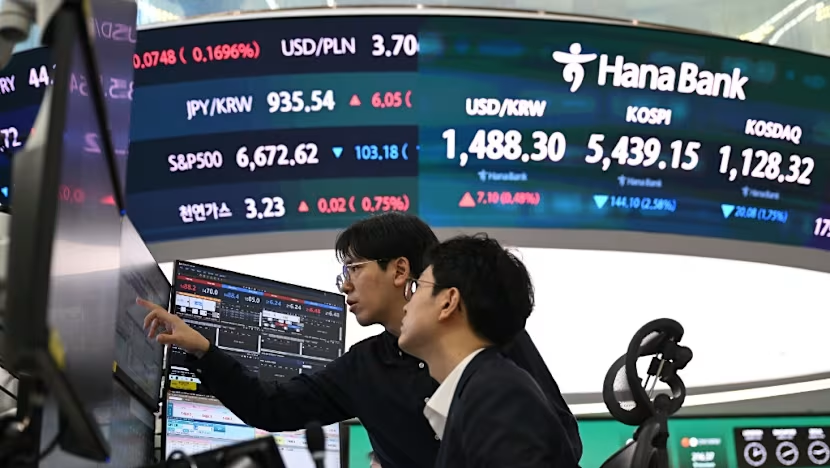
South Korea’s KOSPI fell around 1%, making it one of the weakest major markets in the region.
Heavyweight technology shares placed pressure on the index despite the broader improvement in Asian equities.
However, Naver Corp moved against the trend and gained nearly 8%.
The internet company announced that Nvidia would purchase $1 billion of newly issued shares as part of a partnership to develop an artificial intelligence data centre.
Fed Decision and Big Tech Earnings in Focus
Investors are preparing for several major events that could influence global markets.
The Federal Reserve will announce its latest interest-rate decision on Wednesday. The Bank of England and Bank of Japan will also hold policy meetings later in the week.
Meanwhile, Microsoft, Apple, Amazon and Meta Platforms are scheduled to publish quarterly earnings.
Their results are expected to provide an important test for the artificial intelligence investment theme.
Markets will focus on AI spending, cloud computing growth and whether companies can generate sufficient returns from rising capital expenditure.
Bank of America Sees AI Correction Easing
Bank of America said the recent decline in AI-related stocks appears to have largely run its course.
However, the bank advised investors to become more selective as market leadership expands beyond the technology sector.
It also warned that financial markets remain exposed to economic shocks.
A renewed increase in oil prices or tighter monetary policy could trigger another broad sell-off across risk assets.
Singapore Stocks Rise After Policy Tightening
Singapore’s Straits Times Index edged 0.2% higher.
The Monetary Authority of Singapore unexpectedly tightened monetary policy by slightly increasing the rate of appreciation of its exchange-rate band.
The decision also supported the Singapore dollar.
Singapore manages monetary policy mainly through its currency rather than traditional interest-rate adjustments.
Indonesian Markets Assess Central Bank Leadership Change
Indonesia’s Jakarta Composite Index rose 0.2%.
Investors were assessing the unexpected resignation of Bank Indonesia Governor Perry Warjiyo.
The leadership change raised questions about the future direction of monetary policy and the level of support available for the Indonesian rupiah.
Most Southeast Asian Markets Advance
Elsewhere in the region, Malaysia’s FTSE Bursa Malaysia KLCI increased 0.5%.
The Philippines’ PSEi Composite gained 0.8%, while Thailand’s SET Index declined 0.7%.
New Zealand’s NZX 50 rose 0.3%, extending the broadly positive trend across Asian markets.
Overall, easing geopolitical tensions, lower oil prices and stronger U.S. stock futures supported regional equities. However, investors remain cautious ahead of central bank decisions and major technology earnings.