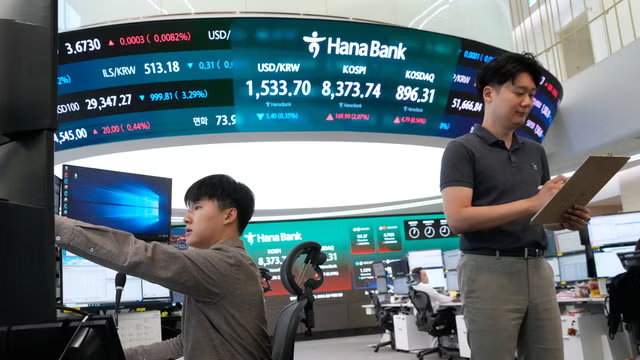
Asian stocks moved lower on Thursday as a renewed selloff in artificial intelligence and semiconductor shares spread across the region.
South Korea’s KOSPI led the decline after heavy losses in Samsung Electronics and SK Hynix. Concerns about future AI infrastructure spending outweighed otherwise resilient economic data from Asia.
KOSPI Falls as Chip Stocks Tumble
The KOSPI dropped around 5% as major semiconductor companies extended their losses.
Samsung Electronics fell 7.5%, while SK Hynix declined 9.2%. Both stocks came under pressure following a weak session for technology shares on Wall Street.
The losses highlighted growing concern that the powerful rally in AI-related chip stocks may be losing momentum.
Meta Report Raises AI Spending Concerns
Investor sentiment weakened after reports that Meta Platforms was considering launching a cloud infrastructure business.
The company could reportedly sell excess AI computing capacity to other businesses.
The plan raised concerns that major technology companies may become more disciplined with AI infrastructure spending. Companies could also make greater use of existing hardware instead of purchasing new processors.
Such a shift could reduce future demand for advanced chips and memory products.
Apple Report Pressures Korean Memory Producers
Separate reports involving Apple added to the pressure on South Korean semiconductor stocks.
Apple was reportedly evaluating memory chips from Chinese suppliers.
The possibility of increased competition from lower-cost Chinese manufacturers weighed on Samsung Electronics and SK Hynix, which are among the world’s largest memory chip producers.
Wall Street Chip Losses Spread to Asia
The Asian selloff followed sharp declines in U.S. semiconductor and storage stocks.
Micron Technology and SanDisk both fell more than 10% during the previous Wall Street session.
However, Nasdaq 100 futures and S&P 500 futures were little changed in later trading. Investors turned their attention toward upcoming U.S. economic data.
Nikkei Falls as Japanese Chip Suppliers Slide
The AI chip selloff also affected Japanese markets.
The Nikkei 225 fell 1.6%, although the broader TOPIX gained around 0.5%.
Several Japanese semiconductor and electronic component suppliers recorded steep losses.
Kioxia Holdings dropped 13.3%, while Mitsui Mining and Smelting fell 9.6%. Ibiden declined 7.9%.
Murata Manufacturing and Furukawa Electric each lost around 7.2%.
The widespread losses showed that concerns about AI spending had spread across the broader semiconductor supply chain.
Taiwan Chip Stocks Come Under Pressure
Taiwanese semiconductor shares also moved lower.
TSMC extended its recent decline alongside other companies connected to the global AI supply chain.
Investors continued to reassess high technology-sector valuations after the strong rally recorded earlier in the year.
SoftBank Gains on OpenAI Loan Report
Not all AI-related shares declined.
SoftBank Group gained 1.5% after Reuters reported that the company had restarted negotiations for a $10 billion loan backed by its OpenAI stake.
The proposed financing would support SoftBank’s broader artificial intelligence investment strategy.
Kakaku.com also moved higher following reports that Bain Capital and LY Corporation had increased their takeover offer for the Japanese price-comparison platform.
Chinese Stocks Show Relative Resilience
Mainland Chinese markets recorded more moderate losses.
The Shanghai Composite fell 1.9%, while the CSI 300 declined 0.9%.
Both indexes gave up earlier gains despite stronger manufacturing surveys and expectations for further government support.
The data suggested that parts of China’s industrial economy remained resilient. However, worries about technology valuations continued to influence market sentiment.
Australian Market Reacts to Trade Deficit
Australia’s ASX 200 traded slightly lower after the country unexpectedly reported a trade deficit for May.
The figures raised concerns about weaker overseas demand for Australian commodities.
Falling export demand could place additional pressure on the economy after a strong performance earlier in the year.
Other Asian Markets Move Higher
Some regional markets avoided the broader decline.
Indonesia’s Jakarta Composite gained 1.8%, while Nifty 50 futures rose around 0.4%.
Recent manufacturing surveys from China, Japan, and Southeast Asia had also shown relatively stable factory activity.
Economic Data Overshadowed by AI Concerns
South Korean inflation matched expectations, indicating that price pressures remained broadly stable.
Export growth also showed that the country’s external sector remained resilient.
However, investors largely overlooked these positive signals. The sharp market decline was driven more by changing global sentiment toward AI and semiconductor stocks than by weaker domestic economic conditions.
Investors Await Trump Comments
Markets remained cautious ahead of expected remarks from U.S. President Donald Trump.
Investors were watching for comments on trade and economic policy that could influence global risk appetite.
For now, concerns about AI spending, chip demand, and elevated technology valuations remain the main forces affecting Asian stock markets.