RBI Governor Says Rate Hikes Are Not on the Table Yet
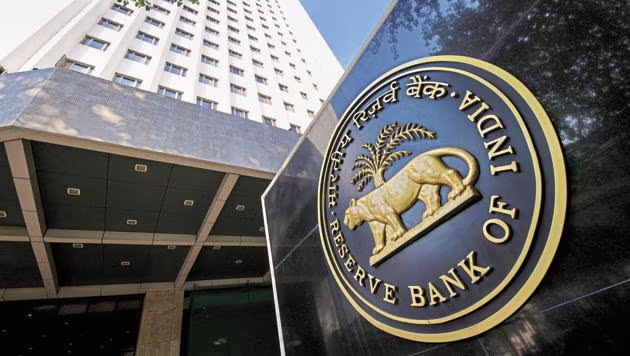
Reserve Bank of India Governor Sanjay Malhotra said it remains too early to discuss interest rate hikes as global economic uncertainty continues.
Speaking to ET NOW on Wednesday, Malhotra said the RBI would continue to base its monetary policy decisions on incoming economic data. He also warned that the secondary effects of recent inflationary shocks remain difficult to predict.
RBI Would Signal Before Raising Interest Rates
Malhotra described discussions about an immediate rate increase as premature.
He explained that the RBI would likely change its monetary policy stance from neutral to restrictive before preparing financial markets for higher interest rates.
Such a move would signal that the central bank was becoming more concerned about inflation and was considering tighter monetary conditions.
For now, however, the RBI does not appear ready to begin another rate-hike cycle.
Global Economic Risks Remain a Concern
The RBI governor said international monetary and economic uncertainty continues to influence India’s policy outlook.
However, he described the easing of geopolitical tensions in West Asia as an important positive development.
Lower regional tensions could reduce pressure on energy prices and improve confidence across global financial markets. India remains particularly sensitive to oil-price movements because it imports a significant share of its energy needs.
Broad Inflation Pressure Has Not Emerged
Malhotra said he had not yet seen evidence of widespread inflationary pressure across the Indian economy.
He added that the immediate upside risks to inflation had weakened. Nevertheless, the RBI continues to monitor whether recent price shocks could produce broader and more persistent effects.
Second-round inflation can emerge when higher prices affect wages, production costs and consumer expectations. This can make inflation more difficult for central banks to control.
RBI Does Not Target a Specific Rupee Level
Malhotra also repeated that the RBI does not defend a specific exchange rate for the Indian rupee.
Instead, the central bank allows market conditions to determine the currency’s value. Its interventions in the foreign-exchange market are mainly designed to prevent disorderly or excessive volatility.
The USD/INR currency pair recently traded around 95 rupees after gaining approximately 0.3% on Monday.
The rupee has weakened during recent sessions after previously strengthening in response to measures introduced by the RBI.
Measures to Attract Dollar Inflows Show Progress
The RBI governor said recent efforts to attract additional U.S. dollar inflows had received an encouraging initial response.
He expects India to record sizeable capital inflows as investors respond to the central bank’s measures and the country’s broader economic outlook.
Stronger dollar inflows could support the rupee and improve liquidity in India’s foreign-exchange market.
Equity Market Pullback Could Limit Foreign Investment
Despite the positive early response, Malhotra warned that foreign investment linked to capital markets could slow.
A moderate correction in Indian equity valuations may reduce the pace of overseas inflows, particularly if international investors become more cautious toward highly valued stocks.
The RBI will therefore continue monitoring inflation, exchange-rate volatility, capital flows and global economic conditions before making any major change to interest-rate policy.