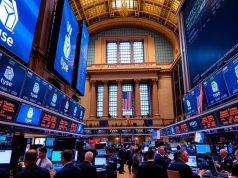
U.S. stocks moved sharply higher on Thursday as investors welcomed an interim peace agreement between the United States and Iran.
The geopolitical development helped ease some concerns created by the Federal Reserve’s more hawkish interest-rate outlook.
S&P 500 and Nasdaq Lead Wall Street Higher
The S&P 500 climbed approximately 1% to 7,495.52 during morning trading in New York.
The technology-focused Nasdaq Composite gained around 1.3% to reach 26,360.19. Meanwhile, the Dow Jones Industrial Average advanced 0.6% to 51,775.55.
U.S. financial markets will remain closed on Friday in observance of the Juneteenth federal holiday.
Stocks Recover After Fed-Driven Sell-Off
Wall Street’s major indexes had fallen during the previous session after the Federal Reserve kept interest rates unchanged.
The decision pushed U.S. government bond yields higher and placed pressure on equities.
More importantly, the Fed’s updated interest-rate projections showed that several officials now expect at least one rate increase in 2026. In March, no policymakers had forecast another hike.
Kevin Warsh Signals a More Hawkish Federal Reserve
The latest meeting was the first led by Federal Reserve Chair Kevin Warsh.
The central bank released a significantly shorter policy statement that focused heavily on controlling inflation. It did not directly mention the Fed’s second major responsibility of supporting maximum employment.
Policymakers also suggested that important changes may be coming to the Fed’s communication strategy and its use of economic data.
Analysts at Vital Knowledge said investors may receive less detailed guidance from the Federal Reserve under its new leadership. This could make future policy decisions more difficult for markets to predict.
U.S. and Iran Sign Interim Peace Agreement
Investor sentiment improved after the United States and Iran signed an initial agreement aimed at ending their conflict and reopening the Strait of Hormuz.
President Donald Trump signed the memorandum of understanding during a dinner at the Palace of Versailles in France on Wednesday.
The development was confirmed through media reports and a video shared by French President Emmanuel Macron.
However, Trump warned that military action against Iran could resume if the agreement fails.
Formal Signing Plans Remain Unclear
Trump confirmed the deal while speaking to reporters after the dinner.
The signing was unexpected because representatives from the United States and Iran had been scheduled to hold a formal ceremony in Switzerland on Friday. It remains unclear whether that event will proceed.
Iranian President Masoud Pezeshkian also signed the agreement on Tehran’s behalf, according to an image released by Iran’s state-run IRNA news agency.
Separate reports indicated that leaders from both countries approved the document electronically.
Full Details of the Agreement Have Not Been Released
The White House has not yet published the complete text of the memorandum.
Therefore, several elements of the agreement remain uncertain.
However, U.S. officials reportedly provided journalists with the draft terms. A version released by Iran was broadly consistent with the American account.
The agreement calls for an end to hostilities, the beginning of negotiations over Iran’s nuclear programme and the reopening of the Strait of Hormuz.
Strait of Hormuz Reopening Eases Energy Concerns
The Strait of Hormuz is one of the world’s most important energy transport routes.
Approximately one-fifth of global oil and liquefied natural gas shipments normally pass through the waterway. However, it has remained largely closed for several months because of the conflict.
The disruption pushed oil prices higher and increased fears that rising energy costs could trigger another global inflation wave.
Under the preliminary agreement, vessels would be allowed to pass through the strait without paying tolls for two months.
The deal does not permanently prevent Iran from imposing fees in the future. The United States would also suspend or remove some sanctions on Iran.
Oil Prices Fall After the U.S.-Iran Deal
Brent crude prices declined following the announcement.
Although oil remains above its pre-war level, prices have fallen significantly from the highs reached earlier in the conflict.
Lower oil prices reduced concerns that energy inflation could force the Federal Reserve and other central banks to keep interest rates higher for longer.
The decline also supported companies that are particularly sensitive to fuel costs.
Airlines and Cruise Stocks Gain
Shares of United Airlines and Delta Air Lines advanced as investors anticipated lower fuel expenses.
Cruise operators Royal Caribbean and Carnival also moved higher.
Airlines and cruise companies consume large amounts of fuel. Therefore, falling oil prices can reduce operating costs and improve their earnings outlook.
Intel Surges on Apple Chip Announcement
Intel shares jumped after Trump said Apple had agreed to work with the semiconductor company on designing and manufacturing chips in the United States.
The announcement supported expectations that Intel could play a larger role in the administration’s effort to expand domestic semiconductor production.
Other chipmakers also gained, including Nvidia, Advanced Micro Devices and Broadcom.
Apple Warns of Higher Component Costs
Apple shares recorded a modest gain after Chief Executive Tim Cook discussed increasing production expenses.
Cook reportedly said the company may need to raise product prices to offset higher costs for memory and storage chips.
The warning highlighted the pressure that rising component prices could place on technology companies and consumers.
Smith & Wesson Shares Soar After Revenue Growth
Smith & Wesson shares also surged after the company reported strong quarterly results.
The firearms manufacturer recorded a 27% increase in quarterly revenue, exceeding market expectations and attracting strong investor interest.