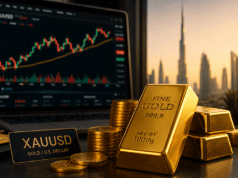
Gold Prices Slip as Rising Oil Costs and Rate Hike Fears Weigh on Demand
Gold prices moved lower on Friday as higher oil prices intensified inflation concerns and increased expectations that the Federal Reserve could keep interest rates elevated or potentially raise them later this year.
Spot gold fell 0.5% to $4,521.52 per ounce, while gold futures declined 0.4% to $4,522.87 per ounce.
The decline highlights growing pressure on precious metals as investors reassess inflation risks and monetary policy expectations.
Higher Oil Prices Fuel Inflation Concerns
Oil markets continued climbing, with Brent crude remaining well above levels seen before the outbreak of conflict in the Middle East.
Rising energy costs have renewed fears that inflation could accelerate globally, potentially forcing central banks to adopt tighter monetary policies.
The possibility of higher borrowing costs has reduced the appeal of non-yielding assets such as gold, which typically performs better during periods of lower interest rates.
Gold Faces Pressure From Stronger US Dollar
Another challenge for gold has been the recent strength in the U.S. dollar.
The dollar remained close to a six-week high, making gold more expensive for overseas investors and reducing international demand.
The greenback has increasingly been viewed as a safe-haven asset during the Iran conflict, partly due to expectations that the U.S. economy may be less vulnerable to rising energy prices because of its role as a major energy producer.
Central Banks Face Growing Inflation Risks
Analysts warn that rising oil prices combined with weaker economic activity could create difficult conditions for policymakers.
Higher inflation alongside slowing growth increases pressure on central banks, particularly those focused heavily on price stability.
This environment raises uncertainty around future interest rate decisions and broader economic outlooks.
Iran Peace Talks Continue to Influence Market Sentiment
Investor attention remains heavily focused on diplomatic efforts aimed at ending the conflict involving Iran, the United States, and Israel.
Market sentiment has shifted repeatedly this week as conflicting reports emerged regarding potential progress in negotiations.
Iran’s foreign minister reportedly met with Pakistan’s interior minister in discussions centered on narrowing differences between Tehran and Washington over peace proposals.
Pakistan has frequently acted as an intermediary in diplomatic efforts between both sides.
Mixed Signals Emerge From Negotiations
Recent comments from U.S. Secretary of State Marco Rubio suggested discussions have shown encouraging signs, although officials cautioned against excessive optimism.
At the same time, reports indicated negotiation gaps may be narrowing.
However, disagreements remain over major issues, including Iran’s enriched uranium program — a key sticking point in talks with the United States.
Conflicting reports surrounding these negotiations have continued fueling uncertainty across financial markets.
Strait of Hormuz Disruptions Keep Oil Markets Tight
Concerns also remain centered on the Strait of Hormuz, one of the world’s most important energy shipping routes.
The passage normally handles roughly 20% of global oil shipments, but ongoing disruptions have sharply reduced tanker activity.
Restricted energy flows continue supporting higher oil prices and increasing fears of prolonged inflation pressure worldwide.
Gold Outlook Remains Tied to Rates and Geopolitics
The outlook for gold may continue depending on three major factors:
- Future Federal Reserve interest rate decisions
- Developments in Iran-related peace negotiations
- Oil price movements and inflation expectations
Until uncertainty around these issues eases, volatility across commodity and currency markets is likely to remain elevated.