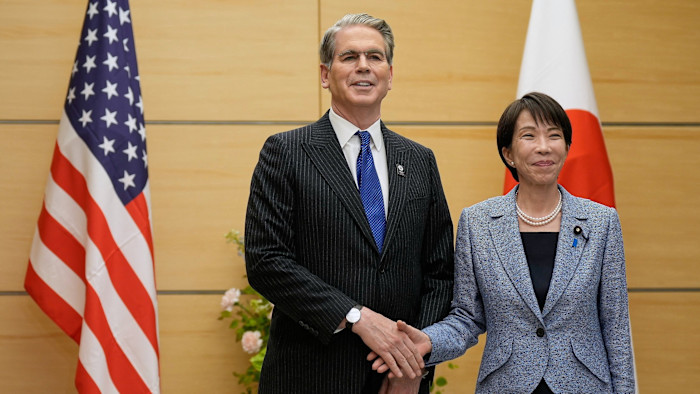
Bessent’s Support Could Strengthen Case for a Bank of Japan Rate Hike in June
Comments from U.S. Treasury Secretary Scott Bessent may help reduce political resistance to another interest rate increase by the Bank of Japan (BOJ), according to analysts.
However, uncertainty remains over whether higher rates would be enough to significantly strengthen the Japanese yen.
Bessent Signals Support for Further BOJ Tightening
Speaking to Reuters, Bessent expressed confidence that BOJ Governor Kazuo Ueda would take appropriate policy action if granted sufficient independence from government influence.
Following a meeting with Ueda, Bessent stated that Japan’s economic fundamentals remain solid and suggested that reduced currency volatility, stronger yen levels and higher interest rates would be consistent with current conditions.
His remarks indicate Washington’s apparent support for additional monetary tightening in Japan.
Markets Expect High Probability of June Rate Increase
Attention is now turning to the Bank of Japan’s next policy meeting scheduled for June 15–16.
Financial markets are currently pricing in roughly an 80% probability that the BOJ will raise its short-term interest rate to 1.0%, up from 0.75%.
If implemented, the move would represent another step in Japan’s gradual departure from years of ultra-loose monetary policy.
Political Resistance Remains a Key Challenge
Despite growing market expectations, a June rate increase may still face opposition from Japanese Prime Minister Sanae Takaichi and members of her administration who favour accommodative policies.
Officials have previously argued that tighter monetary policy could conflict with government efforts to support economic growth through spending and investment.
Analysts believe Bessent’s recent comments may increase pressure on policymakers to accept further tightening if it helps stabilise the yen.
Analysts Say U.S. Pressure Could Influence BOJ Decision
According to strategists, Bessent’s visit to Tokyo and his public statements suggest strong U.S. backing for additional BOJ rate hikes.
Some analysts argue that political resistance could soften if higher interest rates are seen as a way to limit further yen weakness and improve currency stability.
The debate highlights the delicate balance between supporting economic growth and controlling inflationary pressures.
Inflation, Energy Costs and Bond Markets Complicate Outlook
The Bank of Japan’s June meeting comes amid increasing economic uncertainty linked to rising fuel costs and supply disruptions following tensions in the Middle East.
Japan’s heavy dependence on imported energy means higher oil prices continue to create pressure on inflation and household costs.
At the same time, global bond markets have experienced volatility as investors reassess inflation risks and future interest rate expectations.
These developments may complicate the BOJ’s decision-making process.
BOJ Also Faces Decisions on Bond Purchases
Beyond interest rates, the central bank is expected to review its bond purchase reduction programme and outline plans for fiscal year 2027.
Financial market instability may encourage the BOJ to move cautiously when reducing its large government bond holdings, particularly as rising yields expose broader fiscal pressures.
Investors will also closely monitor Governor Ueda’s upcoming speech on June 3 for potential signals regarding the likelihood of a near-term rate increase.
The speech could offer one of the clearest indications yet of the Bank of Japan’s policy direction heading into June.