Chinese Exporters Remain Confident Ahead of Trump’s Beijing Visit
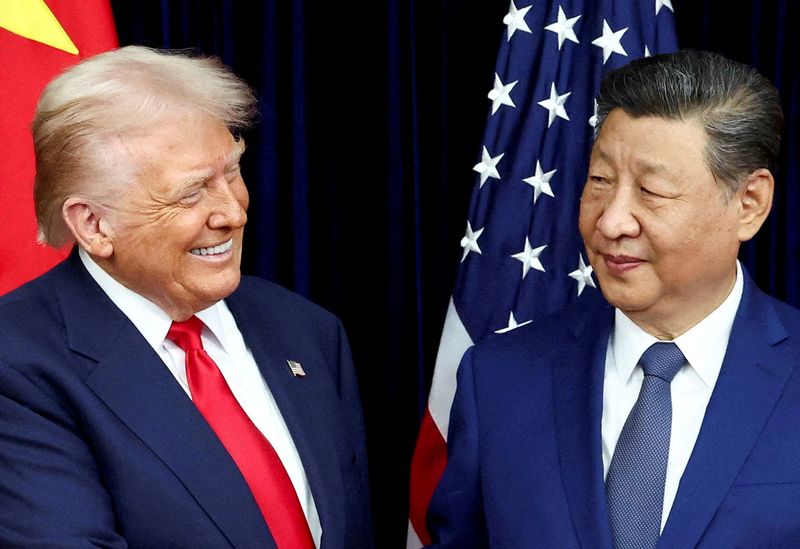
Chinese exporters say they are no longer intimidated by U.S. trade threats as President Donald Trump prepares to visit Beijing later this month.
Yu Yangxian, a Chinese sales executive whose company exports electric lockers and vending machines to the United States, said the visit has little impact on her business outlook.
“As long as the United States continues trading, it will need to do business with us,” Yu explained, noting that her company offsets part of the additional tariff costs by passing them on to American consumers.
She added that China’s manufacturing strength, efficient supply chains, and product quality continue to give local exporters a major competitive advantage.
Chinese Manufacturers Grow More Resilient
Despite the intense tariff battles of 2025, during which some U.S. levies briefly climbed into triple digits, Yu said her company managed to retain most of its American clients while also expanding into new international markets.
According to her, Chinese manufacturers have become increasingly resilient due to years of investment in domestic self-sufficiency and integrated supply chains across multiple industries.
“Whether Trump comes to negotiate or escalate tensions, it does not pose a major threat to us,” she said.
China Expands Into Global Markets
Yu explained that her company is aggressively expanding into Europe, South America, Southeast Asia, and Africa to reduce reliance on the U.S. market and offset rising raw material costs caused by the Iran conflict.
This broader international expansion mirrors China’s national trade strategy.
China ended 2025 with a record trade surplus of $1.2 trillion, fueled by aggressive pricing and stronger exports to developing regions.
While Chinese exports to the United States declined by 20%, shipments to Africa jumped 25.8%, exports to Latin America rose 7.4%, Southeast Asia increased 13.4%, and exports to the European Union climbed 8.4%.
Rare Earth Dominance Gives China Leverage
To counter U.S. tariff pressure, Beijing has increasingly relied on global dependence on Chinese supply chains, especially in the rare earths sector.
China controls the vast majority of rare earth production, materials essential for semiconductors, defense systems, electric vehicles, and advanced technologies.
Cameron Johnson, senior partner at supply chain consultancy Tidalwave Solutions, described rare earths as China’s “ultimate trump card.”
He added that Beijing could also restrict exports of pharmaceuticals, industrial machinery, or electrical transformers needed for America’s power grid expansion.
Iran Conflict Shifts Economic Power Dynamics
Johnson noted that the Iran war currently provides Washington with some leverage because the United States remains a major energy supplier.
However, he argued that China’s broader industrial capabilities could ultimately give Beijing the advantage if geopolitical tensions continue escalating.
“That’s why they’re playing nice,” Johnson said, referring to Washington’s approach toward China.
Pressure to Relocate Production Declines
As tariff concerns gradually move away from the center of U.S.-China tensions, many manufacturers are slowing down plans to relocate production outside China.
Jonathan Chitayat, Asia head at Genimex Group, said his company explored alternative suppliers in Vietnam, Thailand, India, and Indonesia during Trump’s earlier presidency.
Even so, around 75% of his network of 500 suppliers remains based in China.
Many manufacturers reportedly abandoned relocation plans after U.S. tariffs on China were reduced while levies on other countries increased.
“We’ve learned not to overreact,” Chitayat said. “Companies that waited now feel they made the right decision.”
Businesses Adapt to Trump’s Trade Tactics
Mike Sagan, vice president of sourcing at Pride Mobility Products, said his company still relies on China for 70% to 80% of its supply chain needs.
Although diversification remains important, businesses no longer feel the same urgency to move operations out of China.
“The panic has faded,” Sagan explained. “Companies have developed tougher skin when it comes to Trump’s statements.”
Ren Yanlin, an executive involved in overseas factory projects, said many Chinese firms have effectively become “numb” to U.S. trade threats.
“The mindset now is that it doesn’t really matter anymore,” he said.
Businesses Seek Long-Term Stability
Eric Zheng, president of the American Chamber of Commerce in Shanghai, said many companies have low expectations regarding major breakthroughs during Trump’s visit.
Still, businesses welcome the possibility of continued dialogue and an extension of the current tariff truce.
Potential agreements involving Chinese purchases of Boeing aircraft, soybeans, or U.S. energy products could help ease tensions temporarily, he noted.
However, Zheng emphasized that companies need long-term certainty rather than short-term pauses in trade disputes.
“A truce is better than a trade war,” Zheng said. “But businesses need stability that lasts years, not just a few months.”