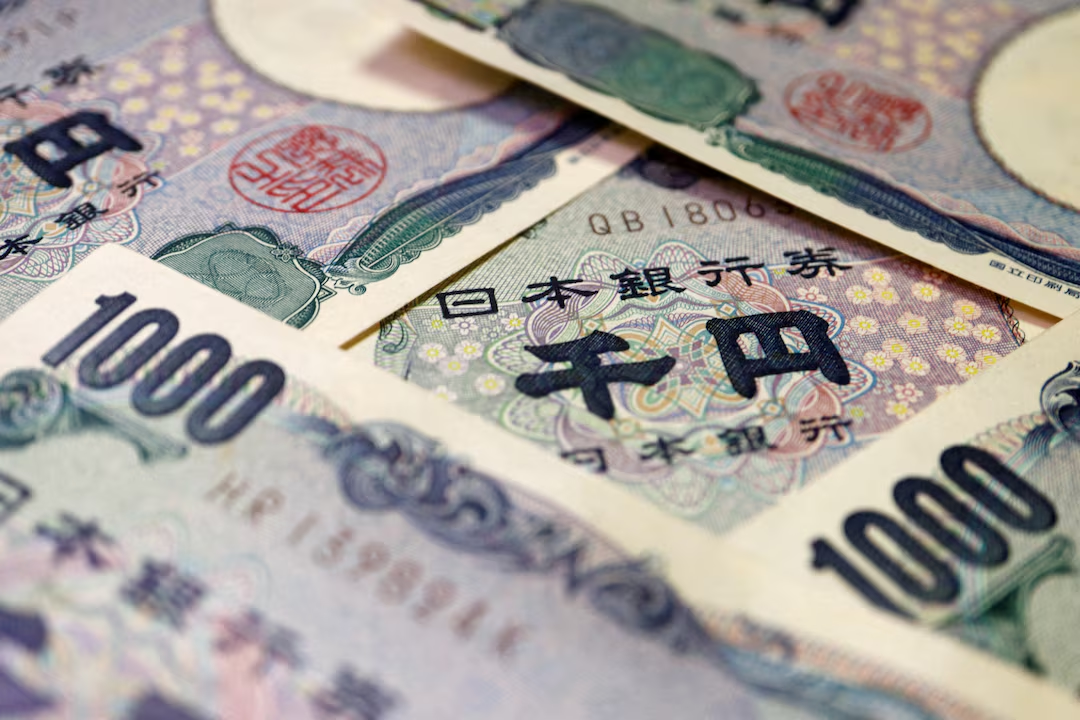
The Japanese yen climbed to its highest level in more than two months on Monday, as speculation intensified that coordinated currency intervention by U.S. and Japanese authorities could be close. Markets were left guessing after Tokyo’s top currency officials refused to rule out action.
At the same time, investors reduced dollar exposure ahead of a key Federal Reserve policy meeting and the possibility that the Trump administration may soon announce a new Fed chair.
The yen gained as much as 1.2% to 153.89 per dollar, marking its strongest level since November. The euro also advanced, reaching a four-month high near $1.1898 before easing slightly to trade around $1.1855.
Trading volumes were thinner due to public holidays in Australia and New Zealand, keeping investor attention firmly on Tokyo. Japan’s Prime Minister Sanae Takaichi said over the weekend that her government was prepared to take “necessary steps” to counter speculative currency moves.
According to a source cited by Reuters, the New York Federal Reserve recently contacted dealers to check dollar-yen exchange rates, a move widely interpreted as a possible precursor to intervention. As a result, traders rushed to unwind short yen positions, pushing the currency roughly 3% higher from Friday’s lows.
Japanese Finance Minister Satsuki Katayama declined to comment on the reported rate checks. Meanwhile, senior currency diplomat Atsushi Mimura said Japan would continue close coordination with the United States on foreign exchange policy and respond appropriately when needed.
The yen has been under pressure partly due to concerns over Japan’s massive government debt, which exceeds twice the country’s economic output. Rising global interest rates have heightened fears over debt sustainability, although Takaichi has pledged tax cuts as she campaigns ahead of a snap election scheduled for February 8.
On Friday, the yen posted its largest single-day gain against the dollar in nearly six months, with sharp moves seen during both Asian and New York trading hours.
The U.S. dollar index, which tracks the greenback against a basket of major currencies, slipped 0.1% to a four-month low of 97.155.
Market strategists said that the combination of official rate checks and increasingly firm rhetoric over the weekend helped fuel the rally. Others noted that the Federal Reserve’s rare involvement has added to market tension, increasing expectations that any intervention could be jointly coordinated and more effective.
Some analysts described the move as a turning point in global foreign exchange markets, noting that the Fed has not directly checked currency levels in more than a decade. The United States last joined coordinated yen intervention in March 2011, following Japan’s earthquake and nuclear disaster.
Dollar Selloff Broadens
The yen’s surge triggered broader dollar selling, lifting several major currencies. The British pound and New Zealand dollar both touched four-month highs, while the Australian dollar climbed to its strongest level since September 2024.
Sterling edged up to $1.36625, the Australian dollar rose to $0.69165, and the New Zealand dollar traded near $0.596.
Analysts said the dollar was already vulnerable, but the sudden strength in the yen accelerated selling across the board. Political uncertainty in the United States, along with expectations around leadership changes at the Federal Reserve, has added to investor caution.
President Donald Trump said last week that he would soon announce his choice to replace Federal Reserve Chair Jerome Powell.
Several Asian currencies also strengthened. The South Korean won jumped 1.5%, the Malaysian ringgit reached its strongest level since mid-2018, and the Singapore dollar climbed to its highest point in more than ten years.
The Federal Reserve is expected to leave interest rates unchanged at its meeting on Wednesday, though markets anticipate signals pointing to further easing later this year, with roughly 50 basis points of cuts already priced in.
Safe-haven demand also pushed precious metals higher. Gold broke above $5,000 per ounce to set a new record, while silver, platinum, and palladium also reached fresh highs.
Strategists said the renewed talk of intervention reflects broader concerns that both Japanese and U.S. authorities may prefer a weaker dollar. Combined with unpredictable U.S. trade policy, including renewed tariff threats, this has reduced the appeal of dollar-denominated assets.