Wall Street Stocks Slip as U.S.-China Tensions Rise and Bank Earnings Take Center Stage
U.S. stocks declined on Tuesday, giving back some of the gains from the prior session as investors digested renewed U.S.-China trade tensions, a wave of bank earnings, and fresh commentary from Federal Reserve officials.
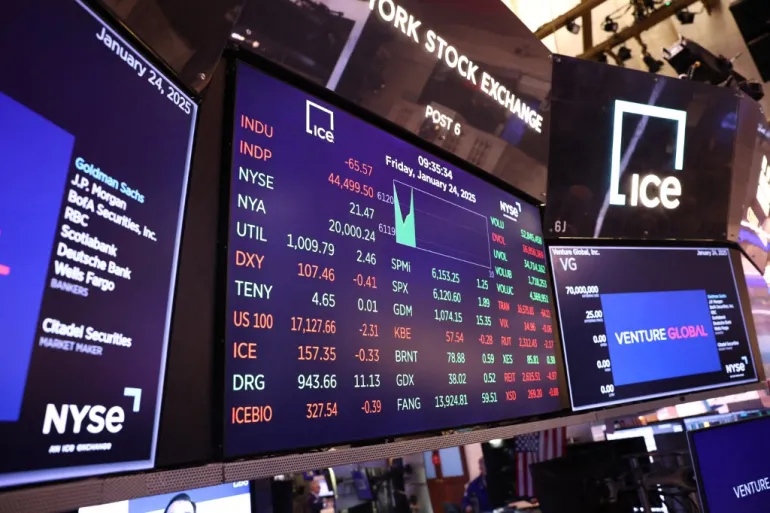
By 09:31 ET (13:31 GMT), the S&P 500 dropped 1.0% (68 points), the Nasdaq Composite fell 1.5% (333 points), and the Dow Jones Industrial Average was down 0.9% (393 points).
Markets had rallied Monday after President Donald Trump appeared to soften his tone on China, following earlier threats to raise tariffs to triple digits over Beijing’s expanded rare earth export controls. Trump’s remarks were later tempered, easing short-term fears of escalation.
Meanwhile, U.S. Treasury Secretary Scott Bessent confirmed that a meeting between Trump and Chinese President Xi Jinping in South Korea later this month remains on track.
Still, investors remain cautious. China recently sanctioned five U.S.-linked subsidiaries of South Korea’s Hanwha Ocean, while both countries are moving forward with additional port fees on global shipping — affecting goods from toys to crude oil.
Bank Earnings Kick Off Reporting Season
Attention turned to Wall Street’s major banks as earnings season officially began.
JPMorgan Chase posted stronger-than-expected results, with profit and adjusted revenue boosted by a rebound in dealmaking after months of tariff-related slowdown. Investment banking fees rose 16%, and net income jumped 21% to $6.9 billion. However, shares fell after the bank increased its credit loss provisions to $3.4 billion, as CEO Jamie Dimon warned of ongoing economic uncertainty, citing geopolitical tensions, sticky inflation, and labor market softness.
Wells Fargo also reported better-than-expected Q3 results, with revenue growth across both its consumer and commercial divisions pushing shares up over 3%. The bank recorded $1.66 EPS on $21.44 billion revenue, beating analyst forecasts.
Bank of America and Morgan Stanley are set to report their earnings next.
Outside banking, Johnson & Johnson beat expectations for both earnings and revenue but saw shares drop 1.7% after announcing plans to spin off its orthopaedics division.
General Motors reported a $1.6 billion charge tied to its reduction in electric vehicle production, as weaker policy support challenges the EV industry. Shares traded slightly higher.
Powell Speech Ahead of Fed Policy Meeting
Markets are also watching Federal Reserve Chair Jerome Powell, who is set to speak at the National Association for Business Economics conference — his final remarks before the Fed’s next policy meeting.
Analysts expect Powell to comment on the lack of key data caused by the ongoing U.S. government shutdown, which has delayed several economic indicators. While some workers have been recalled to release the September CPI report, the timeline for other reports remains uncertain.
According to CME’s FedWatch Tool, traders expect another 25-basis-point rate cut at the upcoming October 28–29 meeting. The Fed reduced rates by the same amount last month to support a slowing labor market.
The shutdown itself shows no sign of resolution, even as the Senate reconvenes.
Gold Hits Record High, Oil Prices Reverse
Gold prices surged to a new all-time high above $4,100 per ounce, supported by growing rate cut expectations and safe-haven demand amid trade uncertainty.
Spot gold rose 0.1% to $4,113.54, after touching a peak of $4,179.48, while futures steadied around $4,132.85 per ounce. The precious metal has gained over 50% year-to-date, breaking the $4,100 level for the first time on Monday.
In contrast, oil prices fell, reversing earlier gains as trade worries reignited concerns about global demand.
A report from the International Energy Agency (IEA) showed that global oil supply could rise by 3 million barrels per day to 106.1 million bpd in 2025, with additional growth projected in 2026. Much of this increase comes from OPEC+, which is unwinding output cuts faster than planned, raising fears of an oversupplied market.
By 09:40 ET, Brent crude was down 2.0% to $62.09, and U.S. WTI fell 1.9% to $58.38 per barrel.