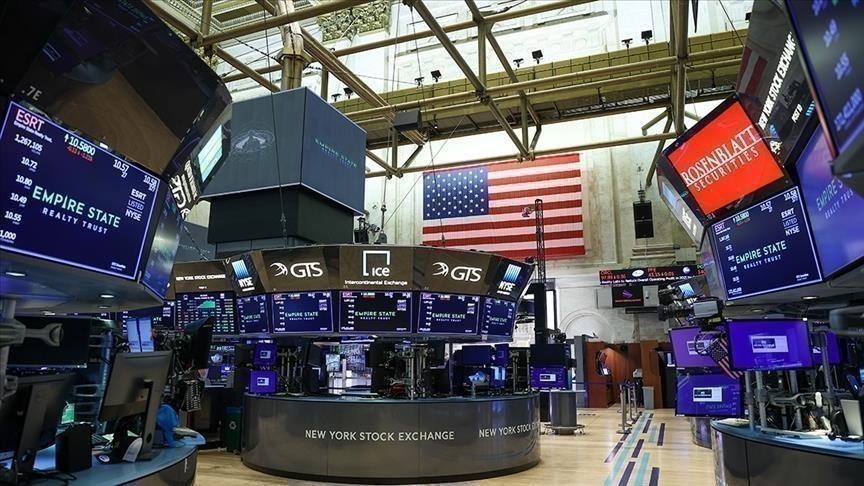
U.S. stocks moved lower on Friday as continued weakness in the technology sector combined with stronger-than-expected producer inflation data weighed on investor sentiment.
At 10:51 ET (15:51 GMT), the S&P 500 declined 0.7% to 6,860.24, while the tech-heavy Nasdaq Composite dropped 0.9% to 22,676.82. The Dow Jones Industrial Average underperformed, falling 1.3% to 48,881.14.
Wall Street had already closed mostly lower on Thursday, with the S&P 500 down 0.5% and the Nasdaq losing 1.2%, although the Dow managed a slight gain.
Tech Stocks Pressure the Market
Nvidia (NASDAQ: NVDA), currently the world’s most valuable company, was a major drag on markets. The stock fell more than 5% despite reporting strong quarterly earnings. Investors appeared concerned about the company’s shareholder return strategy, particularly following a significant rise in its cash balance. Some profit-taking after a strong pre-earnings rally also weighed on shares.
In contrast, Netflix (NASDAQ: NFLX) surged nearly 9% after announcing it would not increase its offer for Warner Bros Discovery (NASDAQ: WBD). Warner determined that an improved $31 per share bid from Paramount Skydance (NASDAQ: PSKY) was superior. Paramount shares jumped 10.5%, while Warner fell 1.6%.
Netflix said matching Paramount’s latest offer would make the deal “no longer financially attractive.” If Warner proceeds with the Paramount proposal, Netflix is set to receive a $2.8 billion termination fee. Warner shareholders are scheduled to vote on the deal on March 20.
Elsewhere, Dell Technologies (NYSE: DELL) climbed about 19% after reporting record quarterly results driven by robust demand for AI servers. Block (NYSE: XYZ) gained 17% after announcing plans to cut more than 4,000 jobs as part of a restructuring effort to integrate artificial intelligence across its operations.
Producer Price Index Surprises to the Upside
On the economic front, January’s Producer Price Index (PPI) rose 0.5% month-over-month and 2.9% year-over-year, both exceeding expectations of 0.3% and 2.6%. Core PPI, which excludes food and energy, increased 0.8% monthly and 3.6% annually, also surpassing forecasts.
Market participants reacted cautiously, as hotter producer inflation could complicate the Federal Reserve’s rate-cut outlook. While inflation had recently taken a back seat to concerns about AI-driven labor market disruption, the stronger PPI data may encourage policymakers to remain patient before easing monetary policy.
JPMorgan analysts slightly revised higher their estimate for January’s core PCE price index, the Fed’s preferred inflation gauge, following the PPI report. The firm now expects core PCE to rise 0.42% month-over-month, compared to its previous estimate of 0.39%.
Analysts suggested that while some Federal Reserve officials may attribute the recent inflation uptick to temporary factors, it is likely to reinforce broader concerns about persistent above-target inflation expressed in recent FOMC minutes.
OpenAI Announces Record $110 Billion Funding Round
In corporate news, Microsoft-backed OpenAI unveiled a record-breaking $110 billion investment round, marking the largest private tech funding deal to date. The round includes $30 billion from SoftBank, $30 billion from Nvidia, and $50 billion from Amazon, giving OpenAI a pre-money valuation of $730 billion.
The company emphasized that rising AI demand across consumers, developers, and businesses requires expanded computing capacity, distribution infrastructure, and capital. OpenAI also confirmed a strategic partnership with Amazon and secured next-generation inference capacity from Nvidia.
Oil Prices Rise Despite Ongoing U.S.–Iran Talks
Oil prices ended the week higher even as the United States and Iran agreed to continue negotiations over Tehran’s nuclear program.
Brent crude futures rose 2.5% to $72.65 per barrel, while West Texas Intermediate (WTI) gained 2.6% to $66.88 per barrel.
Although talks concluded without a definitive agreement, both sides signaled plans to resume discussions next week in Vienna. Markets remain attentive to geopolitical risks that could impact global oil supply.