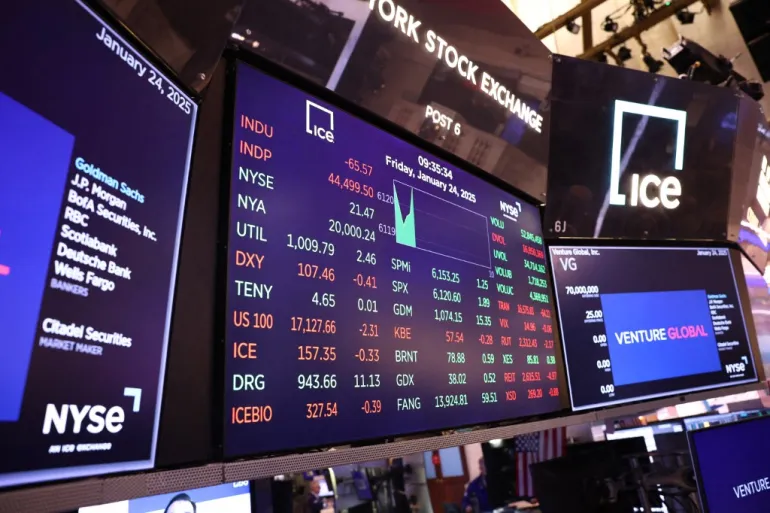
U.S. stocks declined on Monday as investors grew increasingly uneasy about the independence of the Federal Reserve, kicking off a packed week that includes the start of fourth-quarter earnings season and the release of closely watched U.S. inflation data.
By 09:35 ET (14:35 GMT), the Dow Jones Industrial Average was down 380 points, or 0.8%. The S&P 500 slipped 24 points, or 0.3%, while the NASDAQ Composite fell 57 points, or 0.2%.
Both the Dow and the S&P 500 ended last week at record highs, extending a recent run of gains before sentiment shifted at the start of the new trading week.
Political pressure intensifies on Powell
Federal Reserve Chair Jerome Powell said late Sunday that federal prosecutors have opened a criminal investigation tied to his testimony before the Senate Banking Committee regarding renovations to Fed office buildings. Powell suggested the legal threat was politically motivated, pointing to repeated pressure from President Donald Trump to aggressively cut interest rates.
Powell stressed that the issue goes beyond his testimony or the renovation project, warning that it raises broader questions about whether monetary policy decisions will continue to be guided by economic data rather than political influence or intimidation.
His remarks marked his strongest response yet to rising political scrutiny of the central bank. Over the past year, Trump has publicly called for interest rate cuts of at least two percentage points, while the Fed reduced rates by a total of 0.75% in 2025, citing persistent inflation pressures and uncertainty linked to trade policy.
The standoff between the White House and the Fed has taken on added significance with Powell’s term set to expire in May. Trump said last week he is close to naming a successor.
Analysts at ING said Powell’s comments were clearly framed as an attack on the Fed’s independence. They noted that the initial market reaction — simultaneous declines in the dollar, equities, and Treasuries — echoed the so-called “sell America” phase seen last spring.
Inflation data takes center stage
This week’s economic calendar is highlighted by the release of December consumer price index data on Tuesday. Headline inflation is expected to remain steady, while core CPI is forecast to edge slightly higher.
The report follows softer-than-expected inflation figures for November, which some analysts attributed to distortions caused by a prolonged government shutdown late last year.
Markets are widely expecting the Federal Reserve to leave interest rates unchanged at its January meeting, after signaling a higher threshold for further rate cuts in 2026.
Additional data releases this week include producer price inflation, retail sales figures, and comments from several Federal Reserve officials.
Banks kick off fourth-quarter earnings season
Corporate earnings also come into focus, with major U.S. banks set to open the fourth-quarter reporting season.
JPMorgan Chase and Bank of New York Mellon are scheduled to report on Tuesday. Results from Bank of America, Wells Fargo, and Citigroup are due on Wednesday.
Later in the week, investors will hear from Morgan Stanley, Goldman Sachs, and asset manager BlackRock.
The results should shed light on how U.S. corporations navigated economic disruptions from the late-2025 government shutdown and ongoing geopolitical tensions.
Ahead of earnings, financial stocks came under pressure after Trump proposed a one-year cap on credit card interest rates, reviving concerns over increased regulatory scrutiny. In a social media post on Saturday, Trump said he wants to impose a 10% ceiling on credit card annual percentage rates starting January 20, arguing that current rates of 20%–30% are unfair to consumers.
Gold rallies, oil steadies
Elsewhere, gold surged to fresh record highs as investors sought safety amid rising unrest in Iran, growing political pressure on the Federal Reserve, and weaker U.S. employment data.
Spot gold climbed as much as 2% to a record $4,601.17 an ounce and was last trading up 1.8% at $4,589.84. A softer U.S. dollar added to gold’s appeal by making it cheaper for overseas buyers.
Oil prices, meanwhile, consolidated following recent gains. Continued civil unrest in Iran — a key Middle Eastern oil producer — has raised concerns about potential supply disruptions.
Brent crude futures dipped 0.2% to $63.19 a barrel, while U.S. West Texas Intermediate fell 0.1% to $58.90. Both benchmarks rose more than 3% last week as widespread protests intensified, marking the largest demonstrations against Iran’s clerical leadership since 2022 and heightening fears of broader regional instability.