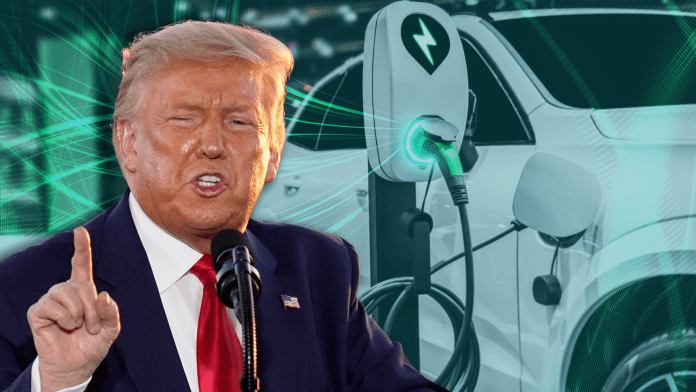
Trump’s EV Crackdown Sends Shockwaves Through America’s Battery Belt
Stanton, Tennessee — population 450 — once buzzed with excitement after Ford Motor Company broke ground in 2022 on a massive electric truck and battery plant expected to employ 6,000 workers. The project transformed the quiet farmland outside Memphis into a construction hub, as local diners filled with workers and developers raced to build new homes and facilities.
Today, that energy has faded. Over the past 18 months, Ford has repeatedly delayed key phases of the plant. The company now plans to begin initial EV production in 2027, with deliveries expected the following year — a sharp delay from the original 2025 launch.
Ford said in a statement that it would remain “nimble” and adjust its product launch timeline to reflect market demand and profitability goals.
A Slowing EV Market and New U.S. Policies
The Ford complex is part of the so-called Battery Belt, a stretch of EV and battery factories running from Georgia to Indiana, representing tens of billions in investment and thousands of promised jobs. Many of these projects are located in Republican-led states like Kentucky and Georgia, which saw a manufacturing boom tied to the electric vehicle push.
But enthusiasm for electric cars has cooled. Consumer demand has weakened, and the expiration of a $7,500 federal EV tax credit on September 30 — part of President Donald Trump’s new economic policies — could further hurt sales. Ford CEO Jim Farley predicted that EV sales may fall by 50% as a result.
Experts say the end of EV incentives, combined with stricter funding rules for battery manufacturers, could threaten the survival of dozens of projects. Many automakers have already scaled back, postponed, or canceled factory plans.
Impact on Local Economies and the Future of Battery Projects
The uncertainty has rattled small towns like Stanton, where locals worry Ford may never finish the plant. Former Mayor Allan Sterbinsky, who lobbied for the project, said residents are anxious about the delays but hopeful the company might repurpose the 3,600-acre site if EV demand remains weak.
Ford says it continues to invest in the community, including $9 million in grants to public safety and infrastructure projects. Still, research from Benchmark Intelligence shows a possible oversupply of battery capacity if all announced U.S. projects move forward. By 2030, the planned factories could produce enough batteries for 13–15 million EVs annually, but analysts expect the U.S. will need only about 3 million units by then.
Some of the excess capacity could serve hybrid vehicles or energy storage systems, but analysts warn of a significant gap between investment and actual demand.
Hyundai’s Georgia Megasite and the Industry’s Uncertain Path
One of the country’s largest EV projects, Hyundai’s $12.6 billion EV and battery plant near Savannah, Georgia, is continuing despite recent challenges. The project suffered delays after a federal raid, but Hyundai says construction will resume within months. The complex plans to hire 8,500 workers by 2031, with wages 25% above the county average, according to Trip Tollison of the Savannah Economic Development Authority.
Tollison acknowledged community worries but expressed confidence that Hyundai can pivot to hybrid production if the EV market continues to slow. “That’s how you lift people out of poverty — by keeping opportunity flexible,” he said.
Despite political uncertainty and market headwinds, analysts say the Battery Belt remains central to America’s industrial revival — but its future may depend on whether Trump’s EV rollback becomes a long-term policy or a temporary pause.