Wall Street Slides as Trump Threatens More Tariffs on China
Wall Street stocks tumbled on Friday after U.S. President Donald Trump said he was considering a “massive increase” in tariffs on Chinese imports amid a growing rare earth dispute between Washington and Beijing.
In a post on Truth Social, Trump added that there was “no reason” to meet with Chinese President Xi Jinping later this month in South Korea, accusing China of sending letters to countries around the world to announce plans for export controls on rare earth elements — key materials in electronics, defense, and renewable energy industries.
The announcement abruptly ended what had been a calm trading session, with markets previously lifted by expectations of Federal Reserve rate cuts. The sudden escalation in U.S.-China trade tensions rattled investor confidence and reignited fears about the global economic outlook.
“He’s caught the market off guard again and thrown more question marks into it,” said Robert Pavlik, senior portfolio manager at Dakota Wealth.
Major Indexes and Sectors Drop
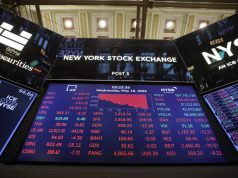
By mid-morning trading, the Dow Jones Industrial Average dropped 446 points (0.96%) to 45,911.98, the S&P 500 slid 99 points (1.47%) to 6,635.51, and the Nasdaq Composite plunged 495 points (2.17%) to 22,525.37.
“We finally got through the worst of the tariff concerns, and now we find ourselves once again facing another round,” said Steve Sosnick, chief market analyst at Interactive Brokers.
Losses were broad-based:
- The S&P 500 tech sector fell 1.9%.
- Financial stocks slipped 1%, and energy shares declined 1.3%.
- The Philadelphia Semiconductor Index dropped 3.4%, making it one of the hardest-hit groups after Trump’s remarks.
The CBOE Volatility Index (VIX) — often referred to as Wall Street’s “fear gauge” — spiked to its highest level in a month, signaling renewed market unease.
China Stocks, Qualcomm Hit Hard
U.S.-listed Chinese stocks suffered steep losses, with Alibaba Group, JD.com, and PDD Holdings each plunging between 5.5% and 6%.
Qualcomm also fell 4.6% after reports that China’s antitrust regulator launched an investigation into its acquisition of Israel’s Autotalks.
Meanwhile, the University of Michigan’s Consumer Sentiment Index for October came in at 55, slightly above expectations of 54.2, offering a modest sign of consumer resilience despite market volatility.
On the New York Stock Exchange, decliners outnumbered advancers by a 2.7-to-1 margin, while on the Nasdaq, the ratio widened to 3.3-to-1. The S&P 500 logged 17 new 52-week highs and 12 new lows, while the Nasdaq Composite recorded 93 new highs and 82 new lows.