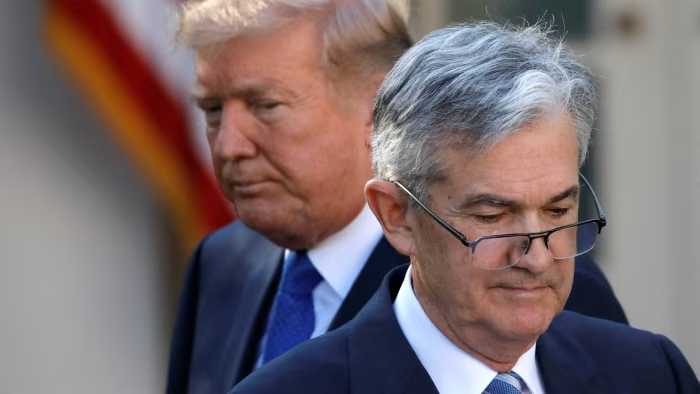
Jerome Powell, chair of the Federal Reserve, said on Sunday that the U.S. Department of Justice has launched a criminal investigation into whether he misled Congress over cost overruns tied to a renovation of the central bank’s Washington headquarters.
The move represents a sharp escalation in pressure from U.S. President Donald Trump, who has repeatedly criticized the Fed for not cutting interest rates quickly enough. While the White House says Trump did not personally order the investigation, the president has publicly called on Powell to step down and suggested he should face legal consequences related to the project’s rising costs.
Critics warn that Trump’s actions could undermine the independence of the world’s most influential central bank, potentially weakening confidence in the U.S. economy and financial system.
Why this matters
Since returning to office a year ago, Trump has sought to exert greater control over the federal government, dismissing thousands of civil servants, removing internal watchdogs, and pushing out Democratic appointees from agencies designed to operate independently. While several institutions have faced pressure, the Federal Reserve stands out as the most consequential target.
The Fed’s mandate is to keep inflation under control, support employment, and maintain financial stability by setting the federal funds rate, which influences borrowing costs across the economy. Rates that are set too high can slow growth by discouraging borrowing, while rates that are too low risk fueling inflation. After aggressively raising rates in 2022 and 2023 to combat post-pandemic inflation, the Fed began easing policy in 2024 and delivered three rate cuts late last year.
What Fed independence means
Congress structured the Fed to operate at arm’s length from political influence. Its seven governors serve staggered 14-year terms, preventing any single president from appointing a majority. Interest rate decisions are also shared with five of the 12 regional Fed bank presidents on a rotating basis, and the institution funds itself independently of Congress.
Trump has repeatedly urged the Fed to slash rates to around 1%, a level typically seen only during crises, and has criticized Powell whenever policy decisions failed to align with his preferences.
The president has also attempted to remove another Fed governor, Lisa Cook, accusing her of filing misleading mortgage documents. Cook has denied the allegations and filed a lawsuit to retain her position. The U.S. Supreme Court is scheduled to hear her case on January 21, a ruling that could have far-reaching implications for the Fed’s autonomy.
Is this unprecedented?
While U.S. presidents have occasionally pressured the Fed behind the scenes, none has publicly threatened to dismiss Fed officials or supported criminal investigations against them.
The Justice Department’s role has also drawn scrutiny. Over the past year, it has pursued cases involving several of Trump’s political opponents, including former FBI Director James Comey, New York Attorney General Letitia James, and Democratic Senator Adam Schiff. Observers note that this marks a departure from past administrations, where prosecutors typically maintained more distance from the White House.
The renovation controversy
The Fed is renovating two historic buildings at its Washington headquarters, with costs rising from an initial estimate of $1.9 billion to roughly $2.5 billion. Officials attribute the increase to higher labor and materials costs, design changes, and unexpected hazards such as asbestos and lead.
Trump has accused Powell of mismanagement and hinted at possible fraud, though he has not presented evidence. The White House has criticized the project as extravagant, citing features such as VIP elevators and premium marble. Powell has rejected those claims and said the upgrades are necessary to address safety concerns.
What Powell is being investigated for
Powell said he has received subpoenas related to his testimony before the Senate Banking Committee last June about the renovation. That suggests prosecutors may be examining whether he provided false statements to Congress, an allegation Powell denies. The Justice Department has not publicly commented, and several Republican senators have said they are not troubled by Powell’s testimony or the project itself.
Could this backfire on Trump?
Possibly. Powell’s term as Fed chair ends in May, but he could remain on the board until 2028, limiting Trump’s ability to reshape the institution quickly. The controversy has also unsettled some Republicans in Congress.
Senator Thom Tillis has said he will oppose future Fed nominees, while Senator Lisa Murkowski has called for an investigation into the Justice Department. Their resistance could stall confirmations in the closely divided Senate Banking Committee, complicating Trump’s plans to install allies at the Fed.
That said, Trump’s strategy could still succeed. A Supreme Court ruling in his favor or criminal charges against Powell could open seats on the board. The Fed’s next policy meeting is scheduled for January 27–28, with little expectation of another rate cut, and several voting regional bank presidents have signaled opposition to further easing.
How investors are reacting
Analysts warn that a politicized Fed could face constraints in managing the economy, raising the risk of higher inflation and threatening the dollar’s role as the world’s reserve currency. That could push investors to demand higher yields on U.S. debt, increasing borrowing costs.
So far, however, markets appear calm. Despite early losses, major U.S. stock indices finished modestly higher on Monday, suggesting investors are watching developments closely but are not yet alarmed.