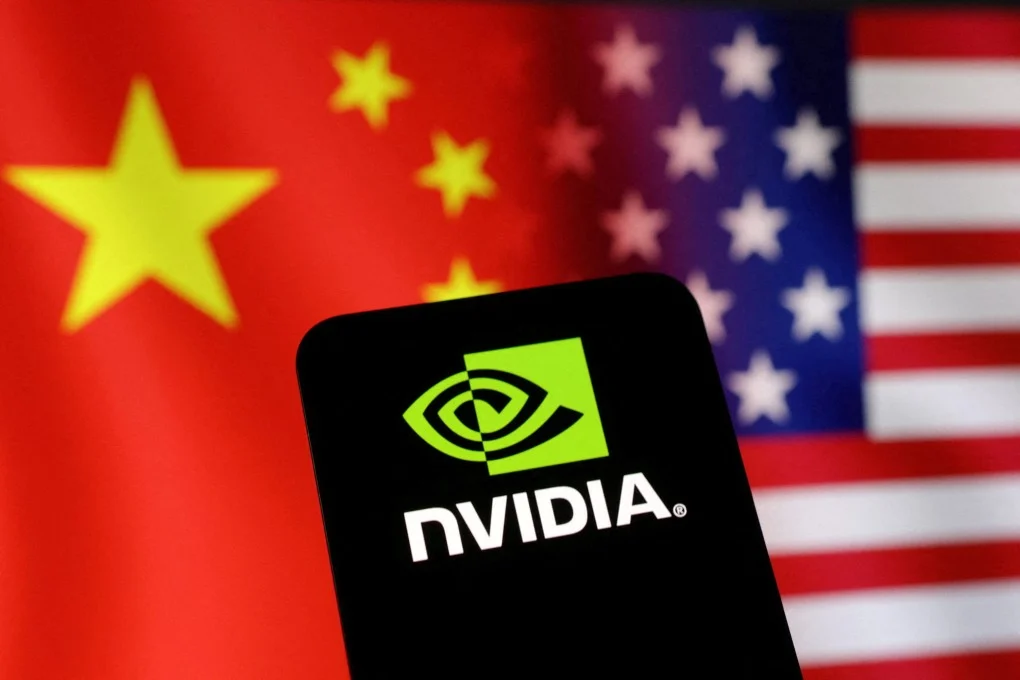
U.S. President Donald Trump announced on Monday that the United States will allow Nvidia’s H200 processors—its second-most powerful AI chips—to be exported to China, with a 25% fee applied to those sales.
The move appears to settle an ongoing debate in Washington over whether U.S. chipmakers should maintain their global lead by selling high-end chips to China or restrict sales to protect national security. It remains unclear whether China will buy the chips, as Beijing has urged domestic firms to avoid U.S. technology.
Nvidia shares climbed 2% in after-hours trading following Trump’s announcement on Truth Social, after rising 3% earlier in the day on a report from Semafor.
Trump said he informed China’s President Xi Jinping about the decision and received a “positive” response. He added that the U.S. Commerce Department is finalizing the details and that the same approach would apply to other AI chipmakers, including AMD and Intel.
According to Trump, the U.S. government will collect a 25% fee—higher than the 15% rate proposed in August. He said the goal is to protect national security, support American jobs, and maintain U.S. leadership in artificial intelligence.
He emphasized that Nvidia’s newest Blackwell and Rubin chips, used widely by U.S. AI firms, are not included in the agreement.
Trump did not say how many H200 units will be approved for export. He noted only that shipments will occur “under conditions that allow for continued strong National Security.”
Officials familiar with the discussions said the decision represents a compromise: it avoids sending Nvidia’s newest Blackwell chips to China, while still allowing limited H200 exports to prevent China from relying solely on Huawei for advanced AI chips.
Nvidia welcomed the decision, saying that offering H200 chips to vetted commercial customers through Commerce Department oversight “strikes a thoughtful balance.” Intel declined to comment, and AMD did not respond.
A White House official said the 25% fee will function as an import tax collected when the chips enter the United States from Taiwan—where they are made—before undergoing a security review and then being exported to China.
National Security Concerns Persist
Critics in Washington warned that selling high-end chips to China could accelerate Beijing’s military modernization. These concerns drove the Biden administration’s earlier restrictions on AI chip exports.
Some officials questioned whether the new approach compromises long-standing U.S. policies aimed at preventing China from advancing its military capabilities. Former Commerce Department official Eric Hirschhorn said: “It’s a terrible mistake to trade off national security for advantages in trade.”
A recent report from the Institute for Progress stated that the H200 is nearly six times more powerful than the H20, the most advanced chip the U.S. currently allows for export to China.
The report also noted that Nvidia’s new Blackwell chips are 1.5 times faster than the H200 for AI training and up to 10 times faster for certain inference tasks, underscoring the widening performance gap.
Several Democratic senators called Trump’s decision a “colossal economic and national security failure,” while Republican Representative John Moolenaar said China will use the chips to strengthen its military and steal Nvidia’s technology.
China Raises Security Concerns Over Nvidia Chips
China has recently increased scrutiny of U.S. hardware. Earlier this year, Beijing’s cyberspace regulator claimed Nvidia’s H20 chips could pose potential security risks, an allegation Nvidia has denied.
Sources also said the Chinese government has discouraged domestic tech firms from purchasing downgraded Nvidia chips like the H20, RTX 6000D, and L20.
Craig Singleton, a senior fellow at the Foundation for Defense of Democracies, said China wants H200 chips, but political tensions may still limit approvals: “Washington may approve the chips, but Beijing still has to let them in.”
Timing Follows Crackdown on Chip Smuggling
Trump’s announcement came on the same day the U.S. Justice Department revealed it had disrupted a China-linked smuggling network that attempted to export at least $160 million worth of restricted Nvidia H100 and H200 chips in late 2024 and early 2025.
Chris McGuire, a former State Department national security official, said Chinese firms will likely still buy H200s because the chip remains far more powerful than anything China can produce domestically.
China’s domestic AI chip industry includes Huawei—now developing a three-year chip roadmap—as well as emerging competitors like Cambricon and Moore Threads.
Despite initial losses at market open, China’s SSE STAR Chip Index and the CSI Semiconductor Index recovered most of their declines by midday Tuesday.