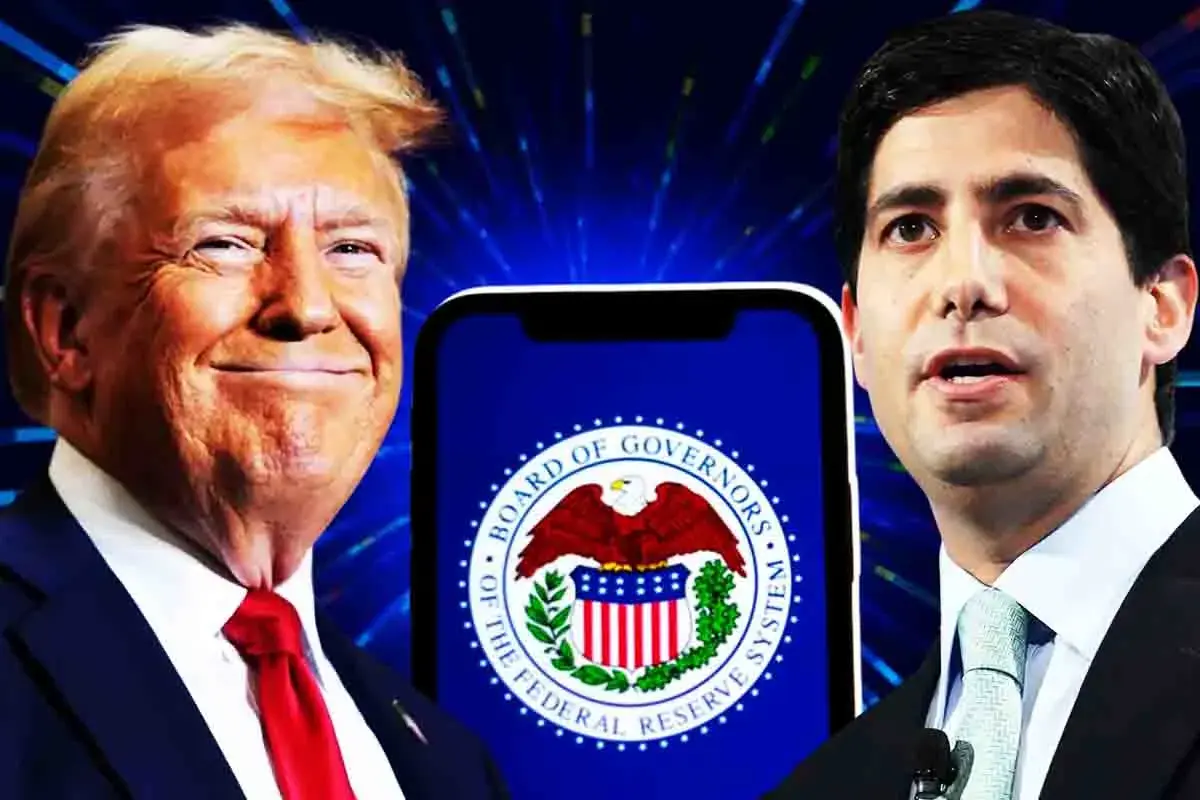
President Donald Trump is expected to announce his nominee to succeed Jerome Powell as chair of the Federal Reserve on Friday, following a White House meeting a day earlier with former Fed Governor Kevin Warsh. Warsh has been a vocal critic of the central bank and has argued that it needs a “regime change” to restore credibility.
Speaking to reporters at the Kennedy Center on Thursday, Trump said he would reveal his choice the next morning, adding that the pick would be “somebody that could have been there a few years ago” and describing the decision as a strong one. A source later confirmed to Reuters that Warsh, 55, met with Trump at the White House.
During his first term, Trump had passed over Warsh in favor of Powell, a decision he later criticized after Powell declined to cut interest rates as aggressively as Trump wanted. This time, Trump has made support for lower rates a clear requirement for any Fed chair candidate. Warsh, along with the other finalists identified by Trump officials, has said the Fed should have moved faster to ease policy.
The nomination, which must be confirmed by the Senate, comes amid unusually intense efforts by the White House to exert influence over the central bank. Traditionally, the Fed’s independence from political pressure has been seen as critical to its role in fighting inflation.
Trump’s push has included an attempt to remove Fed Governor Lisa Cook, a case now before the Supreme Court, as well as a Justice Department probe that Powell has described as part of a broader campaign to intimidate the Fed.
Powell’s term as chair ends in May, and he has declined to say whether he would remain on the Fed’s Board of Governors—an uncommon move that would limit Trump’s ability to fill another vacancy and potentially complicate the transition to new leadership. Powell’s term as a governor runs through 2028.
Trump’s promise of a Friday announcement came just hours after he had suggested the decision would be revealed next week. A White House schedule released late Thursday did not explicitly list a nomination event, showing only an executive order signing session in the late morning and a policy meeting in the afternoon.
Warsh faces heightened scrutiny
Trump’s eventual nominee could face resistance in the Senate. Republican Senator Thom Tillis of North Carolina has warned he may block Fed nominations until the Justice Department investigation involving the central bank is resolved.
Warsh, who served as a Fed governor from 2006 to 2011, was a key liaison to Wall Street under then-Chair Ben Bernanke during the 2008 financial crisis and was known as an advocate of tighter monetary policy. More recently, he has said Trump is right to pressure the Fed for deeper interest-rate cuts.
He has also criticized the central bank for underestimating the inflation-fighting benefits of productivity gains driven by artificial intelligence.
With a Wall Street background that includes managing wealth for billionaire investor Stanley Druckenmiller, and family ties to prominent Trump supporter Ron Lauder, Warsh is likely to face close scrutiny over his independence from the president. While not a White House insider, he has been a longtime confidant of Trump and a guest at his Florida estate, raising expectations that he could act as a “shadow” Fed chair until Powell’s term ends in mid-May.
A lawyer and visiting fellow at Stanford University’s Hoover Institution, Warsh has called for a sweeping overhaul of the Fed, including shrinking its balance sheet and easing banking regulations. He argues that reducing the balance sheet would allow excess liquidity in financial markets to be redirected into the real economy by lowering the policy rate.
That view has gained little traction at the current Fed, which cut rates three times in 2025 but held its benchmark rate steady this week in the 3.50%–3.75% range, signaling no urgency to ease further. The central bank has also paused its balance sheet runoff, citing the need to keep banking reserves ample for effective policy control.
Other names previously floated for the Fed chair role include Rick Rieder of BlackRock, Fed Governor Christopher Waller—one of two officials who dissented from the latest rate decision—and White House economic adviser Kevin Hassett, a strong supporter of several of Trump’s unconventional economic policies.