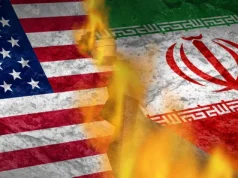
U.S. President Donald Trump said Thursday that an Israeli military strike on Iran “could very well happen,” echoing warnings from a senior Israeli official cited by The Wall Street Journal, who suggested the attack could take place as early as Sunday unless Iran halts its production of nuclear bomb-grade material.
U.S. intelligence has reportedly confirmed that Israel is preparing for such an operation targeting Iran’s nuclear infrastructure, with several American officials—speaking anonymously—stating that an Israeli attack could occur within days.
This is the first public indication of a possible timeline for Israeli military action, as tensions escalate over Iran’s nuclear ambitions. Israel has long sought to prevent Tehran from acquiring nuclear weapons.
Although Trump reaffirmed his preference for a peaceful resolution, some observers suspect that the threat of an imminent Israeli strike may be a tactic to pressure Iran into making concessions at the negotiating table.
“We remain committed to a Diplomatic Resolution to the Iran Nuclear Issue!” Trump posted on Truth Social. He added that his administration has been instructed to pursue negotiations with Iran, saying the country has potential to thrive—but only if it abandons its nuclear ambitions entirely.
Diplomatic progress appears stalled, as a sixth round of U.S.-Iran talks on Tehran’s accelerating uranium enrichment program is set to take place Sunday in Oman, mediated by Omani officials.
Fears of a broader regional conflict are rising amid speculation over an Israeli strike. Iran has threatened to retaliate and has repeatedly stated its goal to eliminate Israel.
Axios reported that the White House has informed Israel it will not directly participate in any military operation targeting Iran’s nuclear sites, citing U.S. and Israeli sources. Analysts suggest Israel is unlikely to act without at least some level of U.S. backing, as past threats have not materialized without Washington’s support.
According to The Wall Street Journal, the U.S. has ruled out offering “offensive assistance” but might provide logistical, intelligence, or defensive aid if Israel comes under Iranian retaliation.
A solo Israeli strike would likely be more constrained, as its air force lacks bombers capable of delivering the deep-penetration “bunker buster” bombs needed to destroy Iran’s fortified Fordow nuclear facility.
Iran Declared in Breach by UN Nuclear Watchdog
The International Atomic Energy Agency (IAEA) board on Thursday found Iran in violation of its nuclear non-proliferation commitments. Tehran responded by announcing plans to expand its uranium enrichment program, including the construction of a third enrichment facility.
A senior Iranian official said a “friendly country” had privately warned of a possible Israeli strike.
Security jitters have grown since Trump revealed that U.S. personnel were being relocated from the region due to potential threats, asserting that Iran must not be allowed to acquire nuclear weapons.
Israeli Prime Minister Benjamin Netanyahu reportedly discussed the possibility of a strike with Trump during a call earlier in the week, according to U.S. officials.
“I don’t want to say imminent, but it looks like it’s something that could very well happen,” Trump said at a White House event, adding that conflict could be avoided—but only if Iran makes greater concessions. “Iran’s going to have to negotiate a little bit tougher,” he said.
The wider region is already unstable, with fallout from the Gaza conflict between Israel and Hamas further complicating matters.
Trump also warned he might authorize airstrikes on Iran if diplomatic efforts collapse. He voiced growing skepticism that Iran will agree to limit its uranium enrichment, while the Islamic Republic continues to demand relief from U.S. sanctions reimposed in 2018 after Trump withdrew from the original nuclear accord.
Trump further expressed concern over rising oil prices, attributing the increase to geopolitical uncertainty stemming from the growing risk of war in the Middle East.
With limited explanation from U.S. officials, some diplomats believe that the troop movements and media leaks about an Israeli strike may be part of a strategy to intensify pressure on Tehran ahead of Sunday’s negotiations.
A senior Iranian official told Reuters that the heightened tension appears designed to push Iran into softening its stance on nuclear rights during the upcoming talks.
Iranian President Masoud Pezeshkian stated that even if Iran’s nuclear facilities were bombed, they would be rebuilt, according to state media.
The IAEA’s finding marks the first time in nearly two decades that the agency has formally accused Iran of breaching non-proliferation obligations, raising the possibility of a referral to the UN Security Council. An IAEA official said Tehran informed the agency of its intent to expand enrichment activities following the board’s resolution.
Although Iran claims its nuclear program is strictly for peaceful energy use, uranium enrichment at higher levels can be used to produce material for nuclear weapons.