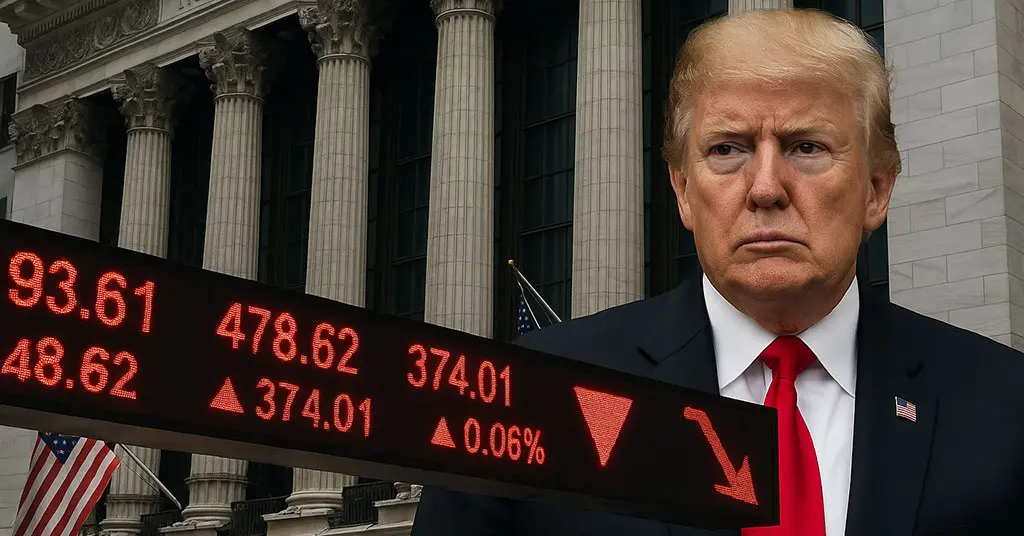
The U.S. Supreme Court’s decision to overturn President Donald Trump’s tariff policy has not brought relief to financial markets. Instead, it has introduced fresh uncertainty around U.S. trade policy, federal debt levels and the direction of the dollar.
The Court did not clarify whether previously collected tariffs must be refunded. This leaves open the possibility of a gap of roughly $170 billion in U.S. government finances. In response, President Donald Trump quickly moved to impose replacement levies, a step that has unsettled European leaders and added further confusion to global trade policy.
Dollar weakens as Treasury market assesses fiscal risks
The U.S. dollar extended its decline during Monday’s Asian trading session, falling notably against traditional safe-haven currencies such as the Swiss franc and the Japanese yen. At the same time, U.S. Treasury markets struggled to interpret the broader consequences for fiscal stability and inflation.
One immediate conclusion is that Trump’s replacement tariffs, set at lower levels, could ease short-term inflation pressures. However, the Supreme Court ruling has also limited presidential authority on trade measures. The longer-term impact of this constraint on the U.S. economy and financial markets remains uncertain.
Analysts warn that uncertainty has returned to the forefront. Heightened rhetoric from European officials has also raised the risk of further trade escalation compared to a year ago.
For the Treasury market, a major concern is the prospect of litigation over tariff refunds. Such cases could take months to move through lower courts, prolonging fiscal uncertainty.
Tariff refunds and U.S. debt issuance concerns
Estimates suggest that tariffs have generated more than $175 billion in revenue so far. While this is small compared with total projected U.S. revenues of over $5 trillion, it is large enough to affect borrowing needs if refunds are required.
If repayments occur, the U.S. government may need to increase debt issuance. That could place upward pressure on long-term Treasury yields, particularly if additional borrowing coincides with already elevated funding requirements and ongoing quantitative tightening by the Federal Reserve.
The 10-year Treasury yield recently stood near 4.1%, down from peaks above 4.5% in mid-2025. The yield curve has steepened, mainly due to falling short-term yields as investors anticipate potential Federal Reserve rate cuts amid moderating inflation.
In Asia, cash Treasury trading was closed for a Tokyo holiday, though futures implied a slightly lower 10-year yield near 4.05%.
Some investors believe markets are focusing too narrowly on short-term effects, such as the possibility of lower inflation and faster rate cuts. A wider perspective suggests that additional borrowing could expand an already large fiscal deficit, potentially leading to further steepening of the yield curve.
Revenue uncertainty clouds the outlook
The Congressional Budget Office had projected that Trump’s tariffs would raise around $300 billion annually over the next decade. However, the newly announced 15% replacement tariff will only remain in place for 150 days, and its full scope remains unclear. Previous tariff rates varied, with some countries such as Britain and Australia facing 10%, while several Asian economies were subject to higher levels.
Bond market participants are particularly sensitive to the risk of increased issuance if refunds are mandated, especially if this occurs alongside other fiscal stimulus measures.
Nevertheless, market reactions have so far been contained. Some analysts argue that concerns about the U.S. fiscal deficit may be overstated, particularly if alternative revenue measures are found or if any additional funding relies on shorter-term Treasury bills.
President Donald Trump may also face limitations in implementing proposals such as a $2,000 “tariff dividend” payment to Americans, which could otherwise have added inflationary pressure.
Despite these uncertainties, the U.S. dollar has continued to weaken. It fell approximately 0.4% against the euro on Monday and has declined nearly 12% since the start of Trump’s second term in early 2025.
Looking ahead, much depends on how investors interpret the Supreme Court ruling. Some view it as a demonstration of institutional checks and balances that could reduce risk premiums on U.S. assets. Others remain concerned that increased liquidity and shifting tariff policy could fuel economic growth and reignite inflation, prompting higher interest rates over time.