Trio Wins 2025 Nobel Economics Prize for Research on Innovation, Growth, and Creative Destruction
The 2025 Nobel Prize in Economics has been awarded to Joel Mokyr, Philippe Aghion, and Peter Howitt for their groundbreaking research on how innovation and the forces of “creative destruction” drive long-term economic growth and improve living standards worldwide.
Their work demonstrates how technological progress creates new industries and production methods that replace outdated ones — leading to higher productivity, better health, and improved quality of life. However, the Royal Swedish Academy of Sciences, which awards the prize, emphasized that such progress “cannot be taken for granted.”
“Economic stagnation, not growth, has been the norm for most of human history,” the Academy noted. “Their research shows that we must recognize and counteract threats to continued progress.”
Concerns Over Policy and Academic Freedom
The laureates also pointed to current global challenges that could threaten innovation. They specifically cited U.S. President Donald Trump’s trade policies and education reforms, which some academics view as constraints on scientific and intellectual freedom.
Mokyr, a professor at Northwestern University, received half of the 11 million Swedish crowns ($1.2 million) prize. An Israeli-American scholar, he said he was deeply moved by recent news of Israeli hostages returning home, admitting he had “forgotten about the Nobel Prize completely.”
His research focuses on the historical roots of modern prosperity — asking why people today live “richer and better lives than our great-great-grandparents.” Mokyr warned that U.S. scientific progress could face setbacks if investment in education and research declines.
He criticized the administration’s policies as “self-destructive,” comparing them to historical examples of nations that restricted scientific exploration. The Trump administration, however, argues that its reforms aim to reduce waste and promote innovation while maintaining the U.S.’s position as the world’s top research funder.
Aghion and Howitt on Trade, Growth, and AI
The remaining half of the Nobel Prize was shared by Philippe Aghion, professor at Collège de France, INSEAD, and the London School of Economics, and Peter Howitt of Brown University.
Aghion warned that tariffs and de-globalization are “obstacles to growth,” stressing that open markets are vital for innovation, technology transfer, and competition. He urged Europe to rethink its industrial strategy and balance competition policy with targeted investments in AI, biotechnology, defense, and climate technologies.
“Anything that gets in the way of openness is an obstacle to growth,” Aghion said. “We need to evolve and reconcile industrial policy with competition.”
Howitt, who described the award as “absolutely stunning,” echoed concerns about protectionism. He said tariff wars could limit innovation by shrinking global markets and reducing incentives for investment.
“Bringing manufacturing jobs back to the U.S. might make political sense but not economic sense,” Howitt added. “We’re good at designing running shoes — others should make them.”
A Landmark Recognition for Economic Research
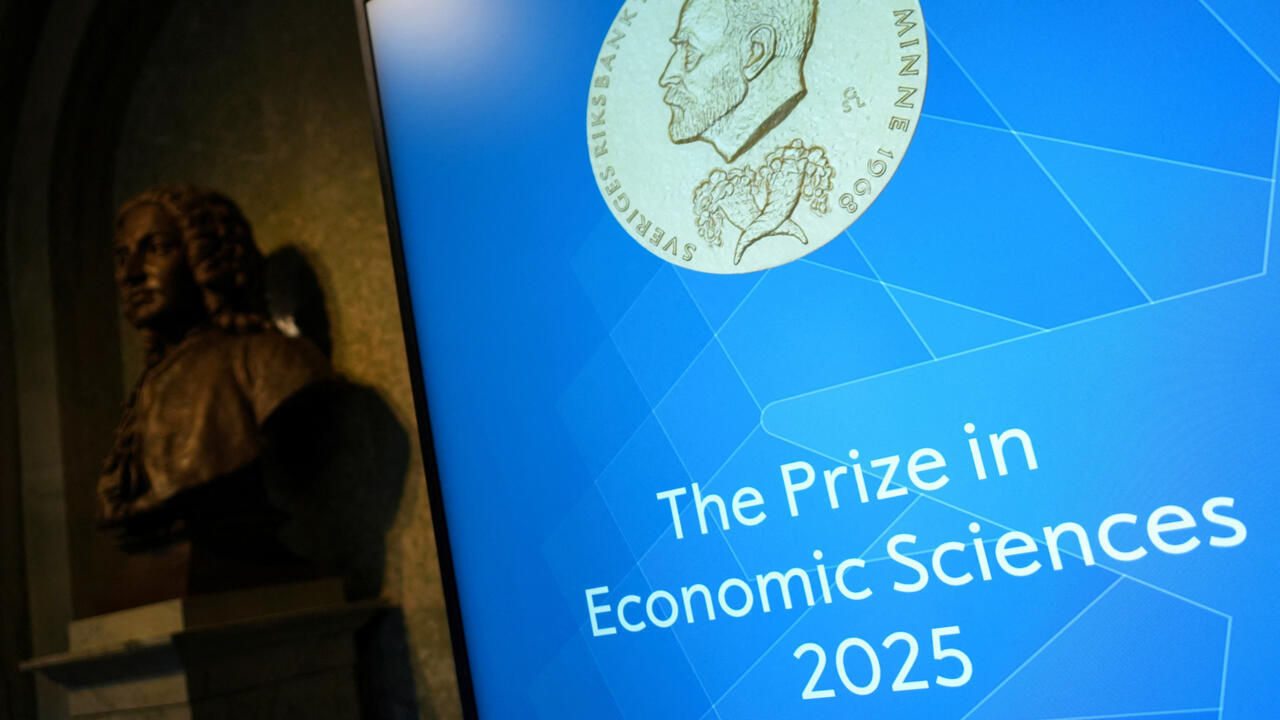
The award, officially known as the Sveriges Riksbank Prize in Economic Sciences in Memory of Alfred Nobel, is the final Nobel Prize announced this year. It underscores how innovation-driven growth — through the lens of creative destruction — remains central to understanding economic development in an era of AI transformation and global policy shifts.
Past recipients of the Economics Nobel include Ben Bernanke, Paul Krugman, and Milton Friedman, each recognized for reshaping global economic thought.