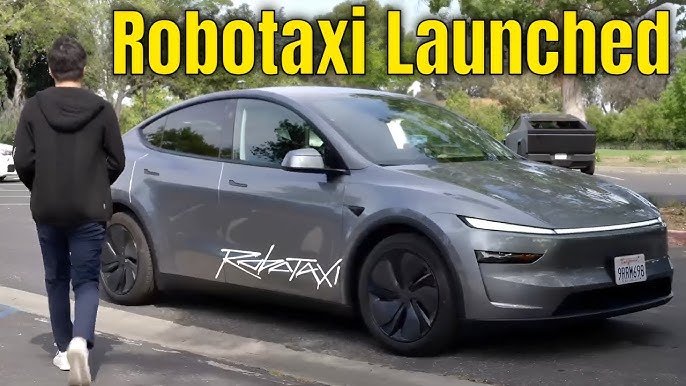
Tesla Launches Pilot Robotaxi Program in Austin, Texas
On Sunday, Tesla (NASDAQ: TSLA) began a limited rollout of its self-driving taxis in Austin, Texas, marking the first time the company has offered driverless rides to paying passengers. CEO Elon Musk announced the milestone as the official “robotaxi launch” via a post on X, while select social media influencers shared their experiences from inside the vehicles.
Milestone Moment for Tesla
Musk described the launch as the culmination of a decade of development, highlighting that Tesla built its AI chip and software teams entirely in-house. Vehicles were seen operating around South Congress, with no driver behind the wheel but a passenger acting as a safety monitor in the front seat. Tesla is conducting the trial with around 10 vehicles, though the extent of human oversight remains unclear.
A small group of influencers received invitations to participate in the test, which is currently limited to a designated area. Rides are being offered at a flat fare of $4.20, according to Musk.
Social media personality and Tesla investor Sawyer Merritt posted footage of his ride on X, documenting his experience booking a robotaxi trip to a local bar using Tesla’s app.
Challenges Ahead for Commercialization
While the pilot is a milestone, experts say Tesla faces major hurdles in scaling the service. Philip Koopman, a Carnegie Mellon professor specializing in autonomous vehicles, said even a successful test in Austin would be “the end of the beginning” rather than a sign of widespread readiness.
Tesla’s high market valuation is increasingly linked to its potential to commercialize autonomous vehicles and robotics. However, full-scale robotaxi deployment across cities may still be years—or even decades—away, according to analysts.
Regulatory Shifts in Texas
Coinciding with Tesla’s rollout, Texas Governor Greg Abbott signed new legislation that will require permits for operating fully autonomous vehicles in the state, effective September 1. The law gives the Texas Department of Motor Vehicles authority to approve or revoke such permits and mandates that companies provide safety protocols for first responders.
This represents a shift from the state’s earlier hands-off approach to AV regulation—Texas law since 2017 had prevented local governments from setting their own AV rules. Though the new law’s requirements are less strict than those in California, legal experts caution that the permits will be easy to obtain but just as easy to lose if safety becomes a concern.
“California permits are hard to get and easy to lose,” said Bryant Walker Smith, a legal scholar on AVs. “In Texas, the permit is easy to get—and easy to lose.”
Safety and Limitations
After years of ambitious, often delayed promises on autonomy, Musk says Tesla is taking a “super paranoid” approach to safety in this trial. For now, the robotaxi service will operate only in specific areas, avoiding bad weather, complex intersections, and limiting rides to adults over 18.
Tesla’s approach also diverges from competitors by relying solely on camera-based vision, eschewing lidar and radar technologies favored by companies like Waymo and Amazon’s Zoox. Musk maintains Tesla’s camera-only system will be both safer and cheaper.
Industry Context
Tesla’s launch comes amid broader skepticism in the autonomous vehicle industry. GM’s Cruise halted operations following a serious incident, and regulators are now keeping a close watch on major AV developers. Despite the risks and regulatory pressure, Tesla remains committed to its vision of an AI-powered driverless future.