
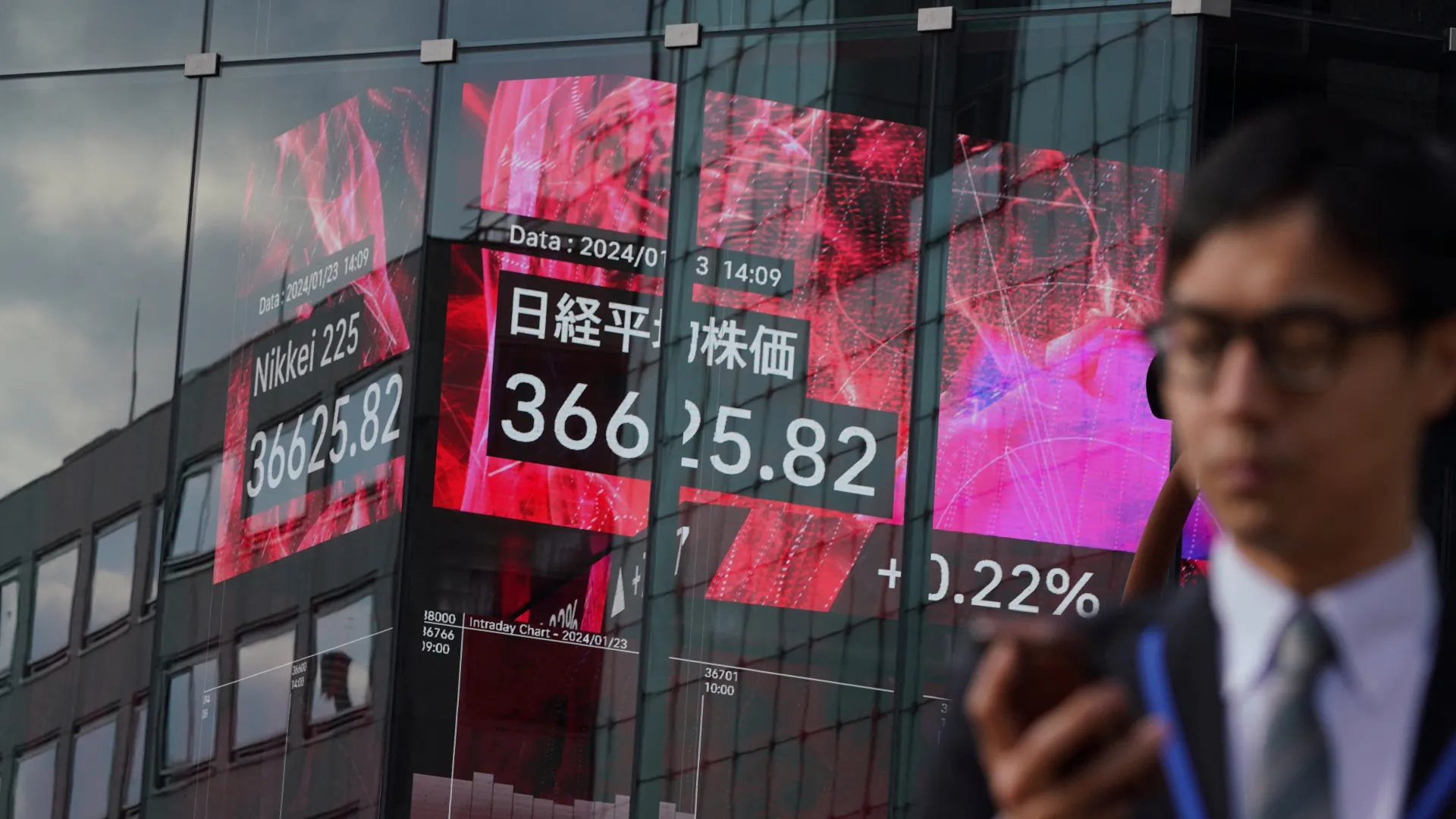
Japanese stocks led Asian markets higher on Thursday. The move came after a government bond auction attracted strong investor demand. At the same time, the U.S. dollar recovered from a five-week low.
The Nikkei 225 jumped 2.2%. Industrial robot maker Fanuc Corp surged nearly 12%, driving much of the index’s strength. In contrast, MSCI’s index of Asia-Pacific shares outside Japan traded flat. Losses in Korea and New Zealand offset gains elsewhere.
European markets were set for a positive open. Pan-regional futures were up 0.6%, German DAX futures rose 0.6%, and FTSE futures added 0.31%.
Tokyo’s latest debt auction showed the strongest demand in more than six years. This helped calm investors after a sharp selloff earlier in the week. That selling had pushed yields on super-long Japanese bonds to record highs and weighed on global fixed-income markets. Bond yields rise when prices fall.
Shoki Omori, chief desk strategist for rates and FX at Mizuho in Tokyo, said the 30-year JGB sale was “unexpectedly strong.” He noted that recent heavy selling likely made valuations look cheap, which encouraged buyers. Even so, he warned that sentiment for longer-dated bonds “remains fragile” and will need several strong auctions to stabilize. The 30-year JGB yield last fell 4 basis points to 3.38%.
The U.S. dollar edged up 0.1% to 155.32 yen. The yen gained ground after a Reuters report said the Bank of Japan may raise rates in December, and the government is expected to support that move.
S&P 500 e-mini futures were mostly flat as U.S. market momentum faded during Asian trading. Weaker U.S. economic data strengthened expectations that the Federal Reserve will cut rates at its meeting next week.
Wall Street closed higher on Wednesday, led by small-cap stocks. The Russell 2000 rose 1.9%, while the S&P 500 gained for a second straight session. The rally came after U.S. private payrolls saw their biggest drop in more than two and a half years.
Another report from the Institute for Supply Management showed services-sector employment contracted in November. The index of prices paid also fell to a seven-month low.
ANZ economist Henry Russell said the data fits the view that recent inflation pressures will ease. He expects disinflation to resume in 2026. He also noted that the Fed should continue cutting rates to address labor-market risks. ANZ forecasts a 25-basis-point cut next week and more reductions in 2025.
Markets largely agree. Fed funds futures now imply an 89% chance of a 25-basis-point rate cut on December 10, up from 83.4% a week earlier, according to CME’s FedWatch tool.
The U.S. dollar index rose 0.1% to 98.99, breaking a nine-day losing streak after touching its lowest level since late October.
The yield on the U.S. 10-year Treasury rose 2.7 basis points to 4.083%. The Financial Times reported that bond investors are concerned Kevin Hassett, a potential nominee for next year’s Federal Reserve chair, may push for aggressive rate cuts in line with President Donald Trump’s preferences.
The Chinese yuan slipped 0.1% to 7.064 per dollar in offshore trading. It had reached its strongest level in over a year on Wednesday. The Australian dollar gained 0.1% after new data showed household spending jumped by the most in nearly two years. Australia’s goods trade surplus also widened more than expected, helped by rising gold exports.
Precious metals cooled after recent highs. Gold fell 0.6% to $4,179.91 per ounce. Silver dropped 2.2% to $57.28 after touching a record $58.98 the day before.
Brent crude inched up 0.4% to $62.94.