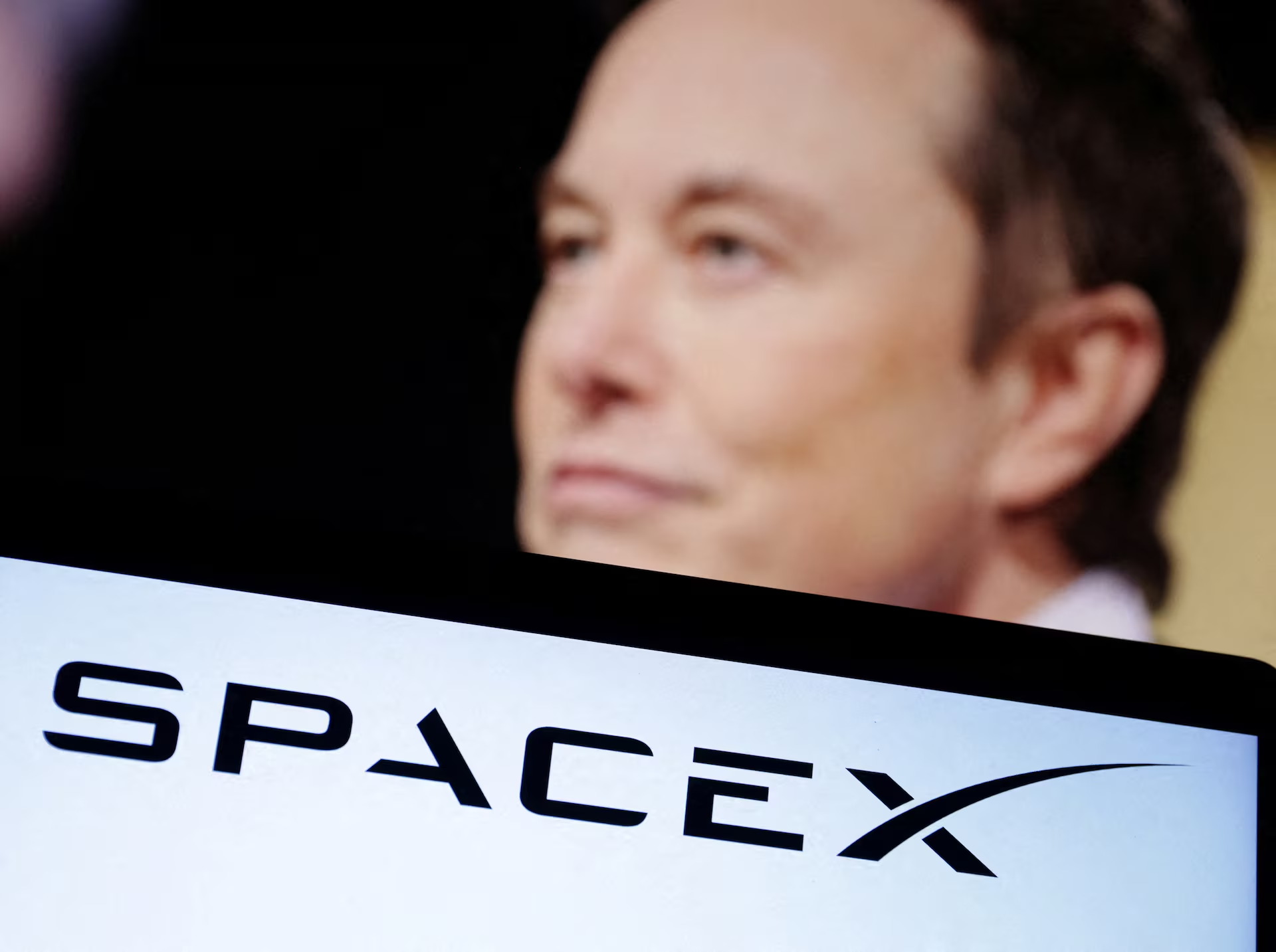
Investors reacted enthusiastically to reports that SpaceX may pursue an initial public offering that could fund Elon Musk’s plans for Mars exploration and value the company at more than $1 trillion. Many investors have been waiting years for a chance to buy into SpaceX.
A source familiar with the matter told Reuters that SpaceX aims to raise more than $25 billion in an IPO, possibly as early as June.
Despite SpaceX operating in a high-risk, capital-heavy industry, demand from retail investors is expected to be enormous.
Shay Boloor, chief market strategist at Futurum Equities Research, said the appetite for shares will be “substantial,” adding:
“It’s going to be the craziest IPO in the history of the stock market. If the valuation starts at $1.5 trillion, I wouldn’t be shocked if it hits over $2 trillion once trading begins.”
Risks, Drama, and Musk’s Controversial Leadership
Investors and analysts noted that Elon Musk’s unconventional management style and anti-establishment attitude are unlikely to scare buyers away.
Musk currently leads five companies, including The Boring Company, xAI, and X (formerly Twitter). His oversight of Tesla, the only publicly traded one, has involved multiple clashes with regulators.
He famously called SEC officials “bastards” after they penalized him for his 2018 “funding secured” tweet about taking Tesla private.
Earlier this year, Musk threatened to quit Tesla if the board did not approve a historic 10-year, $1 trillion pay package. Tesla’s share performance and sales also weakened after his four-month stint leading the Trump administration’s Department of Government Efficiency.
According to Christopher Marangi, co-chief investment officer at GAMCO Investors, this level of risk comes with the territory:
“With a CEO like Musk, the drama is part of the package. The potential reward has to compensate investors for that risk.”
GAMCO already has exposure to SpaceX through its investment in EchoStar, which obtained SpaceX shares in a spectrum deal. Whether GAMCO will buy more in an IPO remains unclear.
“Steak and Sizzle”: Why Investors Want SpaceX
Dan Hanson, senior portfolio manager at Neuberger Berman, said SpaceX combines robust current operations with massive long-term potential. His fund already holds about 5% of its assets in unlisted SpaceX shares.
“This is the rare case where you get both the steak and the sizzle,” Hanson said.
While futuristic projects like sending humans to Mars draw public attention, SpaceX’s core rocket launch business and Starlink satellite network are already established and profitable enough to justify a strong valuation.
IPO proceeds could also accelerate new technologies, such as space-based data centers that require far less cooling than Earth-based facilities.
James St Aubin, chief investment officer at Ocean Park Asset Management, said SpaceX has all the hallmarks of a market favorite in today’s tech cycle:
“There is a blue-sky outlook for its services. Investors can ignore valuation concerns and focus purely on the growth story.”
He speculated that by 2026, the market may expand the “Magnificent Seven” into the “Great Eight” by including SpaceX.
History Suggests Caution on Sky-High IPO Valuations
Data from IPO expert Jay Ritter shows that richly valued tech companies rarely sustain their early momentum.
Between 1980 and 2023, only seven out of 45 high-revenue companies with valuations above 40 times annual sales were trading higher after three years.
On average, these stocks lost about half their value from their first-day close and underperformed the broader market by 63%.
Examples include Beyond Meat, Palm, and Snowflake, which saw sharp declines after going public. Datadog and Zoom were among the few exceptions. Tesla, which listed at a far more modest valuation in 2010, has been an outlier with enormous long-term gains.
Ritter noted that SpaceX’s already massive valuation limits upside potential:
“The extremely high valuation removes some room for future gains. Even if it hits $2 trillion, that’s only a return of 100% to 200%.”