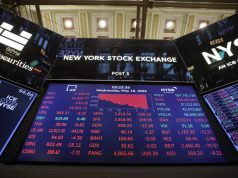
The S&P 500 jumped on Friday, putting the index on track to snap a three-day losing streak as Treasury yields fell following inflation data that came in line with expectations. The positive news helped offset concerns over a new wave of trade tariffs announced by President Donald Trump.
As of 1:36 p.m. ET (17:36 GMT), the Dow Jones Industrial Average rose 350 points, or 0.8%, the S&P 500 gained 0.6%, and the Nasdaq Composite advanced 0.4%.
Inflation Data and Fed Policy
The Commerce Department released August PCE price index data, the Federal Reserve’s preferred inflation gauge, earlier in the day. The report showed core PCE inflation rising 0.2% month-on-month and 2.9% year-over-year, matching July’s pace and economists’ forecasts.
The numbers reassured investors concerned that Trump’s trade policies could push prices higher. Following the release, Fed Vice Chair for Supervision Michelle Bowman reiterated her call for decisive rate cuts, arguing that the labor market remains fragile and inflation is hovering only slightly above the Fed’s target.
By contrast, Fed Chair Jerome Powell earlier this week signaled a more cautious stance, suggesting the central bank should balance risks of higher unemployment against the potential of reigniting inflation.
Additional economic data also pointed to resilience, with second-quarter GDP revised upward, showing stronger-than-expected growth.
Trump Announces New Tariffs
On Thursday, President Trump unveiled a 100% tariff on all branded and patented pharmaceutical products, exempting companies that manufacture in the U.S. He also imposed tariffs of 25% on heavy trucks, 50% on kitchen and bathroom fittings, and 30% on upholstered furniture.
These measures follow earlier sectoral tariffs on automobiles, steel, and electronics. Analysts note that Trump’s pharma tariff strategy has already drawn billions of dollars in U.S. investments from major global drugmakers.
As a result, pharma stocks like Johnson & Johnson, Pfizer, and Eli Lilly are expected to remain in focus. The technology sector may also face new headwinds after reports that the White House is considering a rule requiring U.S. tech firms to match domestic semiconductor output with imports or face tariffs. Such a policy could weigh on foreign chipmakers and heighten trade uncertainty.